All of the visions that confirm the Roman Church after it fell away from the Faith in the 11th century, are false. All the so-called miraculous appearances of the Roman Catholic Mary only serve to keep people in the deadly jaws of heresy, even if they are silent, or don't explicitly say anything contrary to Faith. Such visions confirm Rome's apostasy. "Our Lady of Guadalupe" is among the great "Marian" false apparitions.
Gal. 1:8 But though we, or an angel from heaven, preach a gospel to you besides that which we have preached to you, let him be anathema.
The story of Guadalupe is familiar among my readers, so I will not reiterate it here. Besides bringing souls into a counterfeit religion, we know the miracle is false because the real Blessed Virgin, who was assumed bodily into heaven, is Jewish. Yet, the Guadalupe woman appears as a native of Mexico:

The 7th Ecumenical Council forbids depicting Jesus and the Saints other than they actually are:
7th Ecumenical Council (Nicaea II), 787, Session II, Epistle of Pope Hadrian to Tarasius, Patriarch of Constantinople: ...we found in the above-mentioned synodical epistle of your Holiness, after the fulness of your faith in, and confession of, the sacred Symbol and the six holy Ecumenic Councils, a paragraph concerning holy and venerable images worthy of the highest praise and reception. For you there say, "I receive also all that was determined by the six holy Ecumenical Councils, with all the Canons, legitimately and by divine inspiration enacted therein, among which is the following - In certain sacred pictures, the Lamb, as pointed out by the finger of the forerunner (John the Baptist) is represented which was a type of grace, and under the law prefigured the True Lamb, Christ our God. But while we duly value the ancient types and shadows, as types and prefigurations of the truth, we value more highly the grace and truth itself, receiving the same as the completion of the law. In order therefore, that the perfect image may by presented to the contemplation of all, we decree that in all pictures from henceforth, the figure of our Lord Jesus Christ, the true Lamb of God that taketh away the sin of the world (John I.29), should be portrayed in His human form, instead of the Lamb as heretofore; that we being stirred up by the sight thereof, may be led to meditate upon the depth of the humiliation of God the Word, as to the remembrance of His conversation in the flesh; and of His passion, and of His saving death, and of the redemption thereby accomplished in behalf of the world."
7th Ecumenical Council (Nicaea II), 787, Decree of the Holy, Great, Ecumenical Synod, the Second of Nice: ...we keep unchanged all the ecclesiastical traditions handed down to us, whether in writing or verbally, one of which is the making of pictorial representations, agreeable to the history of the preaching of the Gospel, a tradition useful in many respects, but especially in this, that so the incarnation of the Word of God is shown forth as real and not merely fantastic, for these have mutual indications and without doubt have also mutual significations.We...define with all certitude and accuracy that just as the figure of the precious and life-giving Cross, so also the venerable and holy images, as well in painting and mosaic as of other fit materials, should be set forth in the holy churches of God, and on the sacred vessels and on the vestments and on hangings and in pictures both in houses and by the wayside, to wit, the figure of our Lord God and Savior Jesus Christ, of our spotless Lady, the Mother of God, of the honorable Angels, of all Saints and of all pious people. For by so much more frequently as they are seen in artistic representation, by so much more readily are men lifted up to the memory of their prototypes, and to a longing after them; and to these should be given due salutation and honorable reverence, not indeed that true worship of faith (latreian) which pertains alone to the divine nature; but to these, as to the figure of the precious and life-giving Cross and to the Book of the Gospels and to the other holy objects, incense and lights may be offered according to ancient pious custom. For the honour which is paid to the image passes on to that which the image represents, and he who reveres the image reveres in it the subject represented...
"Tonantzin Guadalupe"Many scholars of the Guadalupan myth tend to explain that the Spanish took advantage of the phonetic similarity between Coatlaxopeuh and Guadalupe, thus achieving a syncretism between the two cults. The original cult of the Virgin of Guadalupe originates in Extremadura, Spain, the place of origin of many of the Spaniards who arrived during the first waves of the conquest.

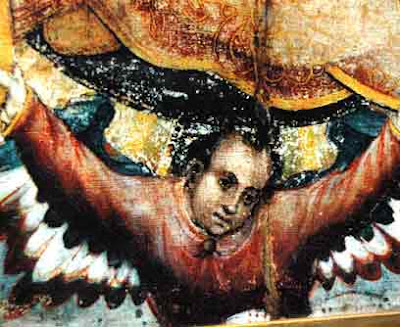
"Saint Peter the Aleut, Martyr"
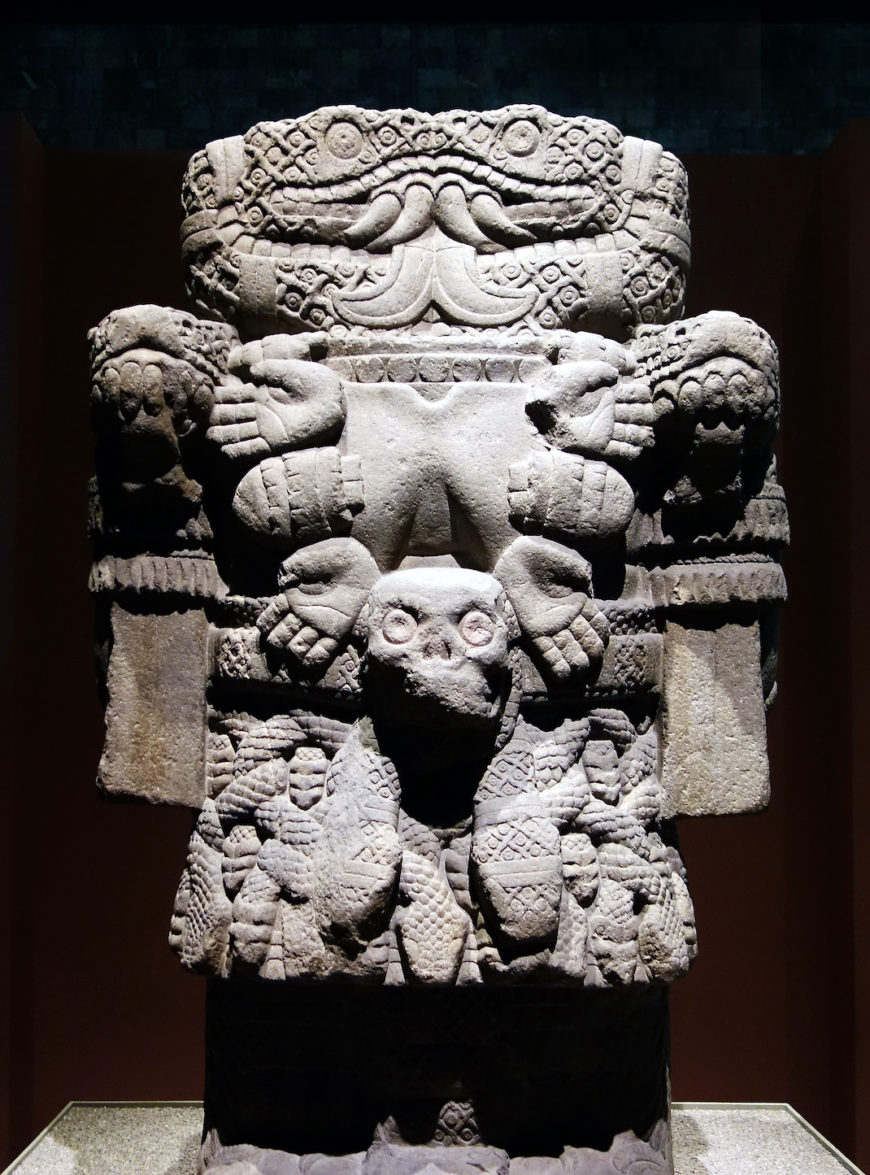
"This goddess has clawed feet, and wears a necklace of body parts and the snake-skirt from which she takes her name. Standing over ten feet tall, the statue towers over onlookers as she leans toward them. With her arms bent and pulled up against her sides as if to strike, she is truly an imposing sight."
"Our Lady of Guadalupe: Tonantzin or the Virgin Mary?", Barnett, 2009Aztec goddess? ...Before the fall of the Aztec capital of Tenochtitlan in 1521, the hill where Juan Diego had his vision had also been the site of an ancient temple to the Aztec goddess Tonantzin (Our Revered Mother), later leveled to the ground by the Spaniards. ...Aztec deities could not only be of double gender but different names represented different facets of the character of the same deity. Tonantzin, therefore, may be associated with the dread goddess Cihuacoatl (a serpent woman)...
The original story of the Virgin of Guadalupe is told in detail in the Nican Mopohua (“Here it is told”), a section of a larger work known as “The Great Event,” a Nahuatl document published in 1649 by Luis de la Vega...in section #26 of the Nican Mopohua, the Virgin is saying that she is the Mother of all the ancient Aztec deities! It follows from this, according to this writer, that the Virgin has incorporated the whole of Nahuatl (Aztec) philosophy and theology into Christianity...
Tonantzin… the deity behind “Our Lady of Guadalupe”Tonantzin – The snake womanThe Aztec religion had a mysterious syncretism that researchers have not been able to solve: the mutation of Tonantzin in different names but with the same meaning.They considered Tonantzin, Coatlicue, Cihuacóatl, or Tetéoinan as “the divine mother”. Some anthropologists believe that under the name of “Cihuacóatl/The Serpent Woman,” this goddess also served as a protector of women.An ancient Mexican story tells that before the Spaniards’ arrival, a lament of a woman crying was heard in the lake of Texcoco saying: “My children, beloved children of Anahuac, your destruction is next.” The priests thought it was the goddess Cihuacoatl who prophesied the destruction of the Anahuac. Shortly after the Mexica people’s defeat, when the Spanish destroyed the great “Templo Mayor” and Tonantzin’s temple in Mexico City and Tepeyac’s hill, the lament of the goddess was also heard, crying for her dwelling which had been defiled by the invader. This story eventually gave way to the legend of “La Llorona.”
Britannica, "La Llorona": a mythological woman in Mexican and Latin American oral tradition whose siren-like wails are said to lure adults and children to their untimely deaths. The legend of La Llorona is a popular ghost story that is especially prominent on Día de los Muertos and in Chicano and Latin American communities.
"Why the Stars on Guadalupe's Mantle are Miraculous"...In the 1990s a Mexican astronomer named Juan Hernandez Illescas conducted a series of studies on the configuration of the stars on the turquoise-blue mantle of Our Lady of Guadalupe. Through computer technology, he was able to regress the map of constellations to the very night of Our Lady’s appearance almost five centuries ago...For example: The forty-six stars visible on Guadalupe’s mantle are the exact representation of the constellations in the night sky over Mexico on 12/12/1531. In 1531, Mexico was still using the old Julian calendar, which was ten days off from the modern calendar. That places her appearance on the morning of the 22nd of December (according to the Gregorian calendar) – the winter solstice.
Pan-Orthodox Sigillion of 1583, Against the Papal Calendar and Certain Latin Practices, #7: That whoever does not follow the customs of the Church as the Seven Holy Ecumenical Councils decreed, and Holy Pascha, and the Menologion with which they did well in making it a law that we should follow it, and wishes to follow the newly-invented Paschalion and the New Menologion of the atheist astronomers of the Pope, and opposes all those things and wishes to overthrow and destroy the dogmas and customs of the Church which have been handed down by our fathers, let him suffer anathema and be put out of the Church of Christ and out of the Congregation of the Faithful.
The Calendar Question
Daniel 7:25 And he shall speak great words against the most High, and shall wear out the saints of the most High, and think to change times and laws: and they shall be given into his hand until a time and times and the dividing of time.
No comments:
Post a Comment