The Longer Catechism of St Philaret of Moscow (1823)
59. What are miracles?
Acts which can be done by no power or art of man, but only by the almighty power of God: for example, to raise the dead.
60. How do miracles serve for a sign that the word spoken is from God?
He who does true miracles works by the power of God; consequently he is in favor with God, and partaker of the divine Spirit; but to such it must belong to speak only the pure truth; and so, when such a man speaks in God’s name, we are sure that by his mouth there speaketh really the Word of God.
On this account our Lord Jesus Christ himself owns miracles as a powerful testimony to his divine mission: The works which the Father hath given me to finish, the same works that I do, bear witness of me, that the father hath sent me (John 5.36).
HOLY FIRE OF JERUSALEM

"Miracle of the Holy Fire - Church of the [Resurrection] Jerusalem Year 2019"
https://www.youtube.com/watch?v=V_juMN60M5k
This miracle has occurred each year on Holy Saturday, since the 4th century - on the old calendar Orthodox Holy Saturday before Pascha, that is! There was one year the fire did not come: 1101 AD. This was right after the First Crusade when Latin clergy, believing they had the true faith, tried to oversee the miracle themselves:
"Holy Fire", Wikipedia: Under Baldwin I, Latin clergy had taken over the Holy Sepulchre, and according to Christopher Tyerman, the Greek clergy were restored "after the fiasco of the failure of the regular "Easter" miracle of the Holy Fire under Latin auspices in 1101, the annual ritual on "Easter" eve when Holy Fire is supposed to descend from heaven to light the priests' candles in the edicule of the Holy Sepulchre... In 1238, Pope Gregory IX denounced the Holy Fire as a fraud and forbade Franciscans from participating in the ceremony.
In denouncing the miracle, however, Gregory IX was denouncing all the Patriarchs of Jerusalem as frauds since the 300's!
Now, however, since the Patriarchs of Jerusalem have apostatized into Ecumenism, it may be that their candles do not light, as it happened with the Latins in 1101 A.D. They could be fraudulently lighting their candles in the Holy Tomb.
There is a You Tube video of an Armenian priest (known by his black pointed hood) claiming the fire is lit naturally. There's just one problem: the Armenians, being Monophysite heretics, are not allowed to enter the Holy Sepulcher on Holy Saturday! They've never been allowed.
But even worse than this, now it seems that those associated with the now Ecumenist Patriarchate of Jerusalem want men to loose faith in the miracle by claiming it is a fraud themselves! After all, the miracle is not very compatible with the one-world, inter-faith religion they are trying to forge. Because the miracle occurs every Holy Saturday (Julian), it makes the Gregorian calendar look bad - as though it wasn't actually the ecclesiastical calendar or something. Hmmm.
But the miracle is much greater than the Patriarch's candle.
The Holy Fire is seen by all present as sparks and flashes of light descending and surrounding the outside of the Holy Sepulcher! It is the power of the Resurrection of Jesus Christ, given as a yearly witness, a sign for unbelievers, and a consolation and encouragement for the faithful. Scientific analysis shows a change in the very atmosphere starting when the ceremony begins:
Science Investigates the Easter Miracle of the Holy Fire in Jerusalem!!!
https://www.youtube.com/watch?v=vgEL7kiMu40
Candles randomly ignite all around the outside of the Holy Tomb. The light does not only come from the Patriarch.
For a short amount of time, the Holy Fire does not burn skin, hair or clothing! Yes, one can dip candles in phosphorus to cause a delayed ignition, but who has ever invented a fire that does not burn?

"For the Faithless - The Proof of the Holy Fire of Jerusalem"
https://www.youtube.com/watch?v=4kZu87tyqJ4"Holy Fire Does Not Burn Clothes"
https://www.youtube.com/watch?v=tiQkHdosCYo
"The Miracle of the Holy Fire in Jerusalem", Hvidt
"The Miracle of the Holy Fire" by Christians from the Orthodox Churches is known as "The greatest of all Christian miracles". It takes place every single year, on the same time, in the same manner, and on the same spot. No other miracle is known to occur so regularly and for such an extensive period of time; one can read about it in sources as old as from the eighth Century AD. ...The Church of the Holy Sepulchre itself is an enigmatic place. Theologians, historians and archaeologists consider the church to contain both Golgatha, the little hill on which Jesus Christ was crucified, as well as the "new tomb" close to Golgatha that received his dead body, as one reads in the Gospels. It is on this same spot that Christians believe He rose from the dead.
One can trace the miracle throughout the centuries in the many itineraries to the Holy Land. The Russian abbot Daniel, in his itinerary, written in the years 1106-07, in very detailed manners presents the "Miracle of the Holy Light" and the ceremonies that frame it. He recalls how the Patriarch goes into the Sepulchre-chapel (the Anastasis) with two closed candles. The Patriarch kneels in front of the stone on which Christ was laid after his death and says certain prayers, upon which the miracle occurs. Light proceeds from the core of the stone a blue, indefinable light which after some time kindles closed oil lamps as well as the two candles of the Patriarch. This light is "The Holy Fire", and it spreads to all people present in the Church. The ceremony surrounding "The Miracle of the Holy Fire" may be the oldest unbroken Christian ceremony in the world. From the fourth century AD all the way up to our own time, sources recall the awe-awakening potent. From these sources it becomes clear that the miracle has been celebrated on the same spot, on the same feast day, and in the same liturgical frames throughout all these centuries...
Column Miraculously Split by the Holy Light
Another miracle associated with the Holy Fire of Jerusalem happened in 1579:

The column that was split by the Holy Fire (1579)
https://novoscriptorium.com/2020/04/21/the-column-that-was-split-by-the-holy-fire-1579-saint-tounom-the-emir/According to written sources, on Holy Saturday of that year, a group of Turkish soldiers forbad the Orthodox entry into the Church of the Resurrection. The crowd of the faithful remained in the church courtyard throughout the entire day, and even after the sun had set.
The Greek Patriarch Sophronius IV was in the first year of his reign. It was the first time he would perform the most important rite of the year, but the Turks deprived him of his legal right. The patriarch stood in prayer at the left side of the church doorway, near a column. And suddenly, when night had already fallen, the column split and the Holy Fire leapt from its interior.
The patriarch immediately lit his candle and passed the Holy Fire to the faithful. Within a few minutes the sacred flame had spread to all those present and the courtyard of the church was illuminated. The awestruck Turkish guards then opened the doors of the church and the patriarch along with the rejoicing faithful poured in towards the Holy Sepulchre.
For further study:
Holy Fire: The Miracle of the Light of the Resurrection at the Tomb of Jesus, Skarlakidis, 2015
85 Historical Accounts (4th - 16th c.)
https://store.ancientfaith.com/holy-fire-miracle-of-the-light-of-the-resurrection/
EXORCISMS through ORTHODOX RELICS
"...in Greece, the Incorrupt Relics in the vertical coffin of Saint Gerasimus of Kefalonia (1509-1579), the powerful exorcist of demons and healer of the mentally sick, is carried above the possessed and mentally ill believers."
The healing relics in this video are from a holy Orthodox Saint, even though the priests in the video are "World Orthodox" (schismatics/heretics). Like the Holy Fire of Jerusalem above, such miracles have continued, in spite of false bishops.
Matt. 7:22-23 Many will say to me in that day: Lord, Lord, have not we prophesied in thy name, and cast out devils in thy name, and done many miracles in thy name? And then will I profess unto them, I never knew you: depart from me, you that work iniquity.
THE APPEARANCE OF THE CROSS NEAR ATHENS IN 1925
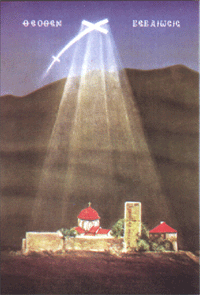
IN THE EARLY 1900’s, and especially in the 1920’s, there were strong anti-Church and secularist forces in power in Greece and in the Ecumenical Patriarchate. Among the actions of these forces, there was introduced, by force, the Gregorian calendar. The Gregorian calendar is adequate for the functions of business, the stock-exchange, and other worldly, secular activities. Liturgically, however, it is practically useless, even harmful. It is in no way possible to reconcile the Gregorian calendar with our canonical, Orthodox Christian Paschalion. Moreover, the introduction of a Church calendar change by a local church created an unacceptable liturgical disunity within the Church Itself.
Vast numbers of the people of Greece refused to accept these anticanonical, anti-Church changes being forced upon them by state police power. Such people suffered, and continue to suffer persecution, imprisonment and deprivation at the hands of secular police powers. But the spiritual eyes of true Orthodox Christians saw clearly even if, at the time, they did not completely comprehend the evil of the new calendar. It was a forerunner and a sign of the greatest heresy in the history of the world—Ecumenism. Many people, however, became confused. Some began to waver. Just as the Arians were in control of the worldly power in 351 and were able to force their heresy upon the empire, so now, the calendar renovationists controlled the worldly power of Greece. In such a troubled and dangerous time, the All-Merciful God heeded the needs of His people. Again, as in 351, God sent a wondrous apparition of the sign of the All-Honorable Cross to seal the truth and put the false teachers to shame.
The appearance of the sign of the Cross took place in this manner:
In 1925, on the eve, of the feast of the Exaltation of the All-Honorable and Life-giving Cross of our Saviour, 14 September according to the Orthodox Church calendar, the all-night vigil was served at the church of St. John the Theologian in suburban Athens. By 9 o’clock that evening, more than 2,000 of the true-Orthodox faithful had gathered in and around the church for the service, since very few true-Orthodox churches had been accidentally left open by the civil authorities. Such a large gathering of people could not, however, go unnoticed by the authorities. Around eleven P.M. the authorities dispatched a battalion of police to the church “to prevent any disorders which might arise from such a large gathering.” The gathering was too large for the police to take any direct action or to arrest the priest at that time and so they joined the crowd of worshippers in the already over-flowing courtyard of the church.
Then, regardless of the true motives for their presence, against their own will, but according to the Will which exceeds all human power, they became participants in the miraculous experience of the crowd of believers.
At 11:30 P.M., there began to appear in the heavens above the church, in the direction of North-East, a bright, radiant Cross of light. The light not only illuminated the church and the faithful but, in its rays, the stars of the clear, cloudless sky became dim and the church-yard was filled with an almost tangible light. The form of the Cross itself was an especially dense light and it could be clearly seen as a Byzantine cross with an angular cross bar toward the bottom. This heavenly miracle lasted for half an hour, until midnight, and then the Cross began slowly to raise up vertically, as the cross in the hands of the priest does in the ceremony of the Elevation of the Cross in church. Having come straight up, the Cross began gradually to fade away.
The human language is not adequate to convey what took place during the apparition. The entire crowd fell prostrate upon the ground with tears and began to sing prayers, praising the Lord with one heart and one mouth. The police were among those who wept, suddenly discovering, in the depths of their hearts, a childlike faith. The crowd of believers and the battalion of police were transformed into one, unified flock of faithful. All were seized with a holy ecstasy. The vigil continued until four A.M., when all this human torrent streamed back into the city, carrying the news of the miracle because of which they were still trembling and weeping.
Many of the unbelievers, sophists and renovationists, realizing their sin and guilt, but unwilling to repent, tried by every means to explain away or deny this miracle. The fact that the form of the cross had been so sharply and clearly that of the Byzantine (sometimes called the Russian Cross) Cross, with three cross-bars, the bottom one at an angle, completely negated any arguments of accidental physical phenomenon.
The fact that such an apparition of the Cross had also occurred during the height of the first great heresy must strike the Orthodox with an especial sense of the magnitude of the importance of the calendar question and of all that is connected with it. No sensible person can discuss this issue lightly, with secular reasoning or with worldly arguments. Renovationists, like the Arians in 351, are left without extenuation or mitigation.
Taken from Orthodox Life, Vol. 22, No. 2 (March-April, 1972), pp. 18-20, Published by Holy Trinity Monastery, Jordanville, New York.
SECOND MIRACLE OF THE HOLY CROSS - CRETE, 1937
https://www.youtube.com/watch?v=68DZSp_DhLc&t=190s
***I do not approve of everything published by this You Tube channel.
After the miracle of the cross in 1925, which confirmed God's approval of the ecclesiastical calendar, a second miracle was given in 1937 to those who would remain faithful to the holy traditions of the Church. This miracle showed which Bishop was remaining faithful to Orthodoxy, and confirmed the Savior's plan for His Church not to return to communion with the schismatic state church of Greece.
BP. MATTHEW CALMS THE "EVIL SEA"

The Life of St. Matthew the New Confessor (+ 1950), Kouris
https://eggolpio.blogspot.com/2013/09/the-life-of-st-matthew-new-confessor.html"In 1927, Ft. Matthew received a divine revelation which inspired him to build, with the help of his spiritual daughter Mariam and other 6 novices, the Convent of the Entry of the Holy Theotokos to the Temple, near the village of Keratea, Attica. As they travelled the region searching for appropriate grounds for the Convent, they passed by the “kaki thalassa” (in English "evil sea"). This body of water off the east coast of Greece had been given this name due to its volatile and loud crashing waves. Fr. Matthew began praying to God, and then made the sign of the Cross over the body of water. To the amazement of those with him, the sea became calm, and to this day is still an extremely calm body of water in contradiction to its name. A short distance from the “evil sea” on the nearby hills is where Ft. Matthew founded the Convent."
THE MYRRH-STREAMING RELICS OF BL. MATTHEW

The Holy Relics of Archbishop Matthew of Bresthena the New Confessor of Athens
MOTHER OF GOD RESTORED HAND OF ST. JOHN OF DAMASCUS

The Icon of the Mother of God, “Of the Three Hands”: In the eighth century during the time of the Iconoclasts, Saint John of Damascus (December 4) was zealous in his veneration of holy icons. Because of this, he was slandered by the emperor and iconoclast Leo III the Isaurian (717-740), who informed the Damascus caliph that Saint John was committing treasonous acts against him. The caliph gave orders to cut off the hand of the monk and take it to the marketplace. Towards evening Saint John, having asked the caliph for the cut-off hand, put it to its joint and fell to the ground before the icon of the Mother of God. The monk begged Our Lady to heal the hand, which had written in defense of Orthodoxy. After long prayer he fell asleep and saw in a dream that the All-Pure Mother of God had turned to him promising him quick healing.
Before this the Mother of God bid him toil without fail with this hand. Having awakened from sleep, Saint John saw that his hand was unharmed. In thankfulness for this healing Saint John placed on the icon a hand fashioned of silver, from which the icon received its name “Of Three Hands.” (Some iconographers, in their ignorance, have mistakenly depicted the Most Holy Theotokos with three arms and three hands.) According to Tradition, Saint John wrote a hymn of thanksgiving to the Mother of God: “All of creation rejoices in You, O Full of Grace,” which appears in place of the hymn “It is Truly Meet” in the Liturgy of Saint Basil the Great.
Saint John Damascene accepted monasticism at the monastery of Saint Savva the Sanctified and there bestowed his wonderworking icon. The Lavra presented the icon “Of Three Hands” in blessing to Saint Savva, Archbishop of Serbia (+ 1237, January 12). During the time of an invasion of Serbia by the Turks, some Christians who wanted to protect the icon, entrusted it to the safekeeping of the Mother of God Herself. They placed it upon a donkey, which without a driver proceeded to Athos and stopped in front of the Hilandar monastery. The monks put the icon in the monastery’s cathedral church (katholikon). During a time of discord over the choice of igumen, the Mother of God deigned to head the monastery Herself, and from that time Her holy icon has occupied the igumen’s place in the temple. At the Hilandar monastery there is chosen only a vicar, and from the holy icon the monks take a blessing for every obedience.
In Greek usage, this Icon is commemorated on June 28; but on July 12 in Slavic usage.
---ARTICLE IS TAKEN FROM OCA.ORG
HOLY CINCTURE OF THE THEOTOKOS

https://full-of-grace-and-truth.blogspot.com/2009/06/holy-belt-zoni-of-theotokos-and.html
...a great treasure of Orthodoxy that has survived to our days: the Holy Zoni of the Theotokos (translated commonly as "Belt", "Sash", "Cincture", and below as "Girdle". However, this final term, as used throughout the following excerpt, may possibly be confused with a separate relic of the Theotokos, her "Esthitos", which is more of a garment or robe as opposed to her belt. Each treasure is remembered on a separate feast day, July 2nd for the Robe of the Theotokos and August 31st for her Belt, but the common Apolytikion mentions both, as both were present in Constantinople and preserved the faithful for centuries.)

MIRACULOUS ICON OF IVERON
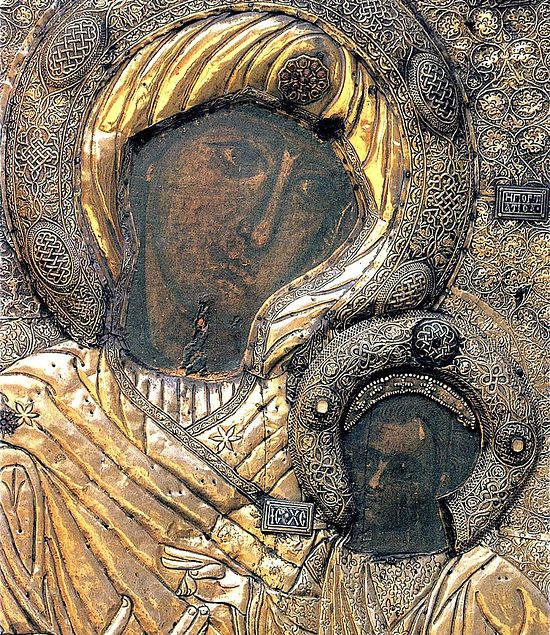
MYRRH STREAMING RELICS
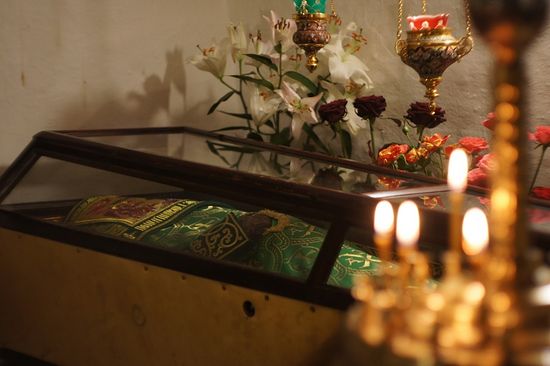
"On the Mysteries and Miraculous Power of Orthodox Holy Objects". Goroshkova and Muzolph
St. John of Damascus, speaking about the veneration of holy relics, writes, “The Lord Christ gave us saving sources: the relics of saints, pouring out diverse blessings, exuding the sweet smell of myrrh… Under the Law, anyone coming into contact with the dead becomes unclean (cf. Num. 19:11); but they are not dead. For since that time that He Who is life itself, the Reason for life, was numbered among the dead, we don’t call dead those who have reposed in the hope of resurrection and with faith in Him… Through relics demons are repelled, the infirm are healed, the blind see the light, lepers are cleansed, temptations and woes cease, and every good and perfect gift descends from above, from the Father of lights (Jas. 1:17) through them for those who ask with undoubting faith.”
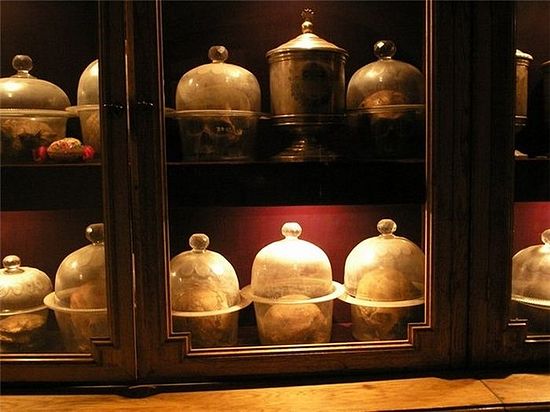
What are myrrh-streaming relics? How are they stored? Where are the most famous ones?
—Myrrh-streaming relics are holy relics whose holiness is moreso confirmed by external manifestations—streams of myrrh. So, periodically a special viscous liquid, myrrh, emanates from them, possessing a powerful, pleasant odor.
The most famous myrrh-streaming relics are in the Far Caves of the Kiev Caves Lavra, belonging to unknown God-pleasers. The origin of only one of them is reliably known—the hieromartyr Clement, Pope of Rome, who suffered at the beginning of the second century in Chersonesus (now a district of Sevastopol). In either 988 or 989 a piece of his relics was translated by the order of Equal-to-the-Apostles Prince Vladimir to Kiev and subsequently ended up in the Caves Lavra.
A Modern Story of Miraculous Healing from Cancer in the Kiev Caves Lavra, Pirogova
https://catalog.obitel-minsk.com/blog/2021/03/a-modern-story-of-miraculous-healing-from-cancer-in-the-kiev-caves-lavra
SAINT DEMETRIOUS THE MYRRH STREAMER
extract from:
"Saint Demetrios and the Gift of Myrrh", (heretical) Melkite Catholic Eparchy of Newton
The Relics of St Demetrios
The life of St Demetrios described how his servant had dipped his garment into the saint’s blood. This was confirmed in the twentieth century restoration of the church and crypt. The first chapel built over the place of the saint’s martyrdom was discovered. Its Holy Table was found to contain an earthen vessel containing earth impregnated with human blood.
When the Great Church was built, its shrine contained only a carved bed, a classical architectural device. When a body reported to be that of St Demetrios was put forth for veneration in the seventh century, the archbishop dismissed its authenticity. The body was proclaimed to be that of the saint after it started exuding perfumed myrrh. The relics were placed in the shrine where they are venerated to this day. This is why St Demetrios is known as the Myrobelite (Exuder of Myrrh).
For centuries, these relics have been exuding this fragrant myrrh and have been the occasion of many healings. Every year around the feast of the saint (October 26), the reliquary chest is opened and the fragrance of the myrrh can be detected for blocks around.

Exudations of Myrrh
Christians, particularly in the East, have long considered the exudation of myrrh a sign that God confirms the holiness of a saint. From time to time streams of a unique viscous liquid emitting a beautiful aroma have appeared in connection with the relics or icons of certain saints. Healings and other seeming miracles have often accompanied this phenomenon.
Perhaps more famous that the relics of St Demetrios are the myrrh-exuding remains of St Nicholas the Wonderworker, Archbishop of Myra. Housed in the crypt of the basilica in Bari, Italy, St Nicholas’ relics continually exude myrrh...
Other saints whose relics have reportedly exuded myrrh include Saints:
- Saint Clement the Confessor, Pope of Rome
- Saint Juliana of Nicomedia
- Saint Peter the Wonderworker, Bishop of Argos
- Saint Simeon of Serbia, founder of Mt. Athos’ Hilandari Monastery
- Saint Simon, founder of Mt. Athos’ Simonopetras Monastery
ST. THEODORA OF VASTA - THE MIRACULOUS TREES AND CURES
TRADITION OF RED EGGS AT PASKA
Excerpt from the Rudder, p.394: ...As concerns the red eggs eaten at the time of the Resurrection, many persons say many things that are destitute of verification. In solving certain questions for the Emperor of Russia, a learned man named Gwes Paisius. says that when the Jews exclaimed "His blood be on us and on our children" (Matt. 27:25). everything they had in their houses at once turned red, and consequently even the eggs. Hence in remembrance of this miracle we too dye our eggs red on the occasion of the Resurrection then being celebrated. This miracle. he says, has come down to us through a tradition of old.

No comments:
Post a Comment