Wednesday, April 22, 2026

The Resurrection after Three Full Days and Nights?

posted on Fr. Cassien's blog, April 15, 2026


Letter of Saint Isidore of Pelusium

To the priest Theognostus. On the three days and three nights of the Lord's sojourn in the tomb

I am utterly astonished by the folly of those who ask, “Why did Christ rise again before three days?” For if they maintain that he did not rise, why dwell on the question of time? If he did rise again, but sooner than he promised, let them acknowledge that the resurrection also proved the undeniable truth of his words. For having accomplished what was and seemed (in view of human weakness) impossible, he certainly would not have been incapable of accomplishing what was possible. Although his later resurrection was the greatest manifestation of his weakness, his earlier resurrection testified to his full power. And since Christ annihilated the countless lists of Hellenic gods, overthrew all idols, destroyed the impious altars defiled with human blood, rendered the devil powerless, cast out demons, subdued savage tribes, subjected the Jews to immense calamities, and raised those who believed in him above the heavens, it would be fitting to worship his divine and irresistible power rather than argue for hours. For that which is most important and transcends all reason cannot be refuted by trivialities. 

However, since the truth abounds, I will attempt to examine the matter itself. Therefore, in response to their attack, let us say this: if we see a debtor who has promised to pay his creditor within three days settle his entire debt before the due date, should we condemn him as a liar or admire him for his faithfulness to the truth? I am of the latter opinion, and so are they, certainly. Therefore, what is inconsistent between Christ's declaration that he would rise again on the third day and his earlier resurrection, to demonstrate his power, mortify the guards, and silence the Jews? An earlier resurrection would not have provoked accusations, but a delay would have aroused great suspicion. The resurrection was supposed to take place while the guards kept watch at the tomb. Now, if it had occurred after the prescribed days had ended and the guards had left, the matter would have seemed suspicious. If Christ did not rise again, how could the apostles have performed such miracles in his name? Why should these witnesses, who braved thousands of dangers and deaths, testified to the truth, sealing their testimony not with ink but with their own blood, be considered unworthy of faith? To be precise, here is what I will say: Christ announced his resurrection on the third day. There is Friday, and there is the Sabbath until sunset, but after the Sabbath, he rose again, thus fully fulfilling the outermost days and the middle day. For he also said that he would rise again on the third day, not after three days. “Destroy this church,” he said, “and in three days I will raise it up” (John 2:19). And the Prophet, foreshadowing in song the mourning of death, being bound by the most powerful death, said: “After two days he will heal us; “On the third day, we will rise again and live in Him” (Hosea 6:3). If they are referring to the words “three days and three nights” (Matthew 12:39), I reply that He fulfilled His promise through His contact with them. For the entire duration of twenty-four hours is called a day. But if someone is born or dies during the first or last hour, the day itself is counted. For example, if someone is born just before sunset, and that day is the first day of the month, it is considered that they were born on that day. But if someone is born after sunset, it will be the second day. So why, when the difference in time is only an hour, or even less, do we say that one was born on the first day and the other on the second? Because it is clear and obvious to everyone that the first simply completed the previous day, while the second lived the following day, composed of twenty-four hours, without taking their eyes off it. Therefore, if this is confirmed by the precise calculation of the hours, why do those who persist in asserting that Truth has not resided in truth torment themselves in vain?


Sunday, April 19, 2026

"Why Orthodox Men Love Church"


***In sharing this video, I do not intend to promote its creator.


Saturday, April 18, 2026

Jeremy Austin: “Why I Quit MHFM!”

..."The Dimond Brothers' Fatal Flaw on Sedevacantism and Orthodoxy"
https://www.la-foi.fr/mhfm/en/pdf/I_Quit_MHFM_20190329.pdf

Sections include:
  • Introduction
  • Sedevacantism According to John C. Pontrello
  • MHFM on Orthodoxy:  Censoring and Faulty Analysis
  • From St. Peter to the Popes of Avignon
  • Human Relations (Contact) According to the Dimonds
  • The Dimonds' Attitude" A Layman's Foundation
  • The Mosaic Explained - Synopsis
  • Endnotes 
  • Links


Also see:
Monastery Accused of Taking Man's $1.6 Million (by fraudulently posing as Benedictines)
The Sedevacantist Delusion - Why Vatican II's Clash with Sedevacantism Supports Eastern Orthodoxy, Pontrello, 2015


The Orthodox Veneration of the Mother of God

Vladimir Mother of God


The Orthodox Veneration of the Mother of God, Maximovitch*, 1952
https://archive.is/eu6yV
Contents
I. The Veneration of the Mother of God during Her Earthly Life
II. The First Enemies of the Veneration of the Mother of God
III. Attempts of Jews and Heretics to Dishonor the Ever-Virginity of Mary
IV. The Nestorian Heresy and the Third Ecumenical Council
V. Attempts of Iconoclasts to Lessen the Glory of the Queen of Heaven: They are put to shame.
VI. “Zeal not According to Knowledge”: The “Immaculate Conception”
VII. The Orthodox Veneration of the Mother of God

VII. THE ORTHODOX VENERATION OF THE MOTHER OF GOD

THE ORTHODOX CHURCH teaches about the Mother of God that which Sacred Tradition and Sacred Scripture have informed concerning her, and daily it glorifies her in its temples, asking her help and defense. Knowing that she is pleased only by those praises which correspond to her actual glory, the Holy Fathers and hymn-writers have entreated her and her Son to teach them how to hymn her. “Implant a battlement round about my intellect, O my Christ, for I endeavor to chant the praise of Thy most pure Mother.” (Ikos of the Dormition) “The Church teaches that Christ was truly born of Mary Ever-Virgin” (St. Epiphanius, “True Word Concerning the Faith”). “It is essential for us to confess that the holy Ever-Virgin Mary is actually Theotokos (Birth-giver of God), so as not to fall into blasphemy. For those who deny that the Holy Virgin is actually Theotokos are no longer believers, but disciples of the Pharisees and Sadducees” (St. Ephraim the Syrian, “To John the Monk”).

From Tradition it is known that Mary was the daughter of the aged Joachim and Anna, and that Joachim descended from the royal line of David, and Anna from the priestly line. The righteous ones were saddened by the fact that they did not have children and could not hope that their descendents would see the Messiah. And behold, when once, being disdained by the Hebrews for their barrenness, they both in grief of soul were offering up prayers to God - Joachim on a mountain to which he had retired after the priest did not want to offer his sacrifice in the Temple, and Anna in her own garden weeping over her barrenness - there appeared to them an angel who informed them that they would bring forth a daughter. Overjoyed, they promised to consecrate their child to God.

In nine months a daughter was born to them, called Mary, who from her early childhood manifested the best qualities of soul. When she was three years old, her parents, fulfilling their promise, solemnly led the little Mary to the Temple of Jerusalem; she herself ascended the high steps and, by revelation from God, she was led into the very Holy of Holies, by the High Priest who met her, taking with her the grace of God which rested upon her into the Temple which until then had been without grace. (See the Kontakion of the Entry into the Temple. This was the newly-built Temple into which the glory of God had not descended as it had upon the Ark or upon the Temple of Solomon.) she was settled in the quarters for virgins which existed in the Temple, but she spent so much time in prayer in the Holy of Holies that one might say that she lived in it. (Service to the Entry, second stitcheron on “Lord, I have cried,” and the “Glory, Both Now...”) Being adorned with all virtues, she manifested an example of an extraordinarily pure life. Being submissive and obedient to all, she offended no one, said no crude word to anyone, was friendly to all, and did not allow any unclean thought (abridged from St. Ambrose of Milan, “Concerning the Ever-Virginity of the Virgin Mary”).

“Despite the righteousness and the immaculateness of life which the Mother of God led, sin and eternal death manifested their presence in her. They could not but be manifested: Such is the precise and faithful teaching of the Orthodox Church concerning the Mother of God with relation to ancestral sin and death” (Bishop Ignatius Brianchaninov, “Exposition of the Teaching of the Orthodox Church on the Mother of God”). “A stranger to any fall into sin” (St. Ambrose of Milan, Commentary on the 118th Psalm), she was not a stranger to sinful temptations. “God alone is without sin” (St. Ambrose, same source), while man will always have in himself something yet needing correction and perfection in order to fulfill the commandment of God; “Be ye holy as I the Lord your God am Holy” (Leviticus 19:2). The more pure and perfect one is, the more he notices his imperfections and considers himself all the more unworthy.

The Virgin Mary, having given herself entirely up to God, even though she repulsed from herself every impulse to sin, still felt the weakness of human nature more powerfully than others and ardently desired the coming of the Saviour. In her humility she considered herself unworthy to be even the servant-girl of the virgin who was to give Him birth. So that nothing might distract her from prayer and heedfulness to herself, Mary gave to God a vow not to become married, in order to please only Him her whole life long. Being betrothed to the elderly Joseph when her age no longer allowed her to remain in the Temple, she settled in his house in Nazareth. Here the Virgin was vouchsafed the coming of the Archangel Gabriel, who brought her the good “tidings of the birth from her of the Son of the Most High. Rejoice, Thou that art full of grace, the Lord is with Thee. Blessed art Thou among women... The Holy Spirit shall come upon Thee, and the power of the Most High shall overshadow Thee: wherefore also that which is to be born shall be holy, and shall be called the Son of God.” (Luke 1:28-35)

Mary received the angelic good tidings humbly and submissively. “Then the Word, in a way known to Himself, descended and, as He Himself willed, came and entered into Mary and abode in her” (St. Ephraim the Syrian, “Praise of the Mother of God”). “As lightning illuminates what is hidden, so also Christ purifies what is hidden in the nature of things. He purified the Virgin also and then was born, so as to show that where Christ is, there is manifest purity in all its power. He purified the Virgin, having prepared her by the Holy Spirit, and then the womb, having become pure, conceived Him. He purified the Virgin while she was inviolate; wherefore, having been born, He left her virgin. I do not say that Mary became immortal, but that being illuminated by grace, she was not disturbed by sinful desires” (St. Ephraim the Syrian, Homily Against Heretics, 41). The Light abode in her, cleansed her mind, made her thoughts pure, made chaste her concerns, sanctified her virginity” (St. Ephraim the Syrian, “Mary and Eve”). “One who was pure according to human understanding, He made pure by grace” (Bishop Ignatius Brianchaninov, “Exposition of the Teaching of the Orthodox Church on the Mother of God”).

Mary told no one of the appearance of the angel, but the angel himself revealed to Joseph concerning Mary’s miraculous conception from the Holy Spirit (Matt. 1:18-25); and after the Nativity of Christ, with a multitude of the heavenly host, he announced it to the shepherds. The shepherds, coming to worship the new-born One, said that they had heard of Him. Having previously endured suspicion in silence, Mary now also listened in silence and kept in her heart the sayings concerning the greatness of her Son (Luke 2:8-19). She heard forty days later Symeon’s prayer of praise and the prophecy concerning the weapon which would pierce her soul. Later she saw how Jesus advanced in wisdom; she heard Him at the age of twelve teaching in the Temple, and everything she kept in her heart (Luke 2:21-51).

Even though full of grace, she did not yet fully understand in what the service and the greatness of her Son would consist. The Hebrew conceptions of the Messiah were still close to her, and natural feelings forced her to be concerned for Him, preserving Him from labors and dangers which it might seem were excessive. Therefore she favored her Son involuntarily at first, which evoked His indication of the superiority of spiritual to bodily kinship (Matt. 12:46-49). “He had concern also over the honor of His Mother, but much more over the salvation of her soul and the good of men, for which He had become clothed in flesh” (St. John Chrysostom, Commentary on John, Homily 21). Mary understood this and heard the word of God and kept it (Luke 11:27, 28). As no other person, she had the same feelings as Christ (Phil. 2:5), unmurmuring bearing the grief of a mother when she saw her Son persecuted and suffering. Rejoicing in the day of the Resurrection, on the day of Pentecost she was clothed with power from on high (Luke 24:49). The Holy Spirit Who descended upon her taught her all things (John 14:26), and instructed (her) in all truth (John 16:13). Being enlightened, she began to labor all the more zealously to perform what she had heard from her Son and Redeemer, so as to ascend to Him and be with Him.

The end of the earthly life of the Most Holy Mother of God was the beginning of her greatness. “Being adorned with Divine glory” (Irmos of the Canon of the Dormition), she stands and will stand, both in the day of the Last Judgment and in the future age, at the right hand of the throne of her Son. She reigns wih Him and has boldness towards Him as His Mother according to the flesh, and as one in spirit with Him, as one who performed the will of God and instructed others (Matt. 5:19). Merciful and full of love, she manifests her love towards her Son and God in love for the human race. She intercedes for it before the Merciful One, and, going about the earth, she helps men.

Having experienced all the difficulties of earthly life, the Intercessor of the Christian race sees every tear, hears every groan and entreaty directed to her. Especially near to her are those who labor in the battle with the passions and are zealous for a God-pleasing life. But even in worldly cares she is an irreplaceable helper. “Joy of all who sorrow, and intercessor for the offended, and feeder of the hungry, consolation of travelers, harbor of the storm-tossed; visitation of the sick, protection and intercessor for the infirm, staff of old age, Thou art the Mother of God on high, O Most Pure One” (Sticheron of the Service to the Hodigitria). “The hope and intercession and refuge of Christians,”“The Mother of God unceasing in prayers” (Theotokion of the Third Tone). “She day and night doth pray for us, and the scepters of kingdoms are confirmed by her prayers” (daily Nocturns).

There is no intellect or words to express the greatness of her who was born in the sinful human race but became “more honorable than the Cherubim and incomparably more glorious than the Seraphim.”“Seeing the grace of the secret mysteries of God made manifest and clearly fulfilled in the Virgin, I rejoice; and I know not how to understand the strange and secret manner whereby the Undefiled has been revealed as alone chosen above all creation, visible and spiritual. Therefore, wishing to praise her, I am struck dumb with amazement in both mind and speech. Yet still I dare to proclaim and magnify her: She is indeed the heavenly Tabernacle” (Ikos of the Entry into the Temple). “Every tongue is at a loss to praise thee worthily; even a spirit from the world beyond is amazed when it seeketh to hymn thee, O Theotokos. But since thou art good, accept our faith, for thou knowest our divinely inspired desire; for thou art the protectress of Christians, and thee do we magnify.” [Apostolos, Holy Apostles Convent, page 414.]


*ROCOR Archbishop John Maximovitch permitted the anathematized Gregorian calendar to be established in the French Orthodox churches under his jurisdiction in the 1950's, until his death in 1966; therefore, he fell under that anathema. 


Zeal not According to Knowledge: The “Immaculate Conception"

The Orthodox Veneration of the Mother of God, Maximovitch, 1952
https://archive.is/eu6yV

VI.  ZEAL NOT ACCORDING TO KNOWLEDGE

(Rom. 10:2)
The corruption by the Latins, in the newly-invented dogma of the “Immaculate Conception,” of the true veneration of the Most Holy Mother of God and Ever-Virgin Mary.

WHEN THOSE WHO censured the immaculate life of the Most Holy Virgin had been accused, as well as those who denied her ever-virginity, those who denied her dignity as the Mother of God, and those who disdained her icons - then, when the glory of the Mother of God had illuminated the whole universe, there appeared a teaching which seemingly exalted highly the Virgin Mary, but in reality denied all her virtues.

This teaching is called that of the Immaculate Conception of the Virgin Mary, and it was accepted by the followers of the Papal throne of Rome. The teaching is this: that “the All-blessed Virgin Mary in the first instant of her conception, by the special grace of Almighty God and by a special privilege, for the sake of the future merits of Jesus Christ, Saviour of the human race, was preserved exempt from all stain of original sin” (Bull of Pope Pius IX concerning the new dogma). In other words, the Mother of God at her very conception was preserved from ancestral sin and, by the grace of God, was placed in a state where it was impossible for her to have personal sins.

Christians had not heard of this before the ninth century, when for the first time the Abbot of Corvey, Paschasius Radbertus, expressed the opinion that the Holy Virgin was conceived without original sin. Beginning from the 12th century, this idea begins to spread among the clergy and flock of the Western church, which had already fallen away from the Universal Church and thereby lost the grace of the Holy Spirit.

However, by no means all of the members of the Roman church agreed with the new teaching. There was a difference of opinion even among the most renowned theologians of the West, the pillars, so to speak, of the Latin church. Thomas Aquinas and Bernard of Clairvaux decisively censured it, while Duns Scotus defended it. From the teachers this division carried over to their disciples: the Latin Dominican monks, after their teacher Thomas Aquinas, preached against the teaching of the Immaculate Conception, while the followers of Duns Scotus, the Franciscans, strove to implant it everywhere. The battle between these two currents continued for the course of several centuries. Both on the one and on the other side there were those who were considered among the Catholics as the greatest authorities.

There was no help in deciding the question in the fact that several people declared that they had had a revelation from above concerning it. The nun Bridget, renowned in the 14th century among the Catholics spoke in her writings about the appearances to her of the Mother of God, who herself told her that she had been conceived immaculately, without original sin. But her contemporary, the yet more renowned ascetic Catherine of Sienna, affirmed that in her conception the Holy Virgin participated in original sin, concerning which she had received a revelation from Christ Himself. (See the book of Archpriest A. Lebedev, Differences in the Teaching on the Most Holy Mother of God in the Churches of East and West.)

Thus, neither on the foundation of theological writings, nor on the foundation of miraculous manifestations which contradicted each other, could the Latin flock distinguish for a long time where the truth was. Roman Popes until Sixtus IV (end of the 15th century) remained apart from these disputes, and only this Pope in 1475 approved a service in which the teaching of the Immaculate Conception was clearly expressed; and several years later he forbade a condemnation of those who believed in the Immaculate Conception. However, even Sixtus IV did not yet decide to affirm that such was the unwavering reaching of the church; and therefore, having forbidden the condemnation of those who believed in the Immaculate Conception, he also did not condemn those who believed otherwise.

Meanwhile, the teaching of the Immaculate Conception obtained more and more partisans among the members of the Roman-Papist church. The reason for this was the fact that it seemed more pious and pleasing to the Mother of God to give her as much glory as possible. The striving of the people to glorify the Heavenly Intercessor, on the one hand, and on the other hand, the deviation of Western theologians into abstract speculations which led only to a seeming truth (Scholasticism), and finally, the patronage of the Roman Popes after Sixtus IV - all this led to the fact that the opinion concerning the Immaculate Conception which had been expressed by Paschasius Radbertus in the 9th century was already the general belief of the Latin church in the 19th century. There remained only to proclaim this definitely as the church’s teaching, which was done by the Roman Pope Pius IX during a solemn service on December 8, 1854, when he declared that the Immaculate Conception of the Most Holy Virgin was a dogma of the Roman church.

Thus the Roman church added yet another deviation from the teaching which it had confessed while it was a member of the Catholic, Apostolic Church, which faith has been held up to now unaltered and unchanged by the Orthodox Church. The proclamation of the new dogma satisfied the broad masses of people who belonged to the Roman church, who in simplicity of heart thought that the proclamation of the new teaching in the church would serve for the greater glory of the Mother of God, to whom by this they were making a gift, as it were. There was also satisfied the vainglory of the Western theologians who had defended and worked it out. But most of all the proclamation of the new dogma was profitable for the Roman throne itself, since, having proclaimed the new dogma by his own authority, even though he did listen to the opinions of the bishops of the Catholic church, the Roman Pope by this very fact openly appropriated to himself the right to change the teaching of the Roman church and placed his own voice above the testimony of Sacred Scripture and Tradition. A direct deduction from this was the fact that the Roman Popes were infallible in matters of faith, which indeed this very same Pope Pius IX likewise proclaimed as a dogma of the Catholic church in 1870.

Thus was the teaching of the Western church changed after it had fallen away from communion with the True Church. It has introduced into itself newer and newer teachings, thinking by this to glorify the Truth yet more, but in reality distorting it. While the Orthodox Church humbly confesses what it has received from Christ and the Apostles, the Roman church dares to add to it, sometimes from “zeal not according to knowledge” (Rom. 10:2), and sometimes by deviating into superstitions and into the “contradictions of knowledge falsely so-called” (I Tim. 6:20). It could not be otherwise. That “the gates of hell shall not prevail” against the Church (Matt. 16:18) is promised only to the True, Universal Church; but upon those who have fallen away from it are fulfilled the words, “As the branch cannot bear fruit of itself, except it abide in the vine; so neither can ye, except ye abide in Me.” (John 15:4).

It is true that in the very definition of the new dogma it is said that a new teaching is not being established, but that there is only being proclaimed as the church’s that which always existed in the church and which has been held by many Holy Fathers, excerpts from whose writings are cited. However, all the cited references speak only of the exalted sanctity of the Virgin Mary and of her immaculateness, and give her various names which define her purity and spiritual might; but nowhere is there any word of the immaculateness of her conception. Meanwhile, these same Holy Fathers in other places say that only Jesus Christ is completely pure of every sin, while all men, being born of Adam, have borne a flesh subject to the law of sin.

None of the ancient Holy Fathers say that God in miraculous fashion purified the Virgin Mary while yet in the womb; and many directly indicate that the Virgin Mary, just as all men, endured a battle with sinfulness, but was victorious over temptations and was saved by her Divine Son.

Commentators of the Latin confession likewise say that the Virgin Mary was saved by Christ. But they understand this in the sense that Mary was preserved from the taint of original sin in view of the future merits of Christ (Bull on the Dogma of the Immaculate Conception). The Virgin Mary, according to their teaching, received in advance, as it were, the gift which Christ brought to men by His sufferings and death on the Cross. Moreover, speaking of the torments of the Mother of God which she endured standing at the Cross of her Beloved Son, and in general of the sorrows with which the life of the Mother of God was filled, they consider them an addition to the sufferings of Christ and consider Mary to be our Co-Redemptress. According to the commentary of the Latin theologians, “Mary is an associate with our Redeemer as Co-Redemptress” (see Lebedev, op. cit., p. 273). “In the act of Redemption, She, in a certain way, helped Christ” (Catechism of Dr. Weimar). “The Mother of God,” writes Dr. Lentz, “bore the burden of her martyrdom not merely courageously, but also joyfully, even though with a broken heart” (Mariology of Dr. Lentz). For this reason, she is “a complement of the Holy Trinity,”and “just as her Son is the only Intermediary chosen by God between His offended majesty and sinful men, so also, precisely, the chief Mediatress placed by Him between His Son and us is the Blessed Virgin.”“In three respects - as Daughter, as Mother, and as Spouse of God –the Holy Virgin is exalted to a certain equality with the Father, to a certain superiority over the Son, to a certain nearness to the Holy Spirit” (“The Immaculate Conception,” Malou, Bishop of Brouges).

Thus, according to the teaching of the representatives of Latin theology, the Virgin Mary in the work of Redemption is placed side by side with Christ Himself and is exalted to an equality with God. One cannot go farther than this. If all this has not been definitively formulated as a dogma of the Roman church as yet, still the Roman Pope Pius IX, having made the first step in this direction, has shown the direction for the further development of the generally recognized teaching of his church, and has indirectly confirmed the above-cited teaching about the Virgin Mary.

Thus the Roman church, in its strivings to exalt the Most Holy Virgin, is going on the path of complete deification of her. And if even now its authorities call Mary a complement of the Holy Trinity, one may soon expect that the Virgin will be revered like God.

There have entered on this same path a group of thinkers who for the time being belong to the Orthodox Church, but who are building a new theological system having as its foundation the philosophical teaching of Sophia, Wisdom, as a special power binding the Divinity and the creation. Likewise developing the teaching of the dignity of the Mother of God, they wish to see in her an essence which is some kind of mid-point between God and man. In some questions they are more moderate than the Latin theologians, but in others, if you please, they have already left them behind. While denying the teaching of the Immaculate Conception and the freedom from original sin, they still teach her full freedom from any personal sins, seeing in her an Intermediary between men and God, like Christ: in the person of Christ there has appeared on earth the Second Person of the Holy Trinity, the Pre-eternal Word, the Son of God; while the Holy Spirit is manifest through the Virgin Mary.

In the words of one of the representatives of this tendency, when the Holy Spirit came to dwell in the Virgin Mary, she acquired “a dyadic life, human and divine; that is, she was completely deified, because in her hypostatic being was manifest the living, creative revelation of the Holy Spirit” (Archpriest Sergei Bulgakov, The Unburnt Bush, 1927, p. 154). “She is a perfect manifestation of the Third Hypostasis” (Ibid., p. 175), “a creature, but also no longer a creature” (p. 191). This striving towards the deification of the Mother of God is to be observed primarily in the West, where at the same time, on the other hand, various sects of a Protestant character are having great success, together with the chief branches of Protestantism, Lutheranism and Calvanism, which in general deny the veneration of the Mother of God and the calling upon her in prayer.

But we can say with the words of St. Epiphanius of Cyprus: “There is an equal harm in both these heresies, both when men demean the Virgin and when, on the contrary, they glorify her beyond what is proper” (Panarion, “Against the Collyridians”). This Holy Father accuses those who give her an almost divine worship: “Let Mary be in honor, but let worship be given to the Lord” (same source). “Although Mary is a chosen vessel, still she was a woman by nature, not to be distinguished at all from others. Although the history of Mary and Tradition relate that it was said to her father Joachim in the desert, “Thy wife hath conceived,’ still this was done not without marital union and not without the seed of man” (same source). “One should not revere the saints above what is proper, but should revere their Master. Mary is not God, and did not receive a body from heaven, but from the joining of man and woman; and according to the promise, like Isaac, she was prepared to take part in the Divine Economy. But, on the other hand, let none dare foolishly to offend the Holy Virgin” (St. Epiphanius, “Against the Antidikomarionites”).

The Orthodox Church, highly exalting the Mother of God in its hymns of praise, does not dare to ascribe to her that which has not been communicated about her by Sacred Scripture or Tradition. “Truth is foreign to all overstatements as well as to all understatements. It gives to everything a fitting measure and fitting place” (Bishop Ignatius Brianchaninov). Glorifying the immaculateness of the Virgin Mary and the manful bearing of sorrows in her earthly life, the Fathers of the Church, on the other hand, reject the idea that she was an intermediary between God and men in the sense of the joint Redemption by Them of the human race. Speaking of her preparedness to die together with her Son and to suffer together with Him for the sake of the salvation of all, the renowned Father of the Western Church, Saint Ambrose, Bishop of Milan, adds: “But the sufferings of Christ did not need any help, as the Lord Himself prophesied concerning this long before: I looked about, and there was none to help; I sought and there was none to give aid (Is. 63:5)” (St. Ambrose, “Concerning the Upbringing of the Virgin and the Ever-Virginity of Holy Mary,” ch. 7).

The same Holy Father teaches concerning the universality of ancestral sin, from which Christ alone is an exception. “Of all those born of women, there is not a single one who is perfectly holy, apart from the Lord Jesus Christ, Who in a special new way of immaculate birth-giving, did not experience earthly taint” (St. Ambrose, Commentary on Luke, ch. 2). “God alone is without sin. All born in the usual manner of woman and man, that is, of fleshly union, become guilty of sin. Consequently, He Who does not have sin was not conceived in this manner” (St. Ambrose, Ap. Aug. “Concerning Marriage and Conception”). “One Man alone, the Intermediary between God and man, is free from the bonds of sinful birth, because He was born of a Virgin, and because in being born He did not experience the touch of sin” (St. Ambrose, Against Julian, Book 2).

Augustine of Hippo writes: “As for other men, excluding Him Who is the cornerstone, I do not see for them any other means to become temples of God and to be dwellings for God apart from spiritual rebirth, which must absolutely be preceded by fleshly birth. Thus, no matter how much we might think about children who are in the womb of the mother, and even though the word of the holy Evangelist who says of John the Baptist that he leaped for joy in the womb of his mother (which occurred not otherwise than by the action of the Holy Spirit), or the word of the Lord Himself spoken to Jeremiah: I have sanctified thee before thou didst leave the womb of thy mother - no matter how much these might or might not give us a basis for thinking that children in this condition are capable of a certain sanctification, still in any case it cannot be doubted that the sanctification by which all of us together and each of us separately become the temple of God is possible only for those who are reborn, and rebirth always presupposes birth. Only those who have already been born can be united with Christ and be in union with this Divine Body which makes His Church the living temple of the majesty of God” (Augustine, Letter 187).

The above-cited words of the ancient teachers of the Church testify that in the West itself the teaching which is now spread there was earlier rejected there. Even after the falling away of the Western church, Bernard, who is acknowledged there as a great authority, wrote, “I am frightened now, seeing that certain of you have desired to change the condition of important matters, introducing a new festival unknown to the Church, unapproved by reason, unjustified by ancient tradition. Are we really more learned and more pious than our fathers? You will say, ‘One must glorify the Mother of God as much as possible.’ This is true; but the glorification given to the Queen of Heaven demands discernment. This Royal Virgin does not have need of false glorifications, possessing as she does true crowns of glory and signs of dignity. Glorify the purity of her flesh and the sanctity of her life. Marvel at the abundance of the gifts of this Virgin; venerate her Divine Son; exalt her who conceived without knowing concupiscence and gave birth without knowing pain. But what does one yet need to add to these dignities? People say that one must revere the conception which preceded the glorious birth-giving; for if the conception had not preceded, the birth-giving also would not have been glorious. But what would one say if anyone for the same reason should demand the same kind of veneration of the father and mother of Holy Mary? One might equally demand the same for her grandparents and great-grandparents, to infinity. Moreover, how can there not be sin in the place where there was concupiscence? All the more, let one not say that the Holy Virgin was conceived of the Holy Spirit and not of man. I say decisively that the Holy Spirit descended upon her, but not that He came with her.”

“I say that the Virgin Mary could not be sanctified before her conception, inasmuch as she did not exist. If, all the more, she could not be sanctified in the moment of her conception by reason of the sin which is inseparable from conception, then it remains to believe that she was sanctified after she was conceived in the womb of her mother. This sanctification, if it annihilates sin, makes holy her birth, but not her conception. No one is given the right to be conceived in sanctity; only the Lord Christ was conceived of the Holy Spirit, and He alone is holy from His very conception. Excluding Him, it is to all the descendants of Adam that must be referred that which one of them says of himself, both out of a feeling of humility and in acknowledgement of the truth: For, “Behold, I was conceived in lawlessnesses.” (Ps. 50:5, OP) How can one demand that this conception be holy, when it was not the work of the Holy Spirit, not to mention that it came from concupiscence? The Holy Virgin, of course, rejects that glory which, evidently, glorifies sin. She cannot in any way justify a novelty invented in spite of the teaching of the Church, a novelty which is the mother of imprudence, the sister of unbelief, and the daughter of light-mindedness.” (Bernard, Epistle 174; cited, as were the references from Augustine, from Lebedev.) The above-cited words clearly reveal both the novelty and the absurdity of the new dogma of the Roman church.

The teaching of the complete sinlessness of the Mother of God:

(1) Does not correspond to Sacred Scripture, where there is repeatedly mentioned the sinlessness of the “One Mediator between God and man, the man Jesus Christ (I Tim. 2:5); “and sin is not in Him.” (I John 3:5 ONT); “Who did no sin, neither was guile found in His mouth.” (1 Pe. 2:22); “One that hath been in all points tempted like as we are, yet without sin” (Heb. 4:15); “Him Who knew no sin, He made to be sin on our behalf.” (II Cor. 5:21) But concerning the rest of men it is said, Who is pure of defilement? No one who has lived a single day of his life on earth (Job 14:4). “But God commendeth His own love to us, in that while we were yet sinners, Christ died for us. Much more then, having now been justified by His blood, we shall be saved from wrath through Him. For if, when we were enemies, we were reconciled to God through the death of His Son, much more, having been reconciled, we shall be saved by His life.” [Rom. 5:8-10 ONT]

(2) This teaching contradicts also Sacred Tradition, which is contained in numerous Patristic writings, where there is mentioned the exalted sanctity of the Virgin Mary from her very birth, as well as her cleansing by the Holy Spirit at her conception of Christ, but not at her own conception by Anna. “There is none without stain before Thee, even though his life be but a day, save Thou alone, Jesus Christ our God, Who didst appear on earth without sin, and through Whom we all trust to obtain mercy and the remission of sins.” (St. Basil the Great, Third Prayer of Vespers of Pentecost.) “But when Christ came through a pure, virginal, unwedded, God-fearing, undefiled Mother without wedlock and without father, and inasmuch as it befitted Him to be born, He purified the female nature, rejected the bitter Eve and overthrew the laws of the flesh.” (St. Gregory the Theologian, “In Praise of Virginity”). However, even then, as Sts. Basil the Great and John Chrysostom speak of this, she was not placed in the state of being unable to sin, but continued to take care of her salvation and overcame all temptations (St. John Chrysostom, Commentary on John, Homily 85; St. Basil the Great, Epistle-160).

(3) The teaching that the Mother of God was purified before her birth, so that from her might be born the Pure Christ, is meaningless; because if the Pure Christ could be born only if the Virgin might be born pure, it would be necessary that her parents also should be pure of ancestral sin, and they again would have to be born of purified parents, and going further in this way, one would have to come to the conclusion that Christ could not have become incarnate unless all His ancestors in the flesh, right up to Adam inclusive, had been purified beforehand of ancestral sin. But then there would not have been any need for the very Incarnation of Christ, since Christ came down to earth in order to annihilate sin.

(4) The teaching that the Mother of God was preserved from ancestral sin, as likewise the teaching that she was preserved by God’s grace from personal sins, makes God unmerciful and unjust because if God could preserve Mary from sin and purify her before her birth, then why does He not purify other men before their birth, but rather leaves them in sin? It follows likewise that God saves men apart from their will, predetermining certain ones before their birth to salvation.

(5) This teaching, which seemingly has the aim of exalting the Mother of God, in reality completely denies all her virtues. After all, if Mary, even in the womb of her mother, when she could not even desire anything either good or evil, was preserved by God’s grace from every impurity, and then by that grace was preserved from sin even after her birth, then in what does her merit consist? If she could have been placed in the state of being unable to sin, and did not sin, then for what did God glorify her? If she, without any effort, and without having any kind of impulses to sin, remained pure, then why is she crowned more than everyone else? There is no victory without an adversary.

The righteousness and sanctity of the Virgin Mary were manifested in the fact that she, being “human with passions like us,” so loved God and gave herself over to Him, that by her purity she was exalted high above the rest of the human race. For this, having been foreknown and forechosen, she was vouchsafed to be purified by the Holy Spirit Who came upon her, and to conceive of Him the very Saviour of the world. The teaching of the grace-given sinlessness of the Virgin Mary denies her victory over temptations; from a victor who is worthy to be crowned with crowns of glory, this makes her a blind instrument of God’s Providence.

It is not an exaltation and greater glory, but a belittlement of her, this “gift” which was given her by Pope Pius IX and all the rest who think they can glorify the Mother of God by seeking out new truths. The Most Holy Mary has been so much glorified by God Himself, so exalted is her life on earth and her glory in heaven, that human inventions cannot add anything to her honor and glory. That which people themselves invent only obscures her face from their eyes. “Brethren, be wary lest there shall be anyone who leadeth you captive through philosophy and vain deceit, according to the tradition of men, according to the elements of the world, and not according to Christ.” [Col. 2:8], wrote the Apostle Paul by the Holy Spirit.

Such a “vain deceit” is the teaching of the Immaculate Conception by Anna of the Virgin Mary, which at first sight exalts, but in actual fact belittles her. Like every lie, it is a seed of the “father of lies” (John 8:44), the devil, who has succeeded by it in deceiving many who do not understand that they blaspheme the Virgin Mary. Together with it there should also be rejected all the other teachings which have come from it or are akin to it. The striving to exalt the Most Holy Virgin to an equality with Christ, ascribing to her maternal tortures at the Cross an equal significance with the sufferings of Christ, so that the Redeemer and “Co-Redemptress” suffered equally, according to the teaching of the Papists, or that “the human nature of the Mother of God in heaven together with the God-Man Jesus jointly reveal the full image of man” (Archpriest S. Bulgakov, The Unburnt Bush, p. 141) - is likewise a vain deceit and a seduction of philosophy. In Christ Jesus there is neither male nor female (Gal. 3:28), and Christ has redeemed the whole human race; therefore at His Resurrection equally did “Adam dance for joy and Eve rejoice” (Sunday Kontakia of the First and Third Tones), and by His Ascension did the Lord raise up the whole of human nature.

Likewise, that the Mother of God is a “complement of the Holy Trinity” or a “fourth Hypostasis”; that “the Son and the Mother are a revelation of the Father through the Second and Third Hypostases”; that the Virgin Mary is “a creature, but also no longer a creature” - all this is the fruit of vain, false wisdom which is not satisfied with what the Church has held from the time of the Apostles, but strives to glorify the Holy Virgin more than God has glorified her.

Thus are the words of St. Epiphanius of Cyprus fulfilled: “Certain senseless ones in their opinion about the Holy Ever-Virgin have striven and are striving to put her in place of God” (St. Epiphanius, “Against the Antidikomarionites”). But that which is offered to the Virgin in senselessness, instead of praise of her turns out to be blasphemy; and the All Immaculate One rejects the lie, being the Mother of Truth (John 14:6).

Thursday, April 16, 2026

Ubi Petrus Playlists


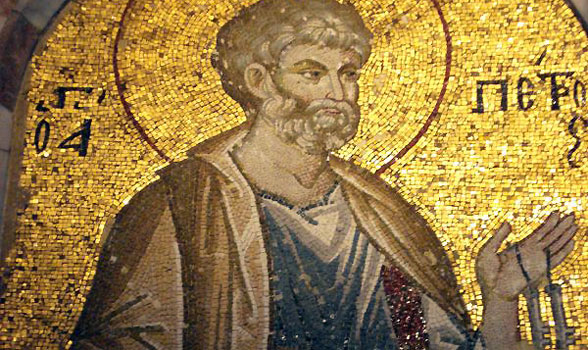
St. Peter mosaic, Istanbul, Turkey


***Ubi Petrus is a member of the Russian Orthodox Church Outside of Russia (ROCOR), which has been in union with the schismatic and heretical Moscow Patriarchate since 2007.  Nevertheless, his refutation of Roman Catholic errors is enlightening. 


Debates Playlist, Ubi Petrus

https://www.youtube.com/watch?v=wiECHK2VqFU&list=PL-n3jXuhqQW6F177MsWv4bzgiP4hV4dvx

"Filioque Debate: Ubi Petrus vs. MIlitant Thomist"

"Pope St. Agatho & the 6th Ecumenical Council - Ubi Petrus vs. Dr. Likoudis, Orthodox vs. Catholic"

In this talk, the late Dr. Likoudis, a convert to Novus Ordo Roman Catholicism from Eastern Orthodoxy, a noted author and formidable speaker, gives his strong argument for the papacy.  It becomes evident in this discussion, though, that Dr. Likoudis is unaware of the heresies and apostasies found in his post-Vatican II religion.  He praises Vatican Council II as the greatest of all time.  Criticizing the Eastern Orthodox for a lack of unity, he is blind to the Great Apostasy of the 20th century, which sifted out a remnant of faithful Orthodox who are united in doctrine and tradition.

"Is the Orthodox Church the One, Holy, Catholic, and Apostolic Church?  Ubi Petrus vs. Voice of Reason"

"Orthodox vs. Catholic Debate: the Pope in the 1st Millennium - Collorafi vs. Ubi Petrus"


Responses Playlist, Ubi Petrus

https://www.youtube.com/watch?v=ibZN9U3kbzw&list=PL-n3jXuhqQW4gZxPfrlKOObsO3cpAzdni

"Why Catholicism is Wrong on Church History, and Erick Ybarra Refuted"

"Refuting Erick Ybarra and Matt Fradd - Yes, You Should become Eastern Orthodox"

"The Biblical Story of the Eucharist"

"Is Michael Lofton Right on Orthodoxy, Ecumenical Councils, & the Magisterium?"

"Reason & Theology's Michael Lofton Doubles Down on His Ignorance of Orthodox Christianity"

"Does the Minimalist Argument for the Papacy Work?"

"Orthodox Christianity vs. Catholicism - Rebuttal to Erick Ybarra"

"Has Michael Lofton Failed on Orthodoxy and Church History?"

"Divorce and Remarriage in the Church Fathers"

"MHFM/VaticanCatholic Refuted on Orthodoxy & Ecumenical Councils - When LARPing Goes Wrong"

"St. Clement of Rome: Proof of Papal Authority?"


More from the Ubi Petrus Ibi Ecclesia website:

All Bishops Are Successors of Peter (Florilegium)
https://ubipetrusibiecclesia.com/2020/01/24/all-bishops-are-successors-of-peter-florilegium/
Though the Pope of Rome, the Pope of Alexandria, and the Patriarch of Antioch (among others) are the successors of Peter by lineage, all bishops are successors to Peter and this is reflected in a variety of patristic sources.

Atheist Refuted by Protestant on The Existence of God


"This Was a Mic Drop Moment", by Highlight Truth

An atheist posed...
I'm sure you can tell me where God comes from...

Monday, April 13, 2026

REFUTED: MHFM against Orthodoxy

Does the Orthodox Church lack the ability to confirm doctrine or discipline?  Is the so-called Reception Theory, in which a Council is considered Ecumenical because received by a subsequent Council, actually an Orthodox teaching?  Was Rome's Council of Florence Ecumenical, according to Orthodox standards?  Was the Church in the east punished by God for rejecting this Council, along with papal authority?   The false claims of the RC sede vacante group Most Holy Family Monastery (Diamond Brothers) are addressed in the following video:

"MHFM/Vatican Catholic Refuted on Orthodoxy & Ecumenical Councils", Ubi Petrus*
"This video discusses the criteria by which the Orthodox Church determines what is and is not an ecumenical council as well as the Council of Florence and why Robert and Frederick Dimond are deceivers and pseudo-monks, whom the canons of numerous local and ecumenical councils warn against."


*Ubi Petrus is a member of the ROCOR, which is now in union with the schismatic and heretical Moscow Patriarchate.  Nevertheless, his refutations against the plentitude of Roman heresies are valuable.


Monday, April 6, 2026

Typika Chants in Western Notation

"Typika", meaning the typical, or regular prayers of the Divine Liturgy that are prayed by laymen, when a priest is not available to offer the Divine Liturgy.  It is proper for these prayers to be chanted, rather than recited, if possible.  
To these prayers are added the scripture readings and variable prayers for the Feast.   The variable prayers can be found here: 

Variable Portions for Typika (Russian schismatic)
https://saintjonah.org/typ/ 

Troparia and Kontakia for Sundays http://orthodoxievco.net/ecrits/liturg/perso/tktriode.htm 

Troparia and Kontakia for Sundays in Pascha and Pentecost http://orthodoxievco.net/ecrits/liturg/perso/tkpente.htm 

Troparia and Kontakia for Fixed Feasts
If Matins is not prayed right before Typika, the beginning Trisagion Prayers are also prayed.  There is a rich Orthodox tradition of rotating weekly through the eight chant tones, but this can be quite daunting for those of us who are recent converts, especially when living far from an Orthodox parish!  The chant selections below are from Greek, Russian, English and Alaskan traditions.  They are chosen for their ease in learning, and sight-singing, for those who are used to western music.  It's helpful to practice with an instrument in order to be sure you've hitting the right notes, but of course, instruments are never used for actual worship, whether it is the Divine Liturgy, the canonical Hours, or any other prayers.  Rubrics are printed in red.  God bless you!


TYPIKA
We pray standing, especially on the Lord's Day, preferably facing east, in front of an icon of our Savior, with a candle, and other icons, especially honoring the Mother of God (Theotokos).

If Typika is not preceded by Matins, begin here:

+ Through the prayers of our Holy Fathers, O Lord Jesus Christ our God, have mercy on us and save us.

Trisagion Prayers:

O Heavenly King, Comforter, Spirit of truth, who art everywhere present, and fillest all things; Treasury of good gifts and Giver of life:  Come and abide in us and cleanse us from all impurity.  Save our souls, of Good One! 
This prayer can be chanted insted, if desired:
Exceptions:

Replace “O Heavenly King…” with the following:
From Pascha to the Ascension 
Christ is risen from the dead, trampling down death by death, and upon those in the tombs bestowing life!  (3x)

Christ is Risen 
https://resources.myrrhbearers.ca/sites/default/files/Christ-is-Risen_Byzantine-English-and-Greek.pdf

From Ascension to its leave-taking:

Thou hast ascended in glory, Christ our God, granting joy to Thy disciples by the promise of the Holy Spirit. Through the blessing, they were assured that Thou art the Son of God, the redeemer of the world.

 On the Saturday before Pentecost, just omit “O Heavenly King…” 

Holy God, Holy Mighty, Holy Immortal: have mercy on us. (3x)

Glory to the Father, and to the Son, and to the Holy Spirit: now and ever and unto ages of ages. Amen.

All-holy Trinity, have mercy on us. Lord, cleanse us from our sins. Master, pardon our iniquities. Holy God, visit and heal our infirmities for thy Name’s sake.

Lord, have mercy. (3x)

Glory to the Father, and to the Son, and to the Holy Spirit: now and ever, and unto ages of ages. Amen.

Our Father, who art in heaven, hallowed be thy Name; thy kingdom come; thy will be done on earth, as it is in heaven. Give us this day our daily bread; and forgive us our trespasses, as we forgive those who trespass against us; and let us not fall into temptation, but deliver us from the evil one.

For Thine is the kingdom, the power and the glory, of the Father, and of the Son, and of the Holy Spirit, now and ever and unto the ages of ages.  Amen.

Lord have mercy. (12x)

Glory to the Father, and to the Son, and to the Holy Spirit, now and ever and to the ages of ages. Amen.
These beginning prayers change for the week of Pascha (Bright Week):
If Typika is preceded by Matins, begin here:

+ Through the prayers of our Holy Fathers, O Lord Jesus Christ our God, have mercy on us and save us.

Typical Antiphons:  (sometime replaced with festal antiphons)

Third Antiphon:  Beatitudes
Troparion (according to the Feast)
This is usually read between the Beatitude verses, as shown here:

Trisagion:

On Christmas, Theophany, Lazarus Saturday, Pascha and Pentecost, we sing the following instead of the Trisagion Hymn: 
 
As Many as Have Been Baptized

Kontakion (according to the Feast)
Prokeimenon (according to the Feast)
Prokeimena for Liturgy

Epistle:

Daily Readings
https://www.ponomar.net/cgi-bin/menologion.cgi


Gospel:
Daily Readings

Cherubic Hymn
(Greek Hymn)
Commemoration of the Living and Departed 

Or, for those not yet baptized:
Lord have mercy on me.  May I be accounted worthy to flee unto Thy Holy Name and to be sheltered under the shadow of Thy wings.  Remove far from me that ancient error, and fill me with faith, hope and love that is in Thee, that I may know that Thou alone art the True God:  Father, Son and Holy Spirit.  Grant me to walk in Thy commandments, and to observe those things that are acceptable before Thee; for if a man does such he shall find life in them.  Inscribe me into Thy Book of Life, and unite me to the flock of Thine inheritance.  Father, let Thy Holy Name be glorified in me, and that of Thy well-beloved Son, our Lord Jesus Christ, and of Thy Life-creating Spirit.  Let Thine eyes look upon me in mercy, and Thine ears be attentive unto the voice of my prayer, that I may give thanks to Thee, worshiping and glorifying Thy great and Most High Name; that I may ever praise Thee all the days of my life.  For all the Powers of Heaven praise Thee, and Thine is the Glory, of the Father, and of the Son, and of the Holy Spirit, both now and ever, and unto the ages of ages.  Amen.
---adapted from prayers for the making of a Catechumen:

(Lenten)
Closing Hymn Selection:
Polyeleion - O Give Thanks to the Lord - Psalm 135 (from Matins)
https://stnicholasjuneau.org/wp-content/uploads/2021/01/Polyeleion-Serbian-Final-Draft.pdf

Christ is Risen (Kievan)

Finally, a Sermon is read:
Writings of the Early Church Fathers

Writings of the Fathers (French)

Sayings of the Desert Fathers (French)

The True Orthodox Church of Greece (Stephanos) broadcasts radio sermons in Greece, but since the loss of bishops and clergy in America, there are no live internet sermons in English.  However, the Holy Protection of the Mother of God Mission in Astoria, NY often posts sermons read by Reader Wasyl (Basil) Schumylowych:

Holy Protection of the Mother of God Mission
https://www.facebook.com/TheHolyProtectionMission/


~~~~~~~~~~~~~~~~~~~~~~~~~~~~~~~~~~~~~~~~

Additional Resources (from schismatic websites):
Typika:  When a priest is not present in order to celebrate the Divine Liturgy
St. Nicholas Orthodox Church, Juneau, AK - Sheet Music
https://stnicholasjuneau.org/orthodox-liturgical-sheet-music/

Hymns and Music, Greek Orthodox Diocese of America 
https://www.goarch.org/chapel/chant

Orthodox Sacred Music Reference Library
https://www.orthodoxchoral.org/en/home

Holy Myrrh Bearers Orthodox Mission
Pascha Sheet Music

Liturgical Sheet Music - Alaskan

from:
St. Nicholas Orthodox Church, Juneau, Alaska
---consecrated in 1894 (now schismatic - OCA)

Western notated sheet music for worship in the Orthodox Church

Categories:
  • Vespers
  • Compline
  • Matins (Orthros)
  • Divine Liturgy
  • Paschal Sheet Music
  • Great Canon of St. Andrew
  • Litanies
  • Sheet Music for the Menaion
  • Presanctified Liturgy
  • The Lenten Triodion
  • Christmas Carols

Thursday, April 2, 2026

Divine Music Project

Saint Romanos the Melodist 

Normally, the public prayers of the Church are chanted. The "Typika" (prayers of the Divine Liturgy prayed by laymen when a priest is not available) is also to be chanted if one is able to do so.

Here is a source for Byzantine Chant in English with western notation!

Saint Anthony's Monastery (schismatic)
Divine Music Project
https://stanthonysmonastery.org/pages/the-divine-music-project

There are free sheet music downloads for:
  • Doxologies and other prayers
  • Divine Liturgies (including Elizabethan and modern English)
  • Vespers
  • Orthros (Matins)
  • Sacraments
  • Feast Days
  • Triodion - Pentecostarion 

"Byzantine vs Western Notation"

Tuesday, March 3, 2026

The Schism of 1054

---translated from the magazine Orthodoxie, Sept. 1978
http://orthodoxievco.net/bul/001.pdf  

[My comments are bracketed, in green.  T. Davis]

"Let us begin by explaining what a schism is. The word comes from Greek and means split, separation. A schism in the Church is therefore a split among Christians, meaning that a portion of the faithful leaves the communion of love, gathers separately, and thus tears apart the unity of believers. A schism is not yet a heresy (false belief), but since the communion of love is broken, the first step toward heresy is taken. There have been schisms throughout the history of the Church, and there will be until the end of time. This is the battle of the Church against the forces of darkness; and closing our eyes to this reality would endanger the very life of the Church.

What we will say about the schism between Orthodoxy and the papacy is, of course, the orthodox point of view, that goes without saying. In matters of faith, we always speak within a very specific context:  that of a truth in which we believe and which we must confess as we believe it.

The schism of 1054 between the West and the East was not a one-year affair, and its causes were multiple.  The symptoms can be traced back several centuries before the date of the fatal rupture, and the divide has continued to widen to this day.

The main causes were the Pope's claim to absolute authority over the entire Church and the dogma of the Filioque.  Secondary causes, both theological and cultural, were also present and were exacerbated by politics.

Let's examine this summary in more detail:

From the earliest times, the Bishop of Rome enjoyed a primacy of honor in the Church; in Rome, the ancient capital of the empire, the princes of the apostles, Peter and Paul, were martyred.  This title of honor was never contested by the Eastern Church.  The tension between East and West arose when, for the first time in the 4th century, the Pope's claim to change this title of honor into a title of authority was felt.  [A distorted claim to authority was based on the Pseudo-Clementine Epistles.]  Initially hidden, "this latent tension would come to light in the 9th century and transform into open opposition" (J. Meyendorff). 

With the emergence of the Carolingian Empire and a new type of Christianity formed by the northern peoples, recently still considered "barbarians," the conflict intensified, not without some responsibility on the part of the Eastern Christians who prided themselves on their antiquity.  The interests of the Frankish Empire aligned with the Pope's claims to oppose the East. [Popes began to base their authority on a handful of forged documents: the Pseudo-Symmachian Forgeries, the early parts of the Liber Pontificalis, the Constitutum and Donatio Constantini, and the Pseudo-Isidore Decretals.  See: "Papal Forgeries: A Road to Schism", by Ubi Petrus:  https://www.youtube.com/watch?v=uBPdjkY_RX4 ]

Language and cultural problems arose, as well as questions of custom and Church discipline:  clerical marriage, fasting rules, the Eucharistic bread, etc.

The first schism erupted in the second half of the 9th century, between Pope Nicholas I and the Patriarch of Constantinople, Photius.  [Pope Nicholas, relying on the Pseudo-Isidore Decretals, inserted himself into the affairs of the Constantinopolitan patriarchate; also, he had adopted the heretical error of St. Augustine that conflated the eternal and temporal procession of the Holy Spirit, and attempted to promulgate the heresy through missionaries to Bulgaria.]

The mission among the Slavs was also a stumbling block between Byzantium and the West.

Charlemagne had already used the "Filioque" for his political ends (without, however, the support of Rome).  The same dogma was once again a source of conflict between Greek and Germanic missionaries in Slavic lands.  This time, the papacy "gave its full support to the Germans and was henceforth no longer neutral" (T. Ware).  The Filioque controversy persisted until the Council of Constantinople in 867, where Pope Nicholas was excommunicated.  Photius, in turn, was deposed by the emperor that same year, and, by a council intended to be the Eighth Ecumenical Council, he was anathematized and condemned.  In 879, Photius was reinstated to the throne by a council, and its decisions were accepted by Rome.  [The 869 Council was annulled by Rome, under Pope John VIII, and this 879 Council was honored as the true 8th Ecumenical for 200 years, until the Gregorian Reforms.]  Peace seemed to have been restored. 

The Filioque subsequently caused further tensions in 1009, and again at the coronation of Emperor Henry II in 1014, when it was interpolated into the Roman Creed.  The mention of Pope Sergius was removed from the diptychs in 1009 [for adding 'filioque' to the Creed], and from then on, the pope's name no longer appeared on the diptychs of Constantinople.  From that moment, communion between Rome and Constantinople ceased.

A serious quarrel broke out between the Normans and the Greeks of Italy; it resulted in the closure of the Latin churches of Constantinople in 1052.  The patriarch, however, strove to restore peace the following year.  For his part, in 1054, the pope sent three legates, headed by Cardinal Humbert.  The contact between the two parties was far from amicable, and from then on the patriarch refused any further contact with the legates.  Humbert lost patience and placed a bull of excommunication on the altar of Hagia Sophia.  Thus began the schism, though it was neither clear nor definitive.  “It was the Crusades that made the schism definitive:  they introduced a spirit of hatred and bitterness, and brought the conflict to the very level of the people.” (T. Ware)

The sack of Constantinople in 1204 and the sacrileges committed by the Crusaders shattered the last vestiges of communion of love between East and West.

An attempt at union, driven by political ends, at the Council of Lyon in 1274, failed.

Another council (in Ferrara and Florence, 1438–1449), where Saint Mark of Ephesus defended Orthodoxy, was no more successful in uniting what was no longer, in substance, the same faith.

From a human perspective, both sides failed time and again.  But in matters of faith, the Orthodox Church did not waver.  The same cannot be said of the Roman Catholic Church (which has entered a new phase of degeneration in our time) [Vatican II]

Reunion is not impossible; not through confusion, but through a return to communion in love and truth."

Hm. Cassian