Friday, October 10, 2025

French Orthodox Chants

This is the website of Father Cassian of the GOC-Stephanos (Matthewite) Synod, which I am still looking into, so not yet able to recommend.  The contents of Father's site seems good, though, and the liturgical chant has the European sounds we are used to in the west.  Apprécier!

LE SITE DES VRAIS CHRÉTIENS ORTHODOXES (VCO) FRANCOPHONES

(THE SITE OF TRUE ORTHODOX CHRISTIANS (VCO) FRENCH SPEAKING) 

http://orthodoxievco.net/

Chants Liturgiques avec Notation

(Liturgical Chants with Notation)

All these chants can be listened to (with synthesized voice) and printed

http://orthodoxievco.net/chants.htm

Thursday, August 28, 2025

Thursday, August 7, 2025

Name-Worship Heresy

Another synod bites the dust.  I had recently been an enquirer with a "Matthewite" synod of the "Genuine Orthodox Church", under Met. Sozomenos out of Birmingham, England.  After taking part in their group WhatsApp chat, however, I was surprised to learn that they believe in the "Name-Worship" heresy, and promptly left. 

This heresy had been condemned early in the 20th century.  The GOC movement began in 1924, in opposition to the abandonment of the ecclesiastical calendar in Greece.  But, in order to justify the Name-Worship heresy, they must not only denounce the 1913 Russian Synod, but also the Synods of the Ecumenical Patriarchs in Constantinople, under Patriarch Joachim III  (1901-1912) and his successor Patriarch Germanos V, as well as Patriarch Gregory of Antioch who condemned the heresy in 1912.  The GOC doesn't tell people what it really believes up front, since most would simply dismiss its members for the deceiving heretics they are.  The sect first has people invest themselves, then the sugar-coated pitch for acceptance of the condemned heresy is made!  

Since I had suggested this synod to readers in the past, I'm now obliged to warn against it, and all other "Matthewite" sects.  Rome fell with the corruption of one man, the pope.  The Orthodox synods, having greater autonomy, have splintered into many sects during this Great Apostasy, so it is difficult to discern who is actually Orthodox.  Here is a synod that rightly condemns the heresy in its belief statement:

Russian True Orthodox Church (RTOC), "What We Believe"

...We reject the heresy of name-worshipping, as did the synods of both Russia and Constantinople in 1913, which goes so far as to believe that “in the very sounds and the letters of the name of God the grace of God is present” (Apology, pg 188) or, which is essentially the same, that God is inseparably present in His name, which results finally in God being somehow subordinate or subject to man; and moreover, that we can consider Him to be somehow at the disposal of man. It is sufficient (even without faith or unconsciously) for a man to pronounce the name of God, and God is somehow obligated through His grace to be with this man and fulfil his desires.” (Decision of the Russian Synod, 1913) 

Here is some historical information: 

A Note on the Heresy of Name-Worship, ROCOR (schismatics)

History
Name-worship began in 1907 with a book written by an ill-educated hermit, formerly a monk of Mt Athos, called Fr Hilarion. In this book, a work of his imagination which was clearly infected by spiritual delusion, Fr Hilarion spoke of the prayer of the heart and wrote that, ‘The name of God is God Himself and can work miracles’. By 1909 this phrase, further distorted and made into a new dogma by Fr Hilarion, had become popular among some Russian peasant monks on Mt Athos. [And purportedly adopted by Rasputin, as well!]

Some of these fell into a sort of obscurantist superstition, claiming that the name of God must have existed before the world was created and that therefore His name cannot be anything but God Himself. They asserted, as a form of fetishistic idolatry, that the name of God is God Himself, hence the title ‘name-worship’. Among other things, this was thought to mean that the mere knowledge of the name of God allows one to work miracles. Paradoxically, this attracted not only uneducated and unscrupulous charlatans, but also esoteric, intellectual philosophers (in fact intellectual charlatans), who saw in it a form of Neo-Platonism - which it is.

The Heresy Condemned
Obviously, for the Church, name-worship is a form of superstitious paganism, which is quite incompatible with Christianity. Since, before the Creation, God did not need a name, so a name was created, a created sound which has no mystical power in itself whatsoever. The main proponent of name-worship was a Russian Athonite monk, a disgraced former cavalry officer whom some considered to be mentally deranged, called Fr Antony (Bulatovich). The Church responded to him and his fanatical peasant followers in no uncertain terms through the highly-educated Patristic figure of Archbishop Antony of Volhynia (later Metropolitan of Kiev and first candidate for Patriarch). He rightly called name-worship a heresy. Naturally, he was supported in this by the monks of Optina (including St Barsanuphius) and Glinsk, by the Russian Holy Synod and, in 1912, by Patriarch Joachim of Constantinople.

However, in 1913 Russian name-worshipping monks on Mt Athos became more and more violent. They began assaulting the other 4,500 Russian Orthodox monks there (among them the future St Silvanus, in Russian Silouan) and threatening to kill them. The new Patriarch of Constantinople, Germanos V, condemned name-worship as pantheistic. Acts of fanatical violence and the persecution of Orthodox monks became so dreadful that the Greek authorities proposed sending in troops and removing all Russian monks, with the secondary aim of hellenising Mt Athos completely. As a result, in June 1913 the Russian government was obliged to send three small ships to Mt Athos to rescue the Orthodox from the violence, taking the name-worshippers off Athos and back to the Russian Empire. In all 840 monks were transported back to Russia in July 1913. In reality, as the name-worshippers themselves admitted, only some fifty were actually leading the new sect. The others were simply pious and zealous, but uneducated. The leaders were defrocked for their violence towards the Orthodox monks, but the vast majority later repented and were received back into the Church.

The Later Attraction of Intellectuals
After these tragic events, His Holiness the Patriarch, St Tikhon of Moscow, was quite firm in his condemnation of name-worship, signing a document to this effect in October 1918. In January 1919 the wealthy landed leader of the name-worshippers, Antony Bulatovich, broke away from the Church, before being murdered on his estate in December 1919 by robbers or soldiers of the Red Army. Most of the proponents of name-worship were uneducated and often illiterate peasants, attracted to the crude and materialistic idolatry of a name. However, after the Revolution two philosophers, who had by then entered the Church and been ordained, though never fully Churched, Fr Paul Florensky and Fr Sergius Bulgakov, both later considered heretics, supported name-worship.  Part of the attraction was without doubt the ‘romantic’ propaganda put about by the eloquent ringleader, Antony Bulatovich. He set himself up as an unjustly deposed victim...

For a study of the heresy itself, see Vladimir Moss' excellent published work On the Name of God:

On the Name of God, Moss, 2007
https://www.academia.edu/10213604/ON_THE_NAME_OF_GOD 
An Examination of the Orthodox Doctrine of the Name of God in the Context of the "Name-Worshipping" Heresy of Fr. A. Bulatovich and Fr. G. Lourie  
Contents  
Historical Introduction
Part I: The Principles of the Orthodox Teaching
1. Names and Knowledge
2. The Nameable and the Unnameable 
3. Names, Energies and Hypostases
4. The Name of Jesus 
Part II:  Art II: The Main Arguments of The Name-Worshippers
5. Name-worshipping and Eunomianism (I) 
6. Name-worshipping and Eunomianism (II)
7. Name-worshipping and Pantheism 
8. Name-worshipping and the Sacraments 
9. Name-worshipping and Icons 
10. Name-worshipping and the Jesus Prayer
Conclusions

Here are two of the synodal decrees that condemn the heresy:

By the Grace of God, the most holy ruling Synod of all Russia, to the all-honorable brethren who are struggling in the monastic polity, grace to you and may peace from the Lord Jesus Christ be abounding.

The recently-appeared teaching of the Schemamonk Hilarion about the most sweet name of the Lord Jesus, which has agitated many of the Orthodox, both monks and laymen, has become a subject of diligent examination in the most holy Synod. For the sake of all possible objectivity, the most holy Synod heard three investigations (attached herein), composed separately from one another; and after sufficient deliberation, unanimously accepted the final conclusions of these investigations, as much as these conclusions are entirely in agreement with the judgments of the Greek theologians of the island of Halki and the decision of the All-Holy ecumenical Patriach and his Synod. Without entering here into a detailed exposition of this newly appeared teaching and all the proofs of its unorthodoxy (they who desire it may read these details in the attached reports), the most holy Synod considers it sufficient to note the principle and most essential points, first of the teaching of Fr. Hilarion as set forth in the book ‘On the Mountains of the Caucasus’, and then the theories of his followers on Mt. Athos, as these were expressed in the ‘Apology’ of Schema-Hieromonk Anthony Bulatovich and in diverse appeals and pamphlets sent from Mt. Athos (including those in the name of “The League of Archangel Michael”). 

As concerns, first of all, the book ‘On the Mountains of the Caucasus’, it had a wide circulation among the monastics and was received favorably, and it is not at all remarkable, for this book has as its subject the precious treasure of the ascetics “noetic asceticism” [prayer of the heart]. It confirms the necessity of this practice which has somewhat been neglected by the monks of our times; it gives a clear expression to many things, which the ascetics feel inwardly in their experience, but in the form of unclear presentiments and conjectures.

An objective judgment of such a desirable book, and much more its condemnation, when considering its shortcomings/failings was not easy, for everyone fittingly feared that in condemning the failings of the book, he might cast a shadow of disapproval upon the sacred truths for which this book was published in order to establish them. In spite of this, however, from the first edition of this book, many who were experienced in the spiritual life found it questionable. The most holy Synod knows, for example, that in one of our most illustrious monasteries in the north of the Empire, reading of ‘On the Mountains of the Caucasus’ was forbidden by the elders. What constitutes the deception of Fr. Hilarion? It consists in this; that Fr. Hilarion, not being satisfied with the description of the prayer of the heart, of its spiritual fruits, its necessity for salvation, etc., bowed to the temptation of giving his own somewhat philosophical elucidation of why the prayer of Jesus is salvific; and forgetting the guidance of the holy Church, he wandered lost in his own theories; he invented, as he himself says, a new “dogma”, which was found nowhere else before, leading not to the magnifying of the most sweet name “Jesus”, nor to a strengthening of the prayer of the heart (which was, we think, the intention of Fr. Hilarion) but leading entirely to the contrary.

Truly, we must ask ourselves what is the Jesus prayer in the understanding of the holy Orthodox Church? It is the invocation of the Lord Jesus Christ. Just as the blind man in Jericho cried out calling upon “Jesus, thou son of David have mercy on me”; and he did not cease from crying, paying no attention until the Lord hearkened unto his prayers (“Lord, that I might have my sight”, etc Mark 10:46-52). So also, does the ascetic of noetic prayer unceasingly call upon the Lord Jesus with undoubting faith, with humility, and with continuous cleansing of the heart that Jesus might come and grant him “to taste and see that the Lord is good”. From the Holy Gospel we know that God does not abandon “His own elect which cry day and night unto Him” (Luke 18:7), for He gives them His grace, for (with the Father and the Spirit) “He cometh and maketh His abode among such” for Himself. Where the grace of the Holy Spirit is, there also are the fruit of the Spirit. “Wherever God is, here also is every good”, as a certain ascetic said, for the kingdom of God is there. Behold, this is what constitutes the source and cause and the entire interpretation of those exalted and sweet conditions which befit those higher degrees of noetic asceticism [prayer of the heart] which do not only possess the soul, but which are also manifested in the bodily life of man; they are the gift of the source of every good in response to our beseeching: an entirely free gift, explainable only by the goodness of Him who gives it; since he is free to give or not to give, to both increase and decrease, and also to take away completely His gifts. But this so natural and comforting explanation which so arouses in us love for the good Lord appeared to Father Hilarian and his followers to be insufficient; and they decided to replace it with their teaching, i.e., that the Jesus prayer saves, because the name “Jesus” is salvatory, for in it, as in the other divine names, God is inseparably present. But saying this, they do not suspect apparently to what fearful conclusions such a teaching inevitably leads. For if this doctrine is true, then it follows that the unconscious repetition of the name of God is effective (so Father Bulatovich states in his Apology, page 89). “If you unconsciously invoke the name of the Lord Jesus, you will still have Him in His name with all His divine properties like a book with everything printed in it; and if you invoke Him as man, you will still have in the name ‘Jesus’ all of God.” However this contradicts the very words of the Lord, “Not everyone that saith unto Me, Lord, Lord, shall enter into the kingdom of Heaven(Matt 7:21 ff). If this new doctrine be true, then in this case, it would be possible for someone to perform miracles with the name of Christ without believing in Christ. However our Lord told the Apostles that they could not cast out the demon “Because of their unbelief” (Matt. 17:20). If the interpretation of Father Hilarion and his followers is accepted, some events cannot be understood such, as that recorded in Acts 19:14 ff. More significantly, the acceptance (by Father Bulatovich) that “in the very sounds and the letters of the name of God the grace of God is present” (Apology, pg 188) or, which is essentially the same, that God is inseparably present in His name, which results finally in God being somehow subordinate or subject to man; and moreover, that we can consider Him to be somehow at the disposal of man. It is sufficient (even without faith or unconsciously) for a man to pronounce the name of God, and God is somehow obligated through His grace to be with this man and fulfill his desires.

But this is now blasphemy! This is a magical superstition, which long before has been condemned by the Holy Church. Certainly both Fr. Hilarion and all those of like mind with him will turn their faces away with horror from such blasphemy; but, however if they do not like this, they are obligated to come to doubt concerning their “dogma” which necessarily results in such a condition. Not less dangerous results are from this new teaching for the ascetic life, for noetic asceticism [prayer of the heart]. If the grace of God is present in those sounds and letters of the name of God, f this name pronounced by us or the idea of it held in our spirit is God, then the first place in noetic asceticism is now taken not by the invocation of the Lord, not by the lifting up of our heart and our mind to Him (for why should I invoke Him, whom I practically by force possess Him already in my heart or spirit?) but rather the first place will be the repetition of the words of the prayer and the mechanical turning of it in the mind and on the tongue.  

An inexperienced ascetic will entirely forget that this prayer is directed towards someone, he will be satisfied only in the mechanical repetition and he will expect from this dead repetition those fruits which only the true Jesus prayer gives. When he does not receive these fruits, he will either lose heart or he will begin to produce them artificially in himself and to accept this exultation wrought by him as the action of grace. In other words, he will fall into deception. Certainly, Fr Hilarion does not wish such to befall anyone.  

The followers of Fr. Hilarion who wrote the ‘Apology’ and the appeals from Mt. Athos consider themselves to be followers of St Gregory Palamas and their opponents to be Barlaamites. This however, is an evident misunderstanding; the similarity between the teaching of St. Gregory and this new teaching is only external and just in appearance. St Gregory taught that we must attribute the term “divinity” not only to the essence of “God” but also to the “energy” or to His energies, i.e., to the divine attributes: wisdom, goodness, omniscience, omnipotence, etc., through which God reveals Himself to them without, and in this manner the Saint taught that we should use the term in a somewhat broader sense than usual. This variable sense of the term constitutes the whole resemblance of St Gregory’s teaching with this new teaching, but essentially there is a complete difference between them. 

First, the Hierarch in no place names the energies “God” but teaches that we should name them “divinity” (not God, but divinity). The difference between these two terms can be easily understood from the following example. It is said, “Christ showed His divinity on Tabor”, but no one, however, would say, “Christ showed His God on Tabor”; this would either be mindless or blasphemy. The word “God” indicates the person or personality, while the word “divinity” the attribute, the quality, the nature. In this way, even if we acknowledge the name of God as an energy of His, in such a case we could name it simply divinity, but not God, much less “God Himself” as do these new teachers. Secondly, the Hierarch nowhere teaches that we should confuse the energies of God with the results of these energies in the created world, which is to confuse the energy with the fruits of the energy. For example, the Apostles saw the glory of God on Tabor and heard the voice of God. We can say about them that they saw and heard the divinity.

Descending from the mountain, the Apostles remembered that which had taken place and then narrate it to others, communicated to them all the words heard by them. Can it be possible to say that they communicated to others the divinity? That their narration was an energy of God? Certainly not. It was simply the fruit of the divine energy, the fruit of its activity in the created world. However, there new teachers manifestly confuse the energy of God with its fruits, when they name as divinity as God Himself, the names of God, and every divine word, and indeed even the church prayers, i.e., not only the word spoken by God, but all our words about God, “The words, by which we name God” as is written in the objection to the Confession of Faith of the Monastery of St Panteleimon (in a parenthesis to the words of St Symeon the new Theologian). But this is already a deification of the creature, pantheism, which considers that all that exists is God. Wherefore, the danger is clearly justified, that was pointed out in the theological verdict from the theologians of Halki theological School. In this confusion of the creature and the divinity one discerns not a resemblance with the teaching of St Gregory Palamas, but rather an exact resemblance to the teaching of Barlaam and his followers, whom the holy Father refuted, for among other things, also accepting somehow two kinds of divinity, created and uncreated (Porphyrius, History of Mt Athos, Vol 3, page 748). In order to support its conjectures, the Apology and other writings of like mind with it did not bring forward quotations from Holy Writ and the writings of the Holy Fathers. For Fr Hilarian did not confess in vain to his spiritual father [Kyrikos] that the teaching of this new dogma “is found nowhere.”

The passages presented do not prove the ideas of the followers of this doctrine, as is proved in detail here in the attached statements. The phrases “thy name”, “The name of the Lord” and the like in the language of sacred literature (and together with these, in the Fathers of the Church and in the Church’s hymns and prayers) are simply descriptive expressions, like “the glory of the Lord”, “the eyes, ears, hands of the Lord”, or referring to a man, “my soul”. It would be extremely erroneous to understand literally and to attribute eyes and ears to the Lord or the soul as separated from a man. Likewise, not in the least is there any foundation to perceive in the former expressions traces of some teaching concerning the name of God; i.e., the deification of he name of God; the phrases simply mean “Thou” or “the Lord”. A great many passages of Holy Writ, aside from the foregoing, are arbitrarily misinterpreted by the followers of this new doctrine, so that justly we can bring to mind the anathema published against them who attempt “to misinterpret and change that which is spoken by the grace of the Holy Spirit” (Greek Triodion pg. 149) which anathema is referred to in the Appeal of the League of Archangel Michael (section 6).

In the appended expositions, examples of such misinterpretations are presented; here one of them of all will suffice. One of the objections in the Confession of the Panteleimonites refers to the words of Symeon the New Theologian, “The words of men are changeable and empty, but the word of God is living and active”. But where herein either refers to the creative word of God (e.g. “Let the be light, and there was light” and the like) or it refers to the begetting before all eternity of the Son of God, the Word of God. The editor of the objection himself simply interpolated after “the word of God” (that is, the words with which we name God) and he achieved that which he desired, forgetting that the words proceeding from the mouth of men, even if they are spoken concerning God, are not possible to be equal with the words from the mouth of God.

With special insistence, the followers of the new teaching refer to the late Fr. John of Kronstadt, in order to prove their doctrine. Wonderful to say, the writings of this blessed man are widely available. One might say that all have read them. Why then up till now, no one has observed in them such a teaching expect Fr. Hilarion and his followers? This and only this now cause one to doubt the accuracy of the reference to Father John. Carefully reading the works of Fr. John everyone can be convinced that Fr John is speaking only concerning the particular phenomenon in our consciousness when praying, with the pronouncement of the name of God in our heart, and especially in the Jesus prayer, we do not separate Him in our consciousness from the pronounced name, and that the Name and God Himself coincide. Fr John counsels that we not separate them, not to attempt in prayer to think of God as separated from the name and outside it; this advice is entirely necessary and reasonable for the man who is praying. If we, so to speak say, enclose God in His name, when in it is pronounced in the heart, we are protected from the danger of attributing to God, when we address Him, a material form, which all the law givers for spiritual warfare dissuade us from doing.

The name of God at the time of prayer should in some fashion be fused or identified with God so as to be inseparable. Not unjustly did Fr. Hilarion in the beginning said that the name of God for the man praying is not ”God” but “like God”. But this is so only in prayer and in our heart and it depends only upon the limits of our consciousness and our created nature. However, never is it concluded from the foregoing, that outside of our consciousness the name of God is identical with God, that it is divinity. Wherefore, Fr John, if he like many other church writers, refers to the special and miraculous power of the name of God, he also clearly gives us to understand that this power does consist of the name itself as such, but in the invocation of the Lord, who or whose grace is acting. For example, we read in his My Life in Christ, (book 4, pg 30, 2nd edition, revised by the author, Petrograd, 1893) “the almighty and creative spirit of our Lord Jesus Christ is everywhere and He can everywhere name the non existent as existing (Matt. 18:20) ‘And lo, I am with you alway…’ But so that the heart of little faith might not think that the Cross or the name of Christ accomplish these things in and of themselves, and that the same Cross and the name of Christ, do not produce miracles when I do not look with the eyes of the heart or of the faith in Christ the Lord and I do not believe with all my heart in everything which he did for our salvation.” These words in no way agree with the new dogma of Fr. Hilarion and Fr Anthony Bulatovich that supposedly “the name has almighty power to work miracles as a consequence of the presence in it of the divinity” (fourth point of the Appeal of the League of the Archangel Michael.). On the contrary, that which Fr. Chrysantus and the others spoke and wrote against such a teaching is validated, i.e., the name of God works miracles under the condition of faith. In other words, when a man pronounces the name, he awaits the miracle not from speaking the words, but he calls upon the Lord, whom the name indicates, and the Lord according to the faith of this man performs the miracle. The Lord also designates this absolutely necessary condition for a miracle, “If ye have faith and doubt not, ye shall not only do this which is done to the fig tree, but also if ye shall say unto this mountain be thou removed and cast into the sea; it shall be done, and all things, whatsoever ye shall ask in prayer, believing, ye shall receive (Matt 21:21-22). “If ye have faith as a grain of mustard seed, ye shall say unto this mountain, remove ye hence to yonder place; and it shall remove; and nothing shall be impossible to you [(Matt 17:20) et. al.]. So does the Apostle Peter explains the healing of the lame man in Acts 3:6 “And His name through faith in His name both made this man strong, whom ye see and know: yea the faith which is by him hath given him this prefect soundness in the presence of you all” (Acts 3:16). The falseness of this new dogma is finally verified by the conclusions, which are derived from it by its followers, especially Fr. Bulatovich in his Apology. According to him, the icons and the sign of the cross and divine mysteries of the church have effect only because upon them or during the course of performance, the name of God is portrayed or pronounced.

One cannot read without extreme astonishment the 12th chapter of the Apology (pg. 172-186) where Fr. Bulatovich, gives a new elucidation of the Divine Liturgy according to his new doctrine. Up to now, the Holy church taught us that bread and wine become the body and blood of the Lord because God by the prayers and the faith (certainly not that of the priest or of one of the congregation, but) of the Church of Christ “sends down His Holy Spirit and makes the bread the body and the wine the blood of His Christ”. Fr Bulatovich in his Apology writes that the mystery is accomplished “precisely by the pronounced name of God” i.e., supposedly, because simply the words “Holy Spirit”, “name of the Holy Spirit” and the sign of the cross was made with the fingers in a position which expressed the name (pg 183-184). But since before this the names of God are pronounced over the gifts indeed more than once, Fr Bulatovich in his sophistry maintains that in the proskomide, from the moment of the piercing of the lamb “the lamb and the wine in the chalice are all-holy, sanctified be the confession of the name of Jesus; it is Jesus according to grace, but not yet according to essence” (pg. 174). If such be the case, why did the Orthodox Church once condemn the so-called bread worshippers, who preformed prostrations before the Holy Gifts before their change? Finally, if the performance of the mysteries is restricted only to the pronouncement of certain names and the performance of certain names and the performance of certain actions, in that case these words could be pronounced and these actions preformed not only by a priest, but also by a layman and indeed even by a non-Christian. Is Fr. Bulatovich really ready to accept that even by such a server the mystery would be accomplished? Why then do we have a lawful hierarchy? It is true that in the synaxaria and other such books there are found narratives of mysteries accomplished without a lawful celebrant when the appointed words of the prayers were pronounced (indeed, sometimes as a joke or childish sport). But all these narratives bear record that God at times “became manifest to them that asked not after Him” (Esaias 65:1), as e.g., the Apostle Paul or at times, that the church’s mysteries must not be a subject of mockery or childish games, for God can punish such. In any case, such narratives do not overturn the God-given ecclesiastical order. Thus from an erroneous principle, Fr Bulatovich necessarily reaches erroneous conclusions, which on their part prove the falseness of the principle.

On the foundation of all the foregoing, the most Holy Synod unanimously is in agreement with the decision of the all-Holy Patriarch and the sacred Synod of the Great Church of Constantinople, which condemned the new teaching as “blasphemous and heretical”; and after this, the synod also beseeches everyone who has been led astray by this new teaching, to abandon this erroneous sophistry and humbly obey the voice of the Mother Church which alone upon the earth is “the pillar and ground of the truth” and outside her there is no salvation. She, the Bride of Christ, knows more than all how to love and honor her heavenly bridegroom. She, more than all, knows, embraces the most sweet name of Jesus and other names of God; but she never permits, however, this honor to extend beyond what is proper, she does permit our purblind human conjectures and our limited human perception to become superior to the truth revealed to the Church by Christ, as if we would correct it.

The Orthodox theology concerning the divine names is as follows:

1. The name of God is holy, worshipful, and desirable, because it is useful to us as a verbal designation for that most desired and most Holy Being, God, the source of every good. This name is of God, because it was revealed to us by God, it speaks to us of God, it refers our spirit towards God, etc. In prayer (especially the Jesus prayer) the name of God, and God Himself are inseparably in our consciousness, and it is if they coincide, and indeed, they cannot and ought not be separated, opposing one to the other; but this only in prayer and only by our heart. Examined theologically and in reality, the name of God is only a name. It is not God Himself nor an attribute (characteristic) of His. The name of an object is not the object itself. Therefore, it is impossible for it to be considered or named either God (this would be mindless and blasphemous) or divinity, for it also is not an energy of God.

2. The name of God uttered in prayer with faith is able to perform miracles, but not by itself in itself, nor as a consequence of some divine power which, in a matter of speaking, is enclosed in it or attached to it, which would then work mechanically, but rather thus: the Lord seeing our faith, in the power of His un-lying promise, He sends His grace, and through it He performs the miracle.

3. Each of the Holy Mysteries are accomplished neither by the faith of him who performs them nor by the faith of him who receives, but neither by the invoking or depiction of the name of God, but by the prayer and faith of the Holy Church, on whose behalf it is preformed and with the power granted he by the Lord’s promise. Such is the Orthodox faith, the patristic and Apostolic Faith.

Now the most Holy Synod invites the superiors and elders of all the venerable monasteries in Russia: after the reading of this epistle, with all the brethren present, to hold the service of supplication, that is appointed for Orthodoxy Sunday, for the return of all who have gone astray. Afterwards, if there are in the brotherhood some of contrary mind, they must express their submission to the voice of the Church and promise that from now on they will withdraw from self-willed arbitrary theories and they shall not offend anyone by them. All are obliged to forgive one another from their heart, if anyone in the excitement of the discussion said or did something offensive to the other, and they should live in peace, working out their salvation. The book, On the Mountain of the Caucuses, as containing grounds leading to erroneous theories and the Apology of Fr Bulatovich and the books and pamphlets written to establish this concocted new teaching, must be proclaimed as condemned by the Church and must be removed from circulation among the brotherhood of the monasteries and their reading to be forbidden. If after this there should still exist stubborn followers of this condemned teaching, immediately they are to be suspended from priestly service, as many as among them have the priest’s office, all who remain obstinate, after counseling, should be referred to the appointed Church court, which in the case of their further persistence and un-repentance, will deprive them of their priestly and monastic rank, so that the evil sheep not infect the flock. The most Holy Synod fervently summons to obedience, Fr Hilarion the Schemamonk, and Anthony the Schemahieromonk and the other foremost defenders of the new doctrine. For if they until now believe that they were defending a truth of the Church and that the words of the Apostle could apply to them concerning “shall hide a multitude of sins” (James 5:20), now when the highest authority of the church both Constantinople and Russia have passed judgment, further persistence in their own opinion is finally a battle opposing the truth and draws, upon them the threatening word of the Lord, “But whoso shall offend one of these little ones, it were better that a millstone were hanged about his neck and that he were drowned in the depth of the sea” (Matt 18:6). But may this lot never befall them, nor any one else, but may the grace of our Lord Jesus Christ and the love of God the Father and the communion of the Holy Spirit, be with all men. Amen.


[Synodal] Epistle of Ecumenical Patriarch Germanos V, April 5, 1913
https://drive.google.com/file/d/1bmFaw9aSNFq7zGVtmP6dV3HPDkCpJF6D/view?pli=1 

Most Holy Overseers and Representatives of the Holy Mountain Athos; children of Our Modesty, grace unto Your Holinesses, and peace from God!

From the various letters received from your holy place, as well as from Your Holinesses' official report by which with sorrow was made known unto the Church concerning a newly-appeared, novel and pretentious teaching disseminated by Russian monks regarding the name of "Jesus", as being that very same Jesus and God Himself, which name in a manner of speaking, is hypostatically identified with Him. Inasmuch as this novel and unwarranted teaching which is derived from delusion and misunderstanding, due to ignorance, results in blasphemous heterodoxy and heresy, as co-identifying and confusing those things which cannot be confused, and thus, leads to pantheism, Our Modesty, along with the Most-Holy Metropolitans, and most-honored beloved brethren and concelebrants in the Holy Spirit, who were greatly troubled by the appearance, and moreover by the constant and daily distribution of this impious and soul-corrupting teaching in your chaste place (The Holy Mountain), perceived
cause to act, and we immediately once more began to give serious attention to this matter, which had been judged by Our ever-memorable predecessor, Joachim III, and by the resolution of the Sacred Synod, which had met for this purpose. And, moreover, for a more complete knowledge of the details of this delusion, we entrusted a study and examination of the source and the foundation of this same teaching to the committee of the Professors of Our Theological School in Halki, after which, having received from them their analytical explanation, relative to this matter, which explanation we have attached a copy to this letter, at a synodal meeting, we then unanimously condemned and denounced in the Holy Spirit, as blasphemous and heretical, the above-mentioned novel teaching concerning the name "Jesus" as being supposedly that self-same Jesus and God, whose very essence is contained in His name. 

Wherefore, by way of this Patriarchal Epistle, we make known to Your Holinesses concerning the Synodal condemnation and judgment of this delusion and direct you to proclaim the decision of the Church to those in the Holy Monastery of St. Panteleimon, and to those in Vatopedi's Skete of St. Andrew, as well as to all of those deluded monks to be found therein, and that you require in Our Name, and in the name of the Church, that they will all completely loathe this blasphemous delusion, and that they from henceforth completely avoid the varied and alien teachings, and faithfully remain only in that which has been received and dogmas, and in the traditional teaching of the Church, for which and by which (Church) there is no novelty. "If any one of you teacheth other than that which ye have received; let him be anathema". 

If they manifest after this second ecclesiastical admonition that some have remained in this heterodox belief and resolution, and continue to hold to this incoherent teaching; that the name "Jesus" is of itself that very God, we then say that they should be considered as heretics and rebels against ecclesiastical discipline, and that the measures indicated by the Sacred Canons must be taken, and that in no way should it be allowed that such (heretics) remain, and by their pestilence corrupt your chaste place. We pray that the Lord God enlighten all unto the path of piety and virtue.

April 5, 1913

Your fervent intercessor in Christ
[Signed:]

+ Germanos of Constantinople

Thursday, June 19, 2025

Synodal Epistle of the GOC to the ROCOR Synod, 1976

To the Hierarchy
of the RUSSIAN ORTHODOX CHURCH OUTSIDE OF RUSSIA,
75, East 93rd Street,
New York 28
N.Y. U.S.A.

Most Right Reverend President MM Philaretos
Right Reverend Prelates, may Christ be with us.

1. In the year 1971 our Synodical Exarchate consisting of their Right Reverences the Bishops of Corinthia Messrs Kallistos, Kitiou Messrs Epifanios and the Reverend Chancellor Eugenios Tombros, proceeded to the USA in order to get in contact with your Synod and arrange the spiritual communication with you, with a view to strenghening the sacred Fight of Orthodoxy.

Before coming to any spiritual contact with you, our Synodical Exarchate submitted to you a “Statement of Credo” of the Church of the Genuine Orthodox Christians of Greece, the content of which was:

“Having accepted the innovation of the New Calendar the Church has become Schismatic and its Holy Mysteries have no validity, being deprived of the Grace of God, in accordance with the First Canon of Basilius the Great”.

This statement was read by the chief Priest Georgios Grambe [Grabbe] in your presence on the 15.9.1971 resulting in:

A. Approval and acceptance by voice of this Statement, absolutely and unanimously, by the whole of Hierarchy.

B. The express affirmation, on your part, to our Synodical Exarchate as to the sending of an official document of your confession of Credo.
Under these presumptions and exclusively, we have been led to the Ecclesiastical, spiritual and Mystical Communication with you, with the upright hope of identity of conception and practical application of all those which the Catholic Orthodox Church of Christ proclaims, thinks and believes too, as much regarding the heresies, as about the Schisms and especially the Calendar question.

Afterwards you have undertaken the obligation in the year 1971, upon application of our Exarchate, No. 736, dated 12.9.1971, to consider the case of derivation of our Hierarchy from one and sole Bishop, the Archbishop Matthew the 1st, of blessed memory, your judgment "to be relied upon the divine and holy Canons” and you have pronounced your decision under No. 16 of 15.9.1971.

Joint masses and joint prayers and visits of clergymen of our Churches ensued, confirming the Unity in Faith and the Communion in Holy Spirit, leading to the conviction that:

First, your attitude towards the followers of the Innovation of the New Calendar, as it is defined by the Orthodox teaching and as reported to you on 15.9.1971 by our Synodical Exarchate.  Second, the absolute interruption of communions with the New Calendar followers.  Third, the consideration on the basis of the Canons of the Church and particularly of the Canon I of Basilius the Great, of the Mysteries officiated by the Innovators would be included in a written Confession of yours, as it was dearly promised in September 1971, and would be realized in an integral manner.

We believed, most Reverend Fathers, that your intentions would be sincere and that you would follow the Orthodox line based on the Divine and Holy Canons.

In the summer of 1972 however, and while we were expecting your written Confession, you sent a circular letter to all the Churches in which, inter alia, and by the way, you said that the introduction of the New Calendar brought about a Schism, quoting in fact the statement of a Greek Professor of Theology, without even dealing with the consequences of the Schism or the way of its confrontation by the Church in accordance with the Holy Canons.
Since then oral statements by clergymen of yours, letters by people grieving for the Orthodox Faith and undeniable information about various violations on the part of higher and lower clergymen of your Church and about complete spiritual communication with Schismatic New Calendar Followers, caused us sorrow and disappointment, protests of our clergymen and laymen and shook our confidence in your views on the Calendar Matter.

Since then we have been making persistent efforts to have your written Confession of Credo on the above matter, and for this reason His Beatitude the Archbishop of our MM. Andreas has written to you twice.
Quite unexpectedly, however, we received a letter No. 3/50/759 dated 13.12.1973 from his most Right Reverence MM Philaretos referring to irrelevant matters and subjects and not to our Archbishop Andreas’ questions.

In the meantime discontent of the Clergy and laymen and ourselves, because of your failure to send us the promised Confession of Faith, kept swelling, and for this reason we sent you our Synodical Document No. 1007/1.5.74, in which once again, due to the importance of the matters involved, we made reference – with analytical Memorandum – to the whole subject of the causes and the consequences of the holiday-calendar Schism, expressing the unanimity of Clergy and laymen in its contents and requested you to send a written reply to the questions included in our said letter.

Having not received a due reply from you we sent our Exarchy consisting of Synodical Prelates MM Kallistos of Corinthia and Nicolaos of Piraeus and of the Archimandrite M. Kallinikos, which having held joint liturgies and prayers with you, was received in audience during the meetings of your Hierarchy on September 12th, 1974 and submitted to you for discussion the burning subjects and the demand for your Confession of Faith.

We consider it certain, Your Graces, that you remember very well what was exchanged then between us, so that we do not need to revert to them.
Our Exarchy asked for the written formulation of your Credo on the Calendar question and the validity or not of the Mysteries of the New Calendar Followers, as the above Memorandum refers to, and received in reply a draft of Confession of Faith, to which it disagreed, the disagreement having been expressed in writing, and in the expectation of the final document our Exarchy extended its stay for a few more days and returned to Greece, hoping that you would send the written Confession of Faith.

All these show the importance we attributed to the written formulation of your Credo and the great efforts we have made to this end.  In spite of the discontent of the Clergy and the laymen of our Church we were waiting tolerantly in full Episcopal conscience, hoping for an Orthodox attitude and line.

Having been in full and ardent expectation, for the last four years, of the proclamation promised by, with great difficulty and with long delay we received on 30.1.1975 your document No. 3.5.760 dated 22.9.74, which includes your views on the Calendar.  You consider “the introduction of the New Calendar as a mistake carrying anomaly and finally bringing about Schism”.  With regards to your viewing of the Mysteries of the New Calendar Followers you adopt the following:

“Concerning the matter relative to the presence or the non-existence of God’s Grace among the Followers of the New Calendar, the Russian Church outside of Russia do not consider themselves or any other local Church having the authority to take final decision, as a final settlement of this matter can only be affected through a properly convened competent Oecumenical Council, with the indispensable participation of a free Church of Russia.”

On the above and on all the contents of your document we have to make the follwoing remarks:

a. The calendar question is not only a “contemporary Temptation”, as you claim, but it made its appearance in 1582, when the Church resisted, condemned and cursed this innovation through the well known Panorthodox Synods of the years 1583-1593 under Jeremias II, Tranos, of 1756 under Cyrill and of 1848 under Anthimos, Patriarch of Constantinople.
If we study well the decisions of these Panorthodox Synods we shall find out that it is not simply a contemporary temptation or an error but also a contraversion to the Holy Spirit “as not having adequeately spoken in the Oecumenical and local Synods”.

“The Panorthodox Synod which was held in 1853 when Jeremias II, called Tranos, was Patriarch of Constantinople, made the following condeming decision:  “Let he who does not follow the customs of the Orthdox Church, as the 7 Holy Oecumenical Synods decreed, by which legislated for us to follow the Holy Easter and the Calendar, and follows instead the newly invented Calendar of the atheist astronomers of the Pope and opposes all these and tries to overthrow and spoil the traditional doctrines of the Church, have the anathema and be outside the assembly of the devouts.  And you the pious and orthodox Christians stick to what you have learned since you were born and have been brought up to and when the time and need come shed your blood in order to safeguard your traditional faith and confession”.

The condemning decision in 1848 when Anthimos was Patriarch speaks about blasphemy against the Holy Spirit on the part of those who accept any innovation and reads as follows:

“We stick to the confession which we have taken over pure from such great men, detesting any innovation, which is considered as dictated by the devil”, “he who accepts an innovation considers the declared orthodox faith inadequate but this faith being already perfect is sealed and is not subject either to reduction, increase or alteration, and for this reason he who dares either to do, advise someone or think about it, has already denied the faith of Christ, he has already willingly submitted himself to the eternal anathema for having blasphemised the Holy Spirit, as not having adequeately spoken in the Scriptures and the Oecumentical Synods”.

Consequently all the innovators either in heresy or in schism have dressed themselves willingly the curse as garment, whether they were Popes, Patriarchs, clergymen, laymen or even an angel from heaven”.

b. The calendar question is considered under trial still undecided while as it appears from the above it is irrevocably judged by the Panorthodox Synods.

c. The presence or the non-existence of the Holy Grace among the New Calendar followers does not depend on any decision of your Church or of any other local Church, because since a church accepting the New Calendar becomes Schismatic, the Holy Canons concerning the Schism apply according to which every schismatic Church is deprived of the Divine Grace (1st Canon of Basilius the Great).

In this respect this is what the Holy Rudder contains:  ‘Schismatics are called those who differentiate themselves from the Catholic Church not on account of doctrines of faith but for certain ecclesiastical and easily solved matters.”

“...All the Schismatics coming to the One, Holy, Catholic Church have to be baptized, because the first prelates of the Schismatics had from the Church the grace to ordain and to baptize, yet once they have been severed from the whole body of the Church they have lost it and can no longer baptize others or ordain and even simply communicate spiritual grace of which they have been deprived through the Schism.  Because as when a part is cut from the body, it is mortified at once because no vital strength is anymore conveyed to it, so the Schismatics too, once they have been torn from the body of the Church, they have immediately been mortified and have lost the spiritual grace and actions of the Holy Spirit” (Holy Nicodemos).  “Consequently those baptized by them are considered to have been baptized by laymen”.

d.  The introduction of the New Calendar brought about upset and disorder in the calendar of holy days of the Church and split up its unity and created a schism, according to the decision of the All Oecumenical Synod which clearly dictates the uniform, simultaneous and like celebration of the Christian holy days.

e.  The schism of the Calendar of holy days is of theological and ecclesiastical significance for, since we believe in a militant and triumphant Church, in a society of Saints, in joint mass of Angels and celebration together of those above with those below, that is of the militant and the triumphant Church, we have no right to recognize a gracious and a sanctifying action in the Mysteries of those who accept the innovation of the New Calendar, severing thus themselves from the One, Catholic and Apostolical Church.

f.  The innovators having become schismatics and “being outside the One, Holy, Catholic and Apostolical Church they are deprived of the one baptism according to the Canon of the Synod of Chalcedon, they have not the ability to convey the divine grace, of which they have been deprived.

g.  With regards to the question of the Calendar we believe, declare and apply what the teachings of the Church dogmatizes and the Holy Canons prescribe about schisms, that is:  A Church accepting the New Calendar becomes schismatic, a thing which the Committee convened in 1923 expressed.

“...The Church of Greece as well as the other autocephalous Orthodox Churches, although internally indepent, are closely linked with one another and united by the principle of the spiritual unity of the Church and they are composed of the only one Church, the Orthodox Church.

Consequently, none of them can sever itself from the rest of them and accept a New Calendar, without becoming schismatic with regard to the others”, and consequently the Orthodox Church clearly expresses itself about the Schism, the effects and consequences of them and not only about their provocation.

II.  In view of the above and in order to avoid any seducement, we clarify the following, which constitute also the practical implementation of the dogmatic teachings of the Church in the daily action of its life and express briefly our Ecclesiastical attitude:

a.  The introduction of the New Calendar for use by the Church has brought about a Schism of theological and doctrinal character.

b.  Any Church accepting the New Calendar becomes entirely schismatic.

c.  The Mysteries of every Schismatic Church are void in accordance with Canon I of Basilius the Great and the Canon of the Synod of Chalcedon.

d.  No spiritual-ecclesiastical communication is allowed or justified with the New Calendar Followers, who are Schismatics in accordance with Canon 33rd of the Synod of Laodicea. 

e.  The Church of the Genuine Orthodox Christians of Greece has no spiritual communication or canonical relations with Churches using the Old Calendar (Jerusalem, Serbia, Russia, etc.) but communicates with Churches which follow the New Calendar Innovation, and this because according to St. Chrysostomos “he who communicates with one [who] has not taken holy communion is excommunicated”.

f.  We accept the Laymen reverting from the delusion of the New calendar with a Confession of the Orthodox faith, by which the delusion of the New Calendar is disavowed, and we anoint them with the Holy Myron of Orthodox origin in the case they have been baptized under the New Calendar (1st Canon of Basilius the Great and the Synod of Chalcedon).

g. We accept for communion New Calendarist clergymen coming back to us after a libelous article against the New Calendar and a disown against their ecclesiastical Authority, and we put our hands on their heads reading on them confirmatory prayers according to Canon 7th of the Second Oecumenical Synod.

h.  We do not perform any mystery or any sacred ceremony to the followers of the New Calendar.

i.  No New Calendar Follower is allowed to participate in our Mysteries, as in the case of Baptism, in which no New Calendar godfather for a child of an Orthodox, or vice versa, is acceptable (according to Apostolical Canon 46th).

j.  We prohibit the attendance of our Followers of Church Celebrations held by New Calendar Followers, as per the Canon 33rd of the Synod of Laodicia.

III.  Because of all the above, Right Reverend Fathers, obeying to the voice of the Church and to our Episcopal Conscience based on the canonical, doctrinal and traditional foundations and acting with a view to preserving immaculate the treasure of the Sacred Heritage, handed down to us by the Holy Fathers, we are led to the interruption of our inter-ecclesiastical relations with your Church, in accordance with our afore taken decision No. 1097 of May 2nd, 1975, wishing that the Lord may help you think in accordance with the Holy Traditions in Jesus Christ, finding no other excuses, because “this is tradition”.

Any further relation with you will depend upon the future attitude and probable revision of your Credo with regards to the Calendar question, for which we will incessantly pray to the Lord.

The Holy Synod

Archbishop of Athens, ANDREAS (President)

The Members
The Bishop of Salonica DEMETRIOS
The Bishop of Corinthia KALLISTOS
The Bishop of Trikkis and Stagon VESSARION
The Bishop of Kitiou EPIFANIOS
The Bishop of Messinia GREGORIOS
The Bishop of Attica and Megara MATTHEW
The Bishop of Pirauos NICOAOS
The Bishop of Vresthena LAZAROS
The Bishop of Argolle  PACKHOMIOS
The Bishop of Ethiotidos AKAKIOS
The Bishop of Servion and Kozani TITEO

The Secretary
Steph. Tsakiroglou, deacon

c.c.
The Metropolitan MM Philaretos and his Synod
The Synod of the Hierarchy of the Church of Russians of the Dispersion in the U.S.A. (and otherwhere member of the Church of Russians of the Dispersion)
The Chief Priest Georgios Grambe, Secretary of the Synod of Russians of the Dispersion in the U.S.A.

Wednesday, June 18, 2025

Are You Giving Others an Antichrist Blessing?


According to St. Leo the Great, the Aaronic priesthood signifies a "temporal ministry", whereas Jesus Christ is of the order of Melchizedeck:

St. Leo the Great, Pope of Rome, Sermon 3, #I. The honor of being raised to the episcopate must be referred solely to the Divine Head of the Church [Jesus Christ]:  ...For it is He [Christ] of whom it is prophetically written, You are a priest forever after the order of Melchizedeck, that is, not after the order of Aaron, whose priesthood descending along his own line of offspring was a temporal ministry, and ceased with the law of the Old Testament, but after the order of Melchizedeck, in whom was prefigured the eternal High Priest.  And no reference is made to his parentage because in him it is understood that He was portrayed, whose generation cannot be declared.  And finally, now that the mystery of this Divine priesthood has descended to human agency, it runs not by the line of birth, nor is that which flesh and blood created, chosen, but without regard to the privilege of paternity and succession by inheritance, those men are received by the Church as its rulers whom the Holy Ghost prepares: so that in the people of God's adoption, the whole body of which is priestly and royal, it is not the prerogative of earthly origin which obtains the unction, but the condescension of Divine grace which creates the bishop.

After the rejection of the true Messiah, the Jews tried to hide His lineage by altering the dates in the book of Genesis.  In doing so, they tried to say Jesus Christ's priesthood was only an Aaronic priesthood.  Jews rejected Christ because they want a secular kingdom.  They are tirelessly working for the coming of their Mashiach, and will accept Antichrist as their Aaronic king.
John 5;43  I am come in the name of My Father, and you receive Me not: if another shall come in his own name, him you will receive.


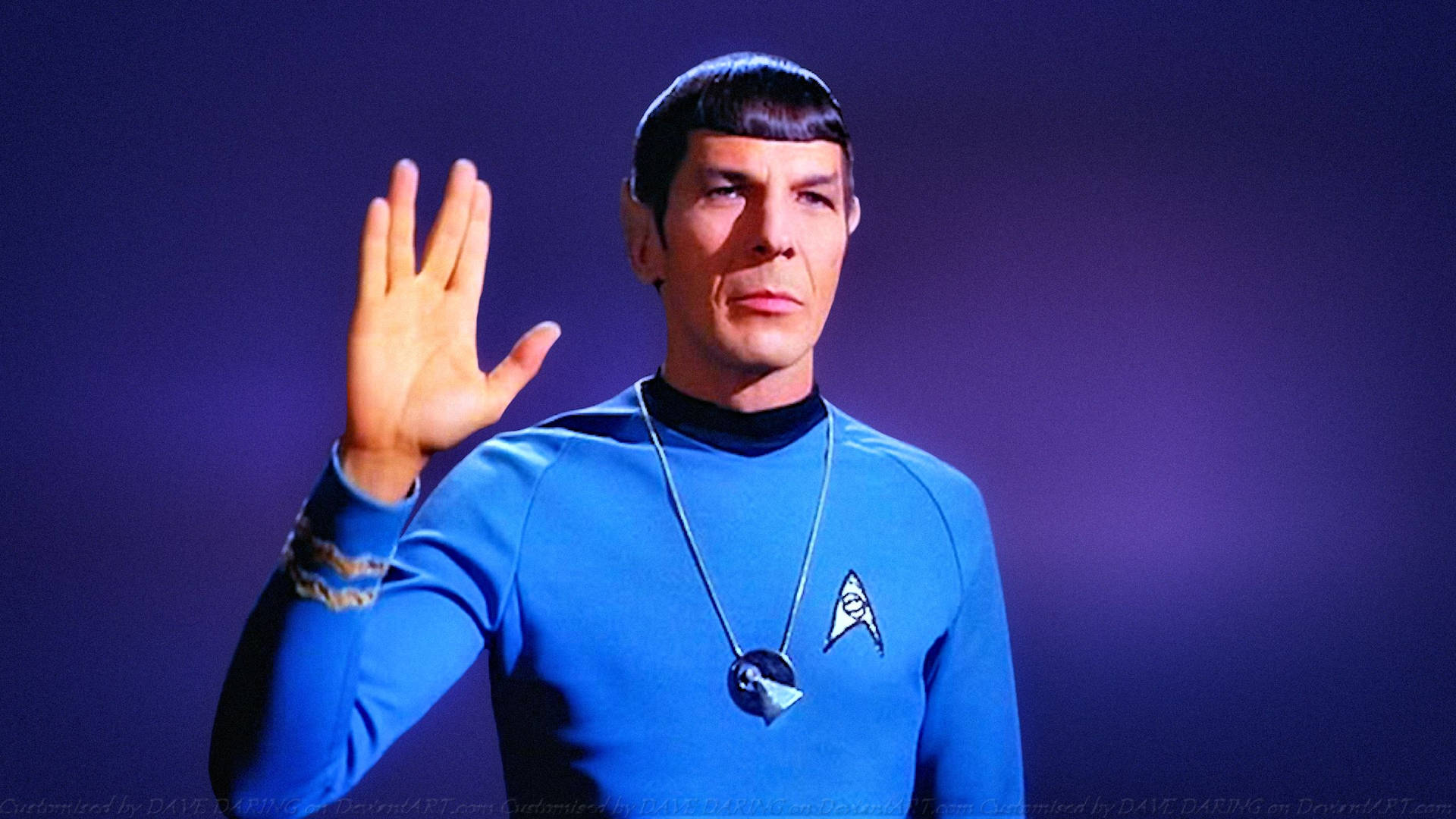
Star Trek's "Spock", played by the Jewish actor Leonard Nimoy

The Birth of 'Live Long and Prosper', 
https://www.youtube.com/watch?v=UdYbpMkH_XQ
"[The sign] came from my childhood, going to synagogue with my family." - Leonard Nimoy

Mork and Mindy, 1978
"Mork" played by Jewish comedic actor Robin Williams

Nanu Nanu, Mork and Mindy Wiki 
https://morkandmindy.fandom.com/wiki/Nanu_nanu

"Nanu nanu (pronounced NAH-noo NAH-noo)...is the typical Orkan greeting. Its usage may be similar to the Hawaiian word "aloha," which may be used as both a greeting and a farewell, since Mork also uses the phrase in his weekly mental reports to Orson.  When meeting new people, the phrase is paired with a Vulcan-style handshake; when addressing another Orkan..."

U. S. President Obama with Star Trek cast member Nichelle Nichols, 2012 (CIA/Mossad operatives)

Nichelle Nichols, Wikipedia:
From 1977 to 2015, she volunteered her time to promote NASA's programs and recruit diverse astronauts...Her brother was a 20 year member of the Heaven's Gate cult [both CIA projects].
She [admittedly had affairs] with both Gene Rodenberry [Jewish creator of Star Trek] and Sammy Davis Jr. [Jewish convert].  She was hired by Hugh (Jew) Hefner as a singer for his Chicago Playboy Club.
Her grandfather was Samuel G. Nichols, a white man who married a black woman, which was taboo at the time.  Her father, Samuel E. Nichols, was the mayor of Robbins, IL.

Obviously, Nichols is from a Jewish family, involved in Intelligence Projects.  The point is, there is an agenda to destroy Christian society, and replace it with an anti-Christian one.  A small part of this has been to get the unsuspecting populace to use this hand sign, which is a repudiation of Christ.

CIA Mossad Pedophile Jew Hugh Hefner, Playboy, Bunny Girls, Staged Chessboard (Tangentially, this video also speaks on the Roman cult of Bacchus.)
https://www.bitchute.com/video/133oHpaokIAF

Heaven's Gate was an Intel Project, Matthis
https://mileswmathis.com/hgate.pdf
Dictionary of American Family Names, 2022
The Meaning of [Surname] Nichols:  2. Americanized form of various like-sounding Jewish surnames.


"Yes, the Vulcan salute is an authentic imitation of the manner by which Cohanim spread their hands in most congregations when blessing the congregation to this day.

Cohanim are those people that today comprise about four to five percent of the Jewish population, all of whom trace their paternal lineage back to Aaron, brother of Moses, who was also the first High Priest. The Cohanim performed the offerings in the Tabernacle and later in the Temple in Jerusalem. They are still afforded certain honors, and they still bless the congregation with exactly the same words with which Aaron blessed us over 3,300 years ago when we finally got the first Tabernacle up and standing...

When the Cohanim bless the people, they stand at the front of the synagogue, face the congregation, cover their faces with their tallit (prayer shawl), and spread out their hands... 

The reason the Cohanim raise and spread out their hands is because that’s just what Aaron did when he blessed us: “And Aaron lifted up his hands towards the people and blessed them…”

But why do they spread their fingers? The Midrash explains that the Shechinah—the divine presence, peers through the fingers of the Cohanim during the priestly blessing, in keeping with the verse, “…behold, He is standing behind our wall, looking from the windows, peering between the cracks.”

...Do that correctly, and you have the original version of what became popularized three thousand years later as the Vulcan salute (just with both hands).

...when the priest raises his hands in blessing...That is the time when the most ancient and concealed is revealed in the small faces, and peace prevails in all."

~~~


1 Thes. 5:2-3  ...the day of the Lord shall so come, as a thief in the night. For when they shall say, peace and security; then shall sudden destruction come upon them...


On the Place of Saint Matthew of Bresthena

...Some Correspondence to Consider, Fr. Mark Smith

https://priest-mark.livejournal.com/2815.html 

Dear Stavros,

Do you have a different version of this story?:

"Knowing the history of a man can always help us understand him more. If one goes to the Holy Mountain, one can find disciples from the line of Vicar-Bishop Matthew. When Vicar-Bishop Matthew was on the Holy Mountain, as a priest, he had a disciple named Fr. Damaskinos, who in turn had a synodia, which now survives in Katounakia, and is led by Fr. Augustine. Father Augustine would relate how his elder, Fr. Damaskinos, explained how the elder Matthew left Mount Athos. This is the story:

When Fr. Matthew was asked to leave Mount Athos for Athens to help in the sacred struggle of the Old Calendarists, he was tormented by this decision, as any Athonite monk would be. The cause was good, but he was an Athonite monk, and if this wasn't the will of God, he could perish. At length he went to his spiritual father, and asked his advice. His spiritual father, in a gentle way, told him 'No', saying, "My son, you have made progress by your monastic life here. You are a priest, and have a disciple, and are able to advance more in the spiritual life. You are a simple man, though, and the world is very complicated. If you leave the Holy Mountain, you will be tricked, and you will fall. Do not leave.

Later, the priest-monk Matthew made his decision, and disobeyed his spiritual father and left Mount Athos for Athens. Any man who wishes can go to the Holy Mountain and check this out themselves from the disciples of Fr. (later-Vicar-Bishop) Matthew. They are still alive. Like so many who have left the Holy Mountain in disobedience, this tells us much about the character of Vicar-Bishop Matthew. He did not believe the monastic axiom: "Obedience is life. Disobedience is death."

Dear Father Mark,

The statement you quoted is clearly falsification and Florinite propaganda. By this time St. Matthew had already been the spiritual father and confessor of three entire Monasteries (Megisti Lavra, Grigoriou and Xenophontos). He did not just have one disciple as the below version of the story stupidly suggests, but he rather had hundreds of spiritual children on Mt. Athos and thousands throughout Greece. Also this Damaskinos they mention was not even one of Bishop Matthew's close spiritual children, and he was a Matthewite for the majority of his life and only became a Florinite in the 1980s. Even still, Damaskinos never slandered Bishop Matthew. I have an open letter written by Damaskinos in which he praises 'Matthew of Bresthena, Germanos of the Cyclades and Chrysostom of Florina' has the three Holy Hierarchs of the 20th Century. In other words, Damaskinos went from being a Matthewite to being an old-calendarist ecumenist, placing truth and falsehood together by imagining that the blaspheming Sergianist Chrysostom of Florina could ever be styled a holy hierarch. The claim that Damaskinos wrote the quoted slander against Bishop Matthew is definitely a Florinite falsification.

More proof that the quote is false is the fact that St. Matthew had already been given the blessing to leave Mt. Athos almost 20 years earlier than the time described in the slanderous story. Around the year 1910, the Sacred Community of Mt. Athos voted St. Matthew to be their representative to the laity of Greece, to preach to them and teach them the ways of piety, for St. Matthew was well known throughout Mt. Athos and Greece as being very holy. He lived in a cave at St. Basil's desert on Athos for several years. He performed miracles and fulfilled prophecies while he was still alive! He was already known during the 1910s as 'O Agıos Pateras,' the Holy Father.

In 1910 he was blessed by the Community of Mt Athos to travel around Greece preaching the Divine Word, like a new St. Kosmas Aitolos. While in Greece he founded a very large Church in Navplion, he built it from scratch, and people throughout Peloponnese would visit his parish to hear him preach and for him to pray for them and heal their sicknesses by God's grace. During this time he also became the Spiritual Father of the Pantanassa Convent in the ancient walled city of Mistras, near Sparta and Bresthena. This Convent is still Matthewite today.

He then founded another large Church and parish in Athens, which is also extant. It was at this time that the Orthodox Christians of Athens experienced his holiness. St. Matthew then became closely acquainted wıth St. Nectarios, and St. Nectarios gave his epigonatıon to St. Matthew as a blessing. This epigonation can be venerated today at Keratea Convent. St. Nectarios also elevated St. Matthew to the rank of Archimandrite.

However, when Metaxakis uncanonically usurped the throne of Athens, and when the persecution against St. Nectarıos began, St. Matthew was disgusted by this and returned to Mt. Athos so he could live ın peace, away from the Church politics. However, he kept in touch with his spiritual children in Greece through letters, many of which are extant.

In 1924 when the new calendar was uncanonically introduced, the zealots of Mt. Athos were LED by St. Matthew, yes, LED BY HIM, because they all acknowledged his spirituality. Also assisting him was the simple monk, Arsenios Kotteas, who agreed with him originally, but later, in the 1940s Arsenios switched over to the Florinites because St. Matthew believed in the sainthood of St. Nectarios, while Chrysostom of Florina and Arsenios Kotteas didn't. Thus the Athonites had been broken into two groups, the Matthewites under St. Matthew who was living in Athens by this time, and the Florinites under the deluded Arsenios Kotteas, who later even left the Florinites and founded a priestless jurisdiction called the Kotteates. This faction still exists today on Athos.

Anyway, St. Matthew was invited to Athens in 1927 not merely to assist the sacred struggle, but to LEAD IT!!! He thus became the LEADER of the Sacred Struggle, and it was under his care that between 1927 and 1935 the Old Calendarists multiplied to include over 800 parishes throughout Greece.

In 1935 Bishops Germanos of Demetrias and Chrysostom of Zakynthos, together with the retired former bishop of Florina, Chrysostom, joined the sacred Struggle. By this time, Chrysostom of Florina was merely a suffragan and could not perform the acts of a bishop because he was retired and did not have a current see. The canons forbid retired bishops from occupying any role in the Synod or from ordaining bishops or even priests, because they are no longer valid bishops after retirement, but only retain the title of former bishop as an act of respect to their person, and are allowed to take part in ecclesiastical acts as witnesses but not as actual performers of the act.

Therefore, when the two bishops and the one FORMER bishop joined the sacred struggle, they read their confession openly before St. Matthew, and it was he, as leader of the Sacred Struggle in Greece and Athos, who received them back into communion with whatever level of priesthood they had prior to their loss of grace in 1924 when they fell into schism. Thus Germanos was received as a Bishop, Chrysostom of Florina was received as a FORMER BISHOP, and Chrysostom of Zaktynthos was received as an Archımandrıte who had been consecrated to the episcopacy by schismatics (he had been consecrated after 1924). Following this Bishop Germanos of Demetrias became the sole canonical active bishop of the G.O.C. He thus assumed the position of President and first-hierarch of the G.O.C. and St. Matthew handed the 800 parishes into Bishop Germanos's care. Immediately after this, on the same day, Bishop Germanos, as a valid acting bishop, together with former bishop Chrysostom of Florina, acting only as a witness, read a cheirothesia on Bishop Chrysostom of Zakynthos and elevated him to the rank of a canonical bishop. These two canonical bishops and the one retired bishop, then consecrated four more bishops. All of the bishops were given ruling diocesan titles and were given different parts of Greece to shepherd.

Germanos of Demetrias was to be commemorated within Thessaly and Macedonia, and Athens only for as long as he was President.

Chrysostom of Florina was retired and therefore was not commemorated in any region unless he was visiting a particular parish. He thus held the rank of merely a suffragan with no diocese and no canonical episcopal rights except for the title 'former metropolitan.'

Chrysostom of Zakynthos was to be commemorated on the Ionian Islands

Germanos of the Cyclades was to be commemorated on the Aegean Islands 

Christopher of Megara was to be commemorated in Western Attica region

Polycarp of Diavlia was to be commemorated in northern Continental Greece (Thebes, Levadıa, Lamia, etc)

Matthew of Bresthena was commemorated in the entire Peloponnese region, where he had previously founded parishes and convents and had a large spiritual following, was well as in Crete, his homeland. He was also commemorated in the three parishes he founded in Athens as well as in the Keratea Convent and Kouvara Monastery in Eastern Attica region. He was given the title Bresthena because this is an ancient title in Peloponnese which is situated in the hill country between Navplion and Mistras, Navplion being where the large Church St. Matthew founded was, and Mistras being where the famous Convent of Panagia Pantanassa was located, both being under his spiritual care. Also, his homeland of Crete, where he also had several spiritual children and at least 20 parishes at this time, is located just across the sea to the south. When Chrysostom of Florina created the Florinite schismato-heresy in 1937, the ENTIRE regions of Peloponnese (Corinth, Patras, Messenia, Sparta, Navplion, Arcadia, Elis) and the island of Crete remained under their canonical ruling bishop, St. Matthew of Bresthena. Thus until the Kallistite schism in 1979, the vast majorıty of Peloponnesian and Cretan Old Calendarists were Matthewites. All of the current Florinite parishes in Peloponnese are those stolen from the Matthewites by Kallistos of Corinth, and later stolen from Kallistos by Kallinikos Sarantopoulos, current bishop of Achaia in the Kiousis Synod.

The bishops consecrated in 1935 were thus by no means suffragans, but ruling bishops. The only suffragan was Chrysostom of Florina himself, who, being retired, was only a former bishop with no canonical rıghts.

When the consecrations of 1935 were announced by the Holy Synod, the first three bishops were only mentioned by name, but when they mentioned Bishop Matthew, they wrote (my paraphrase as I am in Turkey at the moment and do not have the document with me):

'We then consecrated Hieromonk Matthew as Bishop of the once in ancient times glorious diocese of Bresthena, a man well-known for his great piety, much holiness and many spiritual gifts, and for his great service to the Orthodox Church and the Sacred Struggle.'

I also have a letter that Chrysostom of Florina sent to Bishop Matthew in 1935, where Chrysostom praises him continuously. Then suddenly when Chrysostom BETRAYED the Sacred Struggle and began working for the Greek government to submit the old calendarists to the new-calendarist state Church, suddenly the Confessor-Bishop Matthew began to be called unworthy and stupid, and all these lies and slander began on the part of the Florinites. Meanwhile Chrysostom of Florina petitioned for the old calendarists to be forcefully submitted to the state church, for the new calendar to be implemented by force if the synod decided this, for the Keratea Convent to be abolished, and he also praised Stalin and praised Sergius Stragorodsky for his declaration of 1927, and he was also involved with left-wing political parties, and despite the fact that Chrysostom was a TRAITOR, a WOLF IN SHEEP'S CLOTHING and a SERGIANIST to boot, the Florinites lift him up to the seventh heaven, believing that despite all of these heresies, Chrysostom is somehow infallible like some kind of 'old calendar pope'.

Yet whereas St. Matthew held the true confession until his last breath (something Chrysostom FAILED TO DO), past down the apostolic succession to the next generation (something Chrysostom FAILED TO DO), and also guarded the Church from the heresy of Sergianism (something Chrysostom FAILED TO DO), yet they completely turn a blind eye and a deaf ear to St. Matthew's ORTHODOX example, and instead come up with all manner of slander and every kind of lie their demon-possessed minds can conceive.

A lengthy book with all the lives of the new Matthewite Saints will soon be published (there are almost 30 of these new saints). It will include several documents including photocopies of original documents in Greek as well as English translations of the same which will verify EVERY SINGLE STATEMENT MADE ABOVE concerning the holiness of Bishop Matthew as well as EXPOSING the truth about the traitor Chrysostom of Florina with his own words, ı.e., letters Chrysostom of Florina himself had sent to the government, to the state church and to Bishop Matthew and others, proving that Chrysostom of Florina's true desire was to destroy the Sacred Struggle from within.

Unlike the Florinites who cannot find one true fault against Bishop Matthew and therefore resort to LIES and SLANDER that cannot be verified, this book will include ACTUAL DOCUMENTS that prove Chrysostom was a traitor and false-bishop while Bishop Matthew was a True Confessor.

Another interesting note is that the Kiousis Synod's Bishop Kallinikos Sarantopoulos sent a letter to the Matthewite Synod in 1998, in which he writes that he recognizes 'the Matthewite Synod as the true successors of Bishop Matthew, a holy man.' YES!!! A Florinite Bishop, and the most ANTI-MATTHEWITE Bishop among them (!!!), even confesses openly that Bishop Matthew was A HOLY MAN!! Therefore all other Florinites should swallow their tongues before daring to slander St. Matthew the New Confessor.

When the book is published all of these questions will be answered for anyone who reads the documents contained therein.

In Christ,

Stavros


Also See:

The Life of Saint Matthew the New Confessor (1861-1950), Mercian Monks
https://www.youtube.com/watch?v=lbeQtJaFShU