With the Robinson Method, "writing" is pretty straight-forward. The student will:
- learn how to write letters in cursive while learning to spell
- practice penmanship with copywork
- transition to writing a one-page essay each day on any topic
1. PENMANSHIP
Until the 1920's, cursive script was taught to children from the beginning, instead of learning how to print. With the invention of the steel nib ink pen, cursive replaced Roundhand because it was faster. Therefore, it was counterproductive to teach children printing. Learning cursive first has additional benefits, which Stephen Kurkinen at English Streams explains in his instructional videos:
“Handwriting 1: Benefits of Cursive First”
"Handwriting 2: How to Hold a Pencil"
https://www.youtube.com/watch?v=W0ZIKYKWEio
"Handwriting 3: How to Angle Paper"
https://www.youtube.com/watch?v=yQNvWo1VASE
"Handwriting 4: How to Posture Body"
https://www.youtube.com/watch?v=84C34KiP3Bs
"Handwriting 5: How to Write the 26 Letters of the English Alphabet"
https://www.youtube.com/watch?v=OHpSkF5B0ao
Cursive Letter Mastery, free workbook pages
https://www.englishstreams.com/teach-cursive-handwriting/
English Streams, Stephen Kurkinen
https://www.englishstreams.com/start-here/
ABC Journey e-Book and/or Companion Course
"The book covers the Pre-Reading Stage, the Alphabet, Handwriting, Phonics, and Webster's Syllabary and Spelling Sections."
Also see:
“How Should We Teach Our Children to Write? Cursive First, Print Later!” BlumenfeldVideo: “Why Write? Penmanship for the 21st Century,” Weidmann, 2014
Many resources are found on Mr. Don Potter's website (he's the same teacher who re-formatted Webster's Speller):
Don Potter's Handwriting page
http://www.donpotter.net/education_pages/11gth.htmlFundamentals of Cursive Handwriting, Potter
http://www.donpotter.net/pdf/cursive_training.pdfFundamentals of Cursive Training Video, Potter
https://www.youtube.com/watch?v=wlwpgNocon
Really, learning penmanship can simply consist of writing your own letters on paper or a dry erase board, and having your children copy them. You can also create a non-consumable binder filled with copy work pages, as Mrs. Karen Rodriguez explains here:
Penmanship- Spencerian & Robinson Curriculum- FREE RESOURCE- NON-CONSUMABLE, Our House
https://www.youtube.com/watch?v=pmU-6OhNdH0
***Mrs. Rodriguez' website links are no longer available.
You can have your children learn any style of script you choose. Zaner-Bloser is a common, modern script:

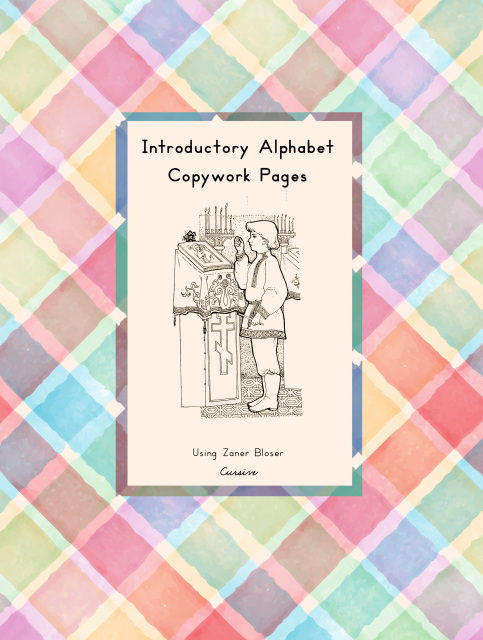
Introductory Alphabet Copywork Pages Using Zaner Bloser Cursive, $10.95
https://www.paideaclassics.org/store/p150/Introductory_Alphabet_Copywork_Pages_Using_Zaner_Bloser_Cursive.html#/Description: Three levels of introductory alphabet copywork for Zaner Bloser Cursive. It can be reproduced for the use of multiple children in a single household. Recommended for kindergarten through first grade. Uses Orthodox illustrations and examples.
Another well-known choice among home school families is Spencerian Script. In the wake of the invention of the steel nib ink pen, Platt R. Spencer (1800-1864), and abolitionist from New York, created a style of script that reflected the art of the Romantic Era, with flowing lines based on a cresting ocean wave.

If you would like to have your children learn Victorian era Spencerian Script, here are some links:
Theory of Spencerian Penmanship, 1874
https://dn790001.ca.archive.org/0/items/TheoryOfSpencerianPenmanship/Theory%20of%20Spencerian%20Penmanship.pdf
Free Set of 71 Spencerian Worksheets
https://drive.google.com/file/d/1r9NMmuyVGr2y9CHuqp-VQqUT__hrLLtl/view
Mott Media has reproduced the original series, if you would like to purchase new books:

Spencerian Penmanship Set (Theory Book and Five Copybooks), $26.99
https://www.mottmedia.com/product-page/spencerian-penmanship-set-six-books
You could also have your child learn a script based on beautiful English Roundhand. In 1812, Teacher and Master Penman John Jenkins developed a simplified method of teaching Roundhand to American children, reducing the alphabet to six basic strokes:
The Art of writing, reduced to a plain and easy system, Jenkins
3 Copperplate Guidelines, The Scratchy Nib
https://thescratchynib.com/blog/free-copperplate-guideline-sheets
Then, in 1877, Thomas Nelson published the Royal Readers series for British schools, which included a new version of round hand script, adapted for the use of the steel pen. Why not have your child learn to write beautifully from the beginning, as children used to?


The Royal Readers, Infant Reader, pp. 59-61
"Exmouth" from DaFont.com, is a downloadable font very similar to The Royal Readers script:
"Exmouth", DaFont.com - free download
This more classical form of script, as well as Spencerian script, works best with a steel tipped fountain pen, since it provides variability in thickness of the pen stroke. In Europe, some children are still taught penmanship using a fountain pens. Here is the disposable pen recommended by Don Potter for beginners:
PILOT Pen 90029 Precise Varsity Pre-Filled Fountain Pens, Medium Point Stainless Steel Nib Black/Blue/Red/Pink/Green/Purple/Turquoise
https://www.amazon.com/PILOT-Pre-Filled-Stainless-Turquoise-90029/dp/B00092PRCA/ref=asc_df_B00092PRCA?tag=bingshoppinga-20&linkCode=df0&hvadid=80401840125200&hvnetw=o&hvqmt=e&hvbmt=be&hvdev=c&hvlocint=&hvlocphy=60635&hvtargid=pla-4584001431069198&psc=1
Children don't need to start with a fountain pen to learn this form of cursive, however. Softer led pencils or flexible felt pens will also work:
Soft Pencils
Video: “Beginners Guide To Doing Calligraphy with a Pencil”, The Happy Ever Crafter
Video: “Drawing Basics: Understanding Pencil Grades”, Leanne Bishop
Koala Tools Bear Claw Pencils (pack of 6) 2B
Felt Brush Pens
Video: “What Pen is This?” - all about felt brush pens
Brush Pens, Black
Paper
Manuscript Tablets - dashed center lines
https://www.dollartree.com/manuscript-tablets-60-sheet/801118
Sketch Pad - medium weight paperComposition Book - wide ruled
Information on Dip Pens
Older, more artistic students may enjoy learning about quill pens, and trying dip pens. Here is an older guide written by the well-known master George Bickham (1684–1758), who also wrote The Universal Penman:
Penmanship made Easy, Bickham https://archive.org/details/georgebickhamspe0000bick/mode/2up
Here is a series, presented by historical re-enactors, about the history of Writing in Colonial America:
Videos: Historical Writing Series, Townsends
Art of Penmaking (How to Make a Quill Pen)https://www.merrycoz.org/parleys/QUILL.xhtml
Video: "How to Use a Dip Pen", Hulan
Video: "How to Prepare a Dip Pen Nib so it Holds a Lot of Ink", Perfect Biscuits
Once you have taught your child to spell and to write his letters, he can begin to use and improve his penmanship and writing skills through copywork. This is part of Ruth Beechick's broader theory of learning language arts the natural way, through reading, narration, copywork and dictation.
"Language Arts the Natural Way: Copying"
https://diyhomeschooler.com/language-arts-the-natural-way-copying/
For his copywork, provide a letter guide your child can refer to. Have him copy words and sentences into his copybook from the text of his reading lesson or the daily synaxarion. He can use loose paper, or a composition book. You can assign prayers, scripture passages, poems, vocabulary words, dictionary excerpts, or whatever you would like him to learn or memorize.
Teaching Bible Memory - free
Parents will check the child's work for errors, making sure he understands how to correct them.
Copybook Resources
Video: “DIY Copybooks for Homeschooling”, Our House
https://www.youtube.com/watch?v=vRHK0kctixY&list=PLxmEpPtGhMZmd81ccs77xdxVsIKN4IsNa&index=8
Copybooks
Using Composition Books
Beginner's Lined Pages in Color, print for free
https://momdelights.com/wp-content/uploads/2017/08/lined-pages-color.pdf
Free Blank Lesson Sheets
23 Unique Note booking Pages, free to print
As the student progresses, have your child copy from dictation, as you slowly read the selection aloud.
Language Arts the Natural Way: Dictation
https://diyhomeschooler.com/language-arts-the-natural-way-dictation/
Proverbs 22:6 Academy - free Copywork pages
Day's of the Month Poem, cursive copy work pages
Three Years with the Poets, Hazard, 1904 ***edit for positive references to fairies, theological errors, etc...
Wheeler's Grades Studies in the Great Authors, 1899 ***edit for positive references to fairies, theological errors, etc...
Older Students
The Young Gentleman and Lady’s Monitor, and English Teacher’s Assistant, Morals & Manners arranged for Copywork, MooreLeaves of Life For Daily Inspiration, SteinmetzThe Polite Lady: or A Course of Female Educationhttps://books.google.com/books?id=E24EAAAAYAAJ&dq=female%20accomplishment&pg=PA3#v=onepage&q&f=falseThe Young Man’s Best Companion, Parkins, 1811
Texts Printed in Roundhand
Webb’s Useful Penmanship, 1796
https://archive.org/details/gri_33125011848302
Art of Penmanship, Huntington, 1821Noye’s Penmanship, 1839
Gentle Grammar 1Gentle Grammar 2Gentle Grammar 3Gentle Grammar 4
Grammar-Land, Nesbitt
https://diyhomeschooler.com/grammar-land-free-ebook-and-go-alongs/
3. ESSAY SKILLS
Once your child has become skilled in copywork and dictation, he is ready to transition to writing essays. Mrs. Karen Rodriguez explains how to transition from Copywork to essays:
“How to Teach your [Children] to Write Essays”, general
"How to Teach a Child to Write An Essay- From Copy Work to Essays 9 Steps"
"Transform Your Child's Writing Skills" - help your child enjoy writing
Textbooks
Upper Elementary Level (12+)
Here is a textbook that is meant to follow Wheeler's Grades Studies in the Great Authors (See above). It utilizes classic literature passages to teach lessons in both grammar and composition:
Wheeler's Graded Studies in English, First Lessons in Grammar and Composition, 1899
Learning Essay Writing, Short Story Writing, Poetry Pointers, Three Booklet Set, $8.00
Cultivating Composition Skills, Martin, $3.25
High School Level
How to Write Better Essays, Greethampreview: