
A Short History of Mary's Psalter
By the 4th century, the ascetic monks of the Egyptian Thebaid were praying 150 Angelic Salutations, or "Rejoice Mary's", consisting of passages taken from St. Luke's gospel (Luke 1:28; 42), following the pattern of the 150 Psalms. First attributed to St. Pachomios, Mary's Psalter, by the 8th Century in the British Isles, Mary's Psalter came to be called the “Rosary”, or “Garland of Roses”. Originally, this veneration of the Mother of God, the Theotokos, did not include meditations, since the use of one's imagination has always been discouraged by the Church Fathers. As the "Rosary" developed later in the apostate west, the use of the imagination was then encouraged. By the 15th century, the "joyful", "sorrowful" and "glorious" mysteries were introduced which promoted the rising heresies of the west, and encouraged men to fall into prelest. Prelest is a state of spiritual delusion due to pride. In this state, one might believe he has received visions of angels or revelations from God, when he actually has been deceived, either by a demon, or simply by his own imagination.
The ancient Latin/Celtic "Hail Mary" was recited as:
O Hail! Virgin Mother of God! Mary, full of Grace, the Lord is with thee. Blessed art thou amongst women, and blessed is the fruit of thy womb, for thou hast given birth to the Savior of our souls!
The Byzantine prayer is this:
Rejoice! O Virgin Theotokos! Mary, full of Grace, the Lord is with thee. Blessed art thou amongst women, and blessed is the fruit of thy womb, for thou hast borne the Savior of our souls!
Clearly, they are very similar, however Gabriel's greeting in the original Greek passage of Luke 1:28 is:
Χαῖρε, κεχαριτωμένη! (Chaire, kecharitomeni!)
Rejoice, (you) favored with grace!
In the Latin, it was translated as:
Ave gratia plena.
Hail, full of grace.
Seemingly lost in translation, the greeting "Hail" connotes Roman sovereignty, whereas "Rejoice" emphasizes what God has done for and through Our Lady, which is echoed in her "Magnificat":
Luke 1:46-55 ...My soul doth magnify the Lord. And my spirit hath rejoiced in God my Saviour. Because he hath regarded the humility of his handmaid; for behold from henceforth all generations shall call me blessed. Because the that is mighty, hath done great things to me; and holy is his name...
After the west fell away into heresy in the 11th century, the prayer was gradually changed to:
Hail Mary, full of grace; the Lord is with thee. Blessed art thou amongst women, and blest is the fruit of thy womb, Jesus. Holy Mary, Mother of God, pray for us sinners, now, and at the hour of our death.
This alteration removed the last part of the long-standing prayer:
...for thou hast given birth to the Savior of our souls!
In doing so, the significance of the virgin birth was deemphasized, making way for the heresy of the Immaculate Conception which attributes false glory to Mary. See:
...This striving towards the deification of the Mother of God is to be observed primarily in the West, where at the same time, on the other hand, various sects of a Protestant character are having great success...in general deny the veneration of the Mother of God and the calling upon Her in prayer...
“There is an equal harm in both these heresies, both when men demean the Virgin and when, on the contrary, they glorify Her beyond what is proper” (St. Epiphanius of Cyprus, “Against the Collyridians”).
“One Man alone, the Intermediary between God and man, is free from the bonds of sinful birth, because He was born of a Virgin, and because in being born He did not experience the touch of sin” (St. Ambrose, Against Julian, Book 2).
...Such a “vain deceit” is the teaching of the Immaculate Conception by Anna of the Virgin Mary, which at first sight exalts, but in actual fact belittles Her. Like every lie, it is a seed of the “father of lies” (John 8:44), the devil, who has succeeded by it in deceiving many who do not understand that they blaspheme the Virgin Mary.
As for the sanctification of the Theotokos, we can look to her Old Testament typos, the Ark of the Covenant, which was covered in purest gold; even so, it was glorious, not so much because of its materials, but because of the Presence of God:
Similarly, the true Ark, the Virgin Mary, who carefully guarded the purity of her virginity, was sanctified by the Presence of Christ at His Incarnation:Ex. 40:29 And Moses was not able to enter into the tabernacle of testimony, because the cloud overshadowed (ἐπεσκίαζεν) it, and the tabernacle was filled with the glory of the Lord.
Luke 1:35 And the angel answered and said to her, “The Holy Spirit will come upon you, and the power of the Highest will overshadow (ἐπισκιάσει) you; therefore, also, that Holy One who is to be born will be called the Son of God.”
Orthodox Veneration of the Mother of God, Ch. 7:
The Orthodox Church teaches about the Mother of God that which Sacred Tradition and Sacred Scripture have informed concerning her, and daily it glorifies her in its temples, asking her help and defense. Knowing that she is pleased only by those praises which correspond to her actual glory, the Holy Fathers and hymn-writers have entreated her and her Son to teach them how to hymn her:Ikos of the Dormition
Set a rampart about my mind, 0 my Christ, for I make bold to sing the praise of Thy pure Mother.
Irmos of the 9th Canticle, Service of the Theophany
Every tongue is at a loss to praise Thee as is due; even a spirit from the world above is filled with dizziness, when it seeks to sing Thy praises, 0 Theotokos. But since Thou art good, accept our faith. Thou knowest well our love inspired by God, for Thou art the Protector of Christians, and we magnify Thee.
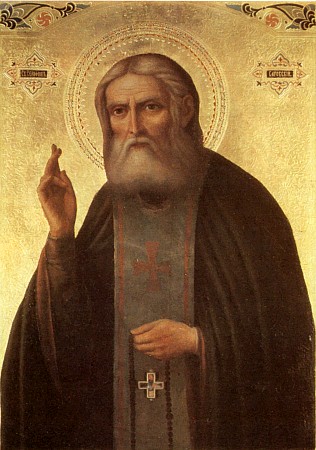
+Glory to Thee, our God, Glory to Thee.O Heavenly King, Comforter, the Spirit of Truth, Who art everywhere present and fillest all things, the Treasury of good things and Giver of life: Come, and abide in us, and cleanse us from every stain, and save our souls, O Good One.+Holy God, Holy Mighty, Holy Immortal: have mercy on us. (3 times)+Glory to the Father, and to the Son, and to the Holy Spirit, both now and ever, and unto the ages of ages. Amen.All-Holy Trinity, have mercy on us. Lord, cleanse us from our sins. Master, pardon our iniquities. Holy God, visit and heal our infirmities for Thy name's sake.Lord, have mercy. (3 times)+Glory to the Father, and to the Son, and to the Holy Spirit, both now and ever, and unto the ages of ages.Our Father, who art in Heaven, hallowed be Thy name. Thy Kingdom come, Thy will be done, on earth as it is in heaven. Give us this day our daily bread, and forgive us our trespasses as we forgive those who trespass against us; and lead us not into temptation, but deliver us from the evil one.For Thine is the Kingdom, and the power, and the glory, of the +Father, and of the Son, and of the Holy Spirit, now and ever and unto ages of ages. Amen.
“O Theotokos and Virgin, rejoice, Mary, full of grace, the Lord is with thee; blessed art thou among women, and blessed is the Fruit of thy womb, for thou hast borne the Savior of our souls.”
Our Father, Who art in heaven! Hallowed be Thy name, Thy kingdom come, Thy will be done, on earth as it is in heaven. Give us this day our daily bread, and forgive us our debts, as we forgive our debtors; and let us not fall into temptation, but deliver us from the evil one.
And:
Open to us the gate of compassion, O blessed Theotokos. Let not our hope in thee miss the mark; by means of thee may we be rescued from adversities! For thou art the salvation of the Christian race.
Closing prayer:
+Glory to the Father, and to the Son, and to the Holy Spirit, both now and ever, and unto the ages of ages. Amen.