Pages

Monday, September 30, 2024

Bishop Paul: My Exodus

Here is an account that some may find helpful.  It's free to read on-line:

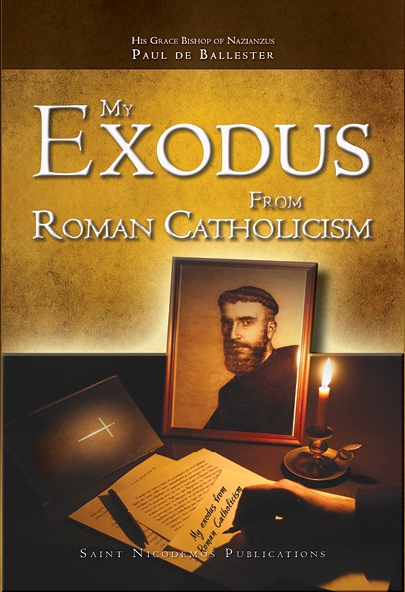
My Exodus From Roman Catholicism, Bp. Paul of Nazianzus
https://oodegr.com/english/biblia/Ballester/perieh.htm

In the cover-page picture, young Fransiscus 
is depicted as a Capuchin monk of the order of St. Francis

© 2011 by St. Nicodemos Publications/Constantine Zalalas All rights reserved
Publisher in Greek: The Holy Royal & Stavropegial Monastery Maheras, Cyprus
Original title:  Ή μεταστροφή μου στην Όρθοδοξία
Translation: Constantine Zalalas
Editing: Eleftheria Kaimakliotis, Marie Eliades, Madalina Reznic, Tatiana Tsakiropoulou-Summers
Publisher in English: Saint Nicodemos Publications Bethlehem, PA www.saintnicodemos.org
ISBN: 0-9831396-0-7
(Book reproduced with kind permission for the website)

Contents:

  • Foreword to the Greek Edition
  • A word to the reader
  • Ch. 1:The First Doubts
  • Ch. 2: Spiritual Counsel
  • Ch. 3:The Monarchy of the Pope
  • Ch. 4: "You are Peter..."
  • Ch. 5: The Beginning of the Dispute
  • Ch. 6: "Come Out of Her, My People..."
  • Ch. 7: Toward the Light
  • Ch. 8: My Encounter with the Truth 
  • Appendix I: Necrology

Appendix II: Photographs


Tuesday, September 17, 2024

One, Holy, Catholic, Apostolic Church

The Longer Catechism of St Philaret of Moscow (1823)

I.5. The Composition of the Catechism.

62. What may be a good order for setting forth a catechetical instruction in religion?
For this we may follow the book of the Orthodox Confession, approved by the Eastern Patriarchs, and take as our basis the saying of the Apostle Paul, that the whole energies of a Christian, during this present life, consist in these three: faith, hope, charity. 
And now abideth faith, hope, charity; these three. (1 Cor. 13.13)
And so the Christian needs: First, Doctrine on faith in God, and on the Sacraments which he reveals; Secondly, Doctrine on hope towards God, and on the means of being grounded in it; Thirdly, Doctrine on love to God, and all that he commands us to love.

63. What does the Church use as her instrument to introduce us to the doctrine of faith?
The Creed.

64. What may we take as a guide for the doctrine of hope?
Our Lord’s Beatitudes and the Lord’s Prayer.

65. Where may we find the elements of the doctrine of charity?
In the Ten Commandments of the Law of God.

II. On Faith.

II.1. On the Creed generally, and on its Origin.
66. What is the Creed?
The Creed is an exposition, in few but precise words, of that doctrine which all Christians are bound to believe.

67. What are the words, of this exposition?
They are as follows:
  1. I believe in one God the Father, Almighty, Maker of heaven and earth, and of all things visible and invisible;
  2. And in one Lord Jesus Christ, the Son of God, the only-begotten, begotten of the Father before all worlds, Light of light, very God of very God, begotten, not made, of one substance with the Father, by whom all things were made;
  3. Who for us men, and for our salvation, came down from heaven, and was incarnate of the Holy Ghost, and of the Virgin Mary, and was made man;
  4. And was crucified for us, under Pontius Pilate, and suffered, and was buried;
  5. And rose again the third day according to the Scripture;
  6. And ascended into heaven, and sitteth on the right hand of the Father;
  7. And he shall come again with glory to judge the quick and the dead, whose kingdom shall have no end.
  8. And I believe in the Holy Ghost, the Lord, the Giver of life, who proceedeth from the Father, who with the Father and the Son together is worshiped and glorified, who spake by the Prophets.
  9. I believe one Holy, Catholic, and Apostolic Church.
  10. I acknowledge one baptism for the remission of sins.
  11. I look for the resurrection of the dead;
  12. And the life of the world to come. Amen.
68. From whom have we this exposition of the faith?
From the Fathers of the first and second œcumenical Councils.

69. What is an œcumenical Council?
An assembly of the Pastors and Doctors of the Catholic Church of Christ, as far as possible, from the whole world, for the confirmation of true doctrine and holy discipline among Christians.

70. How many œcumenical Councils have there been?
Seven: 1, Of Nicæa; 2, Of Constantinople; 3, Of Ephesus; 4, Of Chalcedon; 5, The second of Constantinople; 6, The third of Constantinople; 7, The second of Nicaea.

71. Whence is the rule for assembling Councils?
From the example of the Apostles, who held a Council in Jerusalem (Acts 15). This is grounded also upon the words of Jesus Christ himself, which give to the decisions of the Church such weight that whosoever disobeys them is left deprived of grace as a heathen. But the mean, by which the œcumenical Church utters her decisions, is an œcumenical Council.
Tell it unto the Church; but if he neglect to hear the Church, let him be unto thee as a heathen man and a publican. (Matt. 18.17)
72. What were the particular occasions for assembling the first and second œcumenical Councils, at which the Creed was defined?

The first was held for the confirmation of the true doctrine respecting the Son of God, against the error of Arius, who thought unworthily of the Son of God; the second, for the confirmation of the true doctrine respecting the Holy Ghost, against Macedonius, who thought unworthily of the Holy Ghost.

73. Is it long ago that these Councils were held?
The first was held in the year 325 from the birth of Christ; the second in 381.

II.2. On the Articles of the Creed. 

74. What method shall we follow in order the better to understand the œcumenical Creed?
We must notice its division into twelve articles or parts, and consider each article separately.

II.11. On the Ninth Article. 

252.  What is the Church?
The Church is a divinely instituted community of men, united by the orthodox faith, the law of God, the hierarchy, and the Sacraments.

253.  What is it to believe in the Church?
It is piously to honour the true Church of Christ, and to obey her doctrine and commandments, from a conviction that grace ever abides in her, and works, teaches, and governs unto salvation, flowing from her one only everlasting Head, the Lord Jesus Christ.

254.  How can the Church, which is visible, be the object of faith, when faith, as the Apostle says, is the evidence of things not seen?
First, though the Church be visible, the grace of God, which dwells in her, and in those who are sanctified in her, is not so; and this it is which properly constitutes the object of faith in the Church.
Secondly, the Church, though visible so far as she is upon earth, and contains all Orthodox Christians living upon earth, still is at the same time invisible, so far as she is also partially in heaven, and contains all those that have departed hence in true faith and holiness.

255.  On what may we ground the idea that the Church is at once upon earth and in heaven?
On the following words of the Apostle Paul, addressed to Christians: Ye are come unto Mount Sion, and unto the city of the living God, the heavenly Jerusalem, and to an innumerable company of angels, to the general assembly and Church of the first-born, which are written in heaven, and to God the Judge of all, and to the spirits of just men made perfect, and to Jesus Christ the Mediator of the new covenant (Heb. 12.22–24).

256.  How are we assured that the grace of God abides in the true Church?
First, by this: that her Head is Jesus Christ, God and man in one person, full of grace and truth, who fills his body also, that is, the Church, with like grace and truth (John 1.14, 17).
Secondly, by this: that he has promised his disciples the Holy Ghost to abide with them forever, and that, according to this promise, the Holy Ghost appoints the pastors of the Church (John 14.16).
The Apostle Paul says of Jesus Christ, that God the Father gave him to be head over all things to the Church, which is his body. (Eph. 1.22–23). The same Apostle says to the pastors of the Church: Take heed therefore unto yourselves, and to all the flock, over which the Holy Ghost hath made you Bishops, to feed the Church of our Lord and God, which he hath purchased with his own blood (Acts 22.28).

257.  How are we further assured that the grace of God abides in the Church even till now, and shall abide in it to the end of the world?
Of this we are assured by the following sayings of Jesus Christ himself and his Apostle: I will build my Church, and the gates of hell shall not prevail against it (Matt. 16.18). I am with you alway, even unto the end of the world. Amen (Matt. 28.20). Unto him, God the Father, be glory in the Church by Christ Jesus throughout all ages, world without end. Amen (Eph. 3.21).

258.  Why is the Church one?
Because she is one spiritual Body, has one Head, Christ, and is animated by one Spirit of God. There is one body and one Spirit, even as ye are called in one hope of your calling; one Lord, one faith, one baptism, one God and Father of all (Eph. 4.4–6).

259.  Are we still more expressly assured that Jesus Christ is the one only Head of the one Church?
The Apostle Paul writes, that for the Church, as the building of God, other foundation can no man lay than that is laid, which is Jesus Christ (1 Cor. 3.10–11). Wherefore the Church, as the Body of Christ, can have no other Head than Jesus Christ.
The Church, being to abide through all generations of time, needs also an ever-abiding head; and such is Jesus Christ alone.
Wherefore, also, the Apostles take no higher title than that of ministers of the Church (Col. 1.24–25).

260.  What duty does the unity of the Church lay on us?
That of endeavoring to keep the unity of the Spirit in the bond of peace (Eph. 4.3).

261.  How does it agree with the unity of the Church, that there are many separate and independent churches, as those of Jerusalem, Antioch, Alexandria, Constantinople, Russia?
These are particular churches, or parts of the one Catholic Church: the separateness of their visible organization does not hinder them from being all spiritually great members of the one body of the Universal Church, from having one Head, Christ, and one spirit of faith and grace. This unity is expressed outwardly by unity of Creed, and by communion in prayer and Sacraments.

262.  Is there likewise unity between the Church on earth and the Church in heaven?
Doubtless there is, both by their common relation to one Head, our Lord Jesus Christ, and by mutual communion with one another.

263.  What means of communion has the Church on earth with the Church in heaven?
The prayer of faith and love. The faithful who belong to the Church militant upon earth, in offering their prayers to God, call at the same time to their aid the saints who belong to the Church in heaven; and these, standing on the highest steps of approach to God, by their prayers and intercessions purify, strengthen, and offer before God the prayers of the faithful living upon earth, and by the will of God work graciously and beneficently upon them, either by invisible virtue, or by distinct apparitions, and in divers other ways.

264.  On what is grounded the rule of the Church upon earth to invoke in prayer the saints of the Church in heaven?
On a holy tradition, the principle of which is to be seen also in holy Scripture. For instance, when the Prophet David cries out in prayer, O Lord God of Abraham, Isaac, and of Israel our fathers, he makes mention of saints in aid of his prayer, exactly as now the Orthodox Church calls upon Christ our true God, by the prayers of his most pure Mother and all his saints. See 1 Chr. 29.18.
Cyril of Jerusalem, in his explanation of the divine Liturgy, says: We make mention also of those who are before departed, first, of the Patriarchs, Prophets, Apostles, and Martyrs, that by their entreaties and intercession God may receive our prayers (Myst. 5.9).
Basil the Great, in his sermon on the day of the Forty Holy Martyrs, says: Whoever is afflicted has recourse to the Forty, and whoever is joyful runs to the same; the one that he may find relief from his sorrows, the other that he may keep his happiness. Here the pious wife is to be seen praying for her children; another asks the return of her absent husband; another the restoration of health to the sick. Yes; let your petitions be with the Martyrs.

265.  Is there any testimony of holy Scripture to the mediatory prayer of the saints in heaven?
The Evangelist John, in the Revelation, saw in heaven an angel, to whom was given much incense, that he should offer it, by the prayers of all saints, upon the golden altar which was before the throne; and the smoke of the incense ascended up by the prayers of the saints out of the hands of the angel before God (Rev. 8.3–4).

266.  Is there any testimony of holy Scripture to beneficent apparitions of saints from heaven?
The Evangelist St. Matthew relates that after the death of our Lord Jesus Christ upon the cross, many bodies of the saints which slept arose, and came out of the graves, after his resurrection, and went into the holy city, and appeared unto many (Matt. 27.52–53). And since a miracle so great could not be without some adequate end, we must suppose that the saints which then arose appeared for this, that they might announce the descent of Jesus Christ into hell, and his triumphal resurrection; and so move men born in the Church of the Old Testament to pass over the more readily into that of the New, then opened.

267.  What testimonies are there to confirm us in the belief that the saints, after their departure, work miracles through certain earthly means?
The second (fourth in the Greek) book of Kings testifies that by touching the bones of the Prophet Elisha a dead man was raised to life (2 Kings 13.21).
The Apostle Paul not only in his own immediate person wrought healings and miracles, but the same was done also in his absence by handkerchiefs and aprons taken from his body (Acts 19.12). By this example we may understand that the saints, even after their deaths, may in like manner work beneficently through earthly means, which have received from them holy virtue.
Gregory the Theologian, in his first discourse against Julian, says: Thou wast not abashed by the sacrifices offered for Christ, nor didst fear the great athletes, John, Peter, Paul, James, Stephen, Luke, Andrew, Thecla, and the rest, who before and after these suffered for the truth; who withstood both fire and sword, the torturers, and all sufferings present or threatened, as if their bodies were not their own, or they had had no bodies at all. For what? That they might not, so much as by a word, betray their religion. To whom also great honours and triumphs are with just reason awarded: by whom devils are expelled and diseases healed: who appear in visions, and prophecy: whose very bodies, though separate, when touched or reverenced, have like power with their holy souls; and drops of whose blood, those least tokens of their suffering, like power with their bodies.
John Damascene writes thus: The relics of the saints have been given us by our Lord Jesus Christ as salutary springs, from which manifold blessings flow. And as if in explanation of this, he remarks, that through the mind their bodies also were inhabited of God (Theol. 4.15.3–4).

268.  Why is the Church holy?
Because she is sanctified by Jesus Christ through his passion, through his doctrine, through his prayer, and through the Sacraments. Christ loved the Church, and gave himself for it; that he might sanctify it, having cleansed it with the washing of water by the Word, that he might present it to himself a glorious Church, not having spot, or wrinkle, or any such thing, but that it should be holy, and without blemish (Eph. 5.25–27).
In his prayer to God the Father for believers, Jesus Christ said among other things: Sanctify them through thy truth: thy Word is truth. And for their sakes I sanctify myself, that they also may be sanctified in truth (John 17.17, 19).
269.  How is the Church holy, when she has in her sinners?
Men, who sin, but purify themselves by true repentance, hinder not the Church from being holy; but impenitent sinners, either by the visible act of Church authority, or by the invisible judgment of God, are cut off from the body of the Church; and so she is, in respect of these, also kept holy.
Put away from among yourselves that wicked person (1 Cor. 5.13). Nevertheless the foundation of God standeth sure, having this seal: The Lord knoweth them that are his. And, Let every one that nameth the name of Christ depart from iniquity (2 Tim. 2.19).

270.  Why is the Church called Catholic, or, which is the same thing, Universal?
Because she is not limited to any place, nor time, nor people, but contains true believers of all places, times, and peoples.
The Apostle Paul says that the Word of the Gospel is in all the world; and bringeth forth fruit (Col. 1.5–6), and that in the Christian Church there is neither Greek nor Jew, circumcision nor uncircumcision, barbarian nor Scythian, bond nor free: but Christ is all, and in all (Col. 3.11). They which be of faith, are blessed with faithful Abraham (Gal. 3.9).

271.  What great privilege has the Catholic Church?
She alone has the sublime promises that the gates of hell shall not prevail against her; that the Lord shall be with her even to the end of the world; that in her shall abide the glory of God in Christ Jesus throughout all generations forever; and consequently that she shall never apostatize from the faith, nor sin against the truth of the faith, or fall into error.
We undoubtingly confess, as sure truth, that the Catholic Church can not sin, nor err, nor utter falsehood in place of truth; for the Holy Ghost, ever working through his faithful ministers the fathers and doctors of the Church, preserves her from all error (Encyclical of the Eastern Patriarchs on the Orthodox Faith, Art. 12).

272.  If the Catholic Church contains all true believers in the world, must we not acknowledge it to be necessary for salvation that every believer should belong to her?
Exactly so. Since Jesus Christ, in the words of St. Paul, is the Head of the Church, and he is the Saviour of the Body, it follows that, to have part in his salvation, we must necessarily be members of his body, that is, of the Catholic Church (Eph. 5.23).
The Apostle Peter writes that baptism saveth us after the figure of the ark of Noah. All who were saved from the general deluge were saved only in the ark; so all who obtain everlasting salvation obtain it only in the one Catholic Church.

273.  What thoughts and remembrances should we associate with the name of the Eastern Church?
In Paradise, planted in the East, was founded the first Church of our parents in innocence; and in the East, after the fall, was laid a new foundation of the Church of the redeemed, in the promise of a Saviour. In the East, in the land of Judæa, our Lord Jesus Christ, having finished the work of our salvation, laid the foundation of his own proper Christian Church: from thence she spread herself over the whole universe; and to this day the orthodox Catholic œcumenical faith, confirmed by the seven œcumenical Councils, is preserved unchanged in its original purity in the ancient Churches of the East, and in such as agree with them, as does by God’s grace the Church of Russia.

274.  Why is the Church called Apostolic?
Because she has from the Apostles, without break or change, both her doctrine and the succession of the gifts of the Holy Ghost, through the laying on of consecrated, hands. In the same sense the Church is called also Orthodox, or Rightly-believing.
Ye are no more strangers and foreigners, but fellow-citizens with the saints, and of the household of God, and are built on the foundation of the Apostles and Prophets, Jesus Christ himself being the chief corner-stone (Eph. 2.19–20).

275.  What does the Creed teach us, when it calls the Church Apostolic?
It teaches us to hold fast the Apostolical doctrine and tradition, and eschew such doctrine and such teachers as are not warranted by the doctrine of the Apostles.
The Apostle Paul says: Therefore, brethren, stand fast, and hold the traditions which ye have been taught, whether by word or our epistle (2 Thes. 2.15). A man that is a heretic after the first and second admonition reject (Tit. 3.10). For there are many unruly, vain talkers and deceivers, especially they of the circumcision, whose mouths must be stopped; who subvert whole houses, teaching things which they ought not, for filthy lucre’s sake (Tit. 1.10–11). But if thy brother neglect to hear the Church, let him be to thee as a heathen man and a publican (Matt. 18.17).

276.  What ecclesiastical institution is there through which the succession of the Apostolical ministry is preserved?
The ecclesiastical Hierarchy.

277.  Whence originates the Hierarchy of the Orthodox Christian Church?
From Jesus Christ himself, and from the descent of the Holy Ghost on the Apostles; from which time it is continued, in unbroken succession, through the laying on of hands, in the Sacrament of Orders. And he gave some, Apostles; and some, Prophets; and some, Evangelists; and some, Pastors and Teachers; for the perfecting of the saints, for the work of the ministry, for the edifying of the Body of Christ (Eph. 4.11–12).

278.  What hierarchical authority is there which can extend its sphere of action over the whole Catholic Church?
An œcumenical Council.

279.  Under what hierarchical authority are the chief divisions of the Catholic Church?
Under the Orthodox Patriarchs and the Most Holy Synod.

280.  Under what ecclesiastical authority are lesser orthodox provinces and cities?
Under Metropolitans, Archbishops, and Bishops.

281.  What rank in the Hierarchy is held by the Most Holy Russian Synod?
The same rank with the Most Holy Orthodox Patriarchs. (See the Letters of the M. H. Patriarchs on the institution of the M. H. Synod.)

282.  If any one desire to fulfill his duty of obedience to the Church, how may he learn what she requires of her children?
This may be learned from holy Scripture, from the canons of the holy Apostles, the holy œcumenical and provincial Councils, and the holy Fathers, and from the books of Ecclesiastical Rules and Rubrics.

~~~

Additional teaching from:

The Christian Catechism of Metropolitan Anthony 

Ninth Article of the Creed

[ed.: against the modern heresies of Ecumenism, Florinism and Cyprianism - which say heretics or schismatics are part of the Church in some way.]

Q. Then, can it be accepted that a division of the Church has ever occurred or will occur, or a separation of churches?
A. In no case. From a single indivisible Church, heretics and schismatics separated or fell away at different times and through that ceased to be members of the Church, and the Church cannot lose her unity, according to the words of the Savior.

[ed.:  against "the papacy" heresy]

Q. What must be said about the teaching which, based on the oneness of the high priest of the old covenant, wants to see a similar single high priest (pope) in the new testament Church?
A. This teaching is not false, but the Holy Scriptures are clear about who will replace the Old Testament high priests: none other than the Lord Jesus Christ. “And they on the one hand who have become priests are many, being hindered from continuing by reason of death; but He on the other hand, because He abideth forever, hath the intransitive priesthood” (Heb. 7:23-24).

Q. How can we be sure that Jesus Christ is the only head of the one Church?
A. The Apostle Paul writes that for the Church, as the building of God, “No one is able to lay any other foundation beside the One being laid, Who is Jesus Christ” (1 Cor. 3:11). Therefore, for the Church, as the body of Christ, there cannot be another head besides Jesus Christ.
The Church as it must abide in all generations of the age, requires also a head that is always abiding; and such is the one Jesus Christ. For this reason, the apostles are called no more than ministers of the Church (see Col. 1:24-25).

Q. And what should one answer those who disagree thus: “Jesus Christ ascended to the heavens, but the Church needs a physical high priest here on earth leading men to God”?
A. This idea is utterly refuted in the following words of the apostle: “Wherefore He is also able to save to the uttermost those who come to God through Him, since He ever liveth to intercede on their behalf” (Heb. 7:25). From here it is clear that the above objection is based on lack of faith in Christ as the Pilot of the Church.

[ed.:  against the anathematized "new" calendar, which attempts to divide, not only earthly churches, but the unity of prayer between earth and heaven]

Q. What means of communion does the Church on earth have with the one in heaven?
A. The prayer of faith and love. The faithful, belonging to the Church on earth, while bringing prayer to God, at the same time are calling upon the help of the saints belonging to the heavenly Church; and this Church, enjoying higher degrees of boldness towards God, through their mediating prayers cleanse, strengthen, and bring before God the prayers of the faithful living on earth; and by the will of God, they act on them graciously and beneficially either by an unseen power, or through their revelations, or through some other means.

Q. What is the basis of the rule for the Church on earth that it must call upon the saints in prayer?
A. Sacred Tradition, the foundations of which are visible even in Scripture.


Sunday, September 8, 2024

The Bishop

Those who propose a thousand year apostasy of the Church's hierarchy, because Rome departed from the Faith, are denying the permanency of what Christ has established for the salvation of souls.


Decree X
We believe that what is called, or rather is, the Holy Catholic and Apostolic Church in which we have been taught to believe, contains generally all the Faithful in Christ, who, being still on their pilgrimage, have not yet reached their home in the Fatherland. But we do not in any wise confound this Church which is on its pilgrimage with that which is in the Fatherland, because it may be, as some of the heretics say, that the members of the two are sheep of God, the Chief Shepherd (Ps. 94:7), and hallowed by the same Holy Spirit. For that is absurd and impossible, since the one is yet militant, and on its journey; and the other is triumphant, and settled in the Fatherland, and has received the prize.  Of which Catholic church, since a mortal man cannot universally and perpetually be head, our Lord Jesus Christ Himself is head, and Himself holding the rudder is at the helm in the governing of the Church, through the Holy Fathers. And, therefore, over particular Churches, that are real Churches, and consist of real members (of the Catholic Church), the Holy Spirit has appointed Bishops as leaders and shepherds, who being not at all by abuse, but properly, authorities and heads, look unto the Author and Finisher of our Salvation (Heb. 2:10; 12:2), and refer to Him what they do in their capacity of heads forsooth.

But forasmuch as among their other impieties, the Calvinists have fancied this also, that the simple Priest and the High Priest (Bishop) are perhaps the same; and that there is no necessity for High Priests, and that the Church may be governed by some Priests; and that not a High Priest (only), but a Priest also is able to ordain a Priest, and a number of Priests to ordain a High Priest. They affirm in lofty language that the Eastern Church assents to this wicked notion — for which purpose the Tenth Chapter was written by Cyril [fabricated writing of the Calvinists]— we explicitly declare according to the mind which has obtained from the beginning in the Eastern Church: 

That the dignity of the Bishop is so necessary in the Church, that without him, neither Church nor Christian could either be or be spoken of. For he, as a successor of the Apostles, having received in continued succession by the imposition of hands and the invocation of the All-holy Spirit the grace that is given him of the Lord of binding and loosing, is a living image of God upon the earth, and by a most ample participation of the operation of the Holy Spirit, who is the chief functionary, is a fountain of all the Mysteries (Sacraments) of the Catholic Church, through which we obtain salvation.

And he is, we suppose, as necessary to the Church as breath is to man, or the sun to the world. It has also been elegantly said by some in commendation of the dignity of the High Priesthood, “What God is in the heavenly Church of the first-born, (Heb. 12:23) and the sun in the world, that every High Priest is in his own particular Church, as through him the flock is enlightened, and nourished, and becomes the temple of God.” (Eph. 2:21)

And that this great mystery and dignity of the Episcopate hath descended unto us by a continued succession is manifest. For since the Lord has promised to be with us always (Matt. 28:20), although He is with us by other means of grace and Divine operations, yet in a more eminent manner does He, through the Bishop as chief functionary, make us His own and dwell with us, and throug h the divine Mysteries is united with us; of which the Bishop is the first minister, and chief functionary, through the Holy Spirit, and suffer us not to fall into heresy.  And, therefore [John] of Damascus, in his Fourth Epistle to the Africans, said that the Catholic Church is everywhere committed to the care of the Bishops; and that Clement the first, Bishop of the Romans, and Evodius at Antioch, and Mark at Alexandria, were successors of Peter is acknowledged.  Also that the divine Andrew seated Stachys on the Throne of Constantinople, in his own stead; and that in this great holy city of Jerusalem our Lord Himself appointed James, and that after James another succeeded, and then another, until our own times.  And, therefore, Tertullian in his Epistle to Papianus called all Bishops the Apostles’ successors. To their succession to the Apostles’ dignity and authority Eusebius, the (friend) of Pamphilus, testifies, and all the Fathers testify, of whom it is needless to give a list; and this the common and most ancient custom of the Catholic Church confirms.

And that the dignity of the Episcopate differs from that of the simple Priest, is obvious.  For the Priest is ordained by the Bishop, but a Bishop is not ordained by a Priest, but by two or three High Priests, as the Apostolic Canon directs (Ap. C. 1).  And the Priest is chosen by the Bishop, but the High Priest is not chosen by the Priests or Presbyters, nor is he chosen by secular Princes, but by the Synod of the Primatial Church of that country, in which is situated the city that is to receive the ordinand, or at least by the Synod of the Province in which he is to become a Bishop.  Or, if the city choose him, it does not do so absolutely; but the election is referred to the Synod; and if it appear that he hath obtained this agreeably to the Canons, the (Bishop) Elect is advanced by ordination by the Bishops, with the invocation of the All-holy Spirit; but if not, he is advanced whom the Synod chooses.  

And the (simple) Priest, indeed, retains to himself the authority and grace of the Priesthood, which he has received; but the Bishop imparts it to others also.  And the one having received the dignity of the Priesthood from the Bishop, can only perform Holy Baptism, and Prayer-oil, minister sacrificially the unbloody Sacrifice, and impart to the people the All-holy Body and Blood of our Lord Jesus Christ, anoint the baptized with the Holy Myron (Chrism), crown the Faithful legally marrying, pray for the sick, and that all men may be saved and come to the knowledge of the truth (1 Tim. 2:4), and especially for the remission and forgiveness of the sins of the Faithful, living and dead.  And if he be eminent for experience and virtue, receiving his authority from the Bishop, he directs those Faithful that come unto him, and guides them into the way of possessing the heavenly kingdom, and is appointed a preacher of the sacred Gospel.

But the High Priest is also the minister of all these, since he is in fact, as has been said before, the fountain of the Divine Mysteries and graces, through the Holy Spirit, and he alone consecrates the Holy Myron (Chrism).  And the ordinations of all orders and degrees in the Church are proper to him; and in a primary and highest sense he binds and looses, and his sentence is approved by God, as the Lord hath promised (Matt. 16:19).  And he preaches the Sacred Gospel, and contends for the Orthodox faith, and those that refuse to hear he casts out of the Church as heathens and publicans (Matt. 18:17), and he puts heretics under excommunication and anathema, and lays down his own life for the sheep (Jn. 10:11).  From which it is manifest, that without contradiction the Bishop differs from the simple Priest, and that without him all the Priests in the world could not exercise the pastorate in the Church of God, or govern it at all.

But it is well said by one of the Fathers, that it is not easy to find a heretic that has understanding.  For when these forsake the Church, they are forsaken by the Holy Spirit, and there remains in them neither understanding nor light, but only darkness and blindness.  For if that had not happened to them, they would not have opposed things that are most plain; among which is the truly great mystery of Episcopacy, which is taught by Scripture, written of, and witnessed to, both by all Ecclesiastical history and the writings of holy men, and always held and acknowledged by the Catholic Church.

On the Departure of the Soul

St. Cyril of Alexandria, Homily 14

English translation from:

On the departure of the soul, and about the Second Coming.

I fear death, for it is bitter to me. I fear hell, for it is unending. I fear Tartarus [lower hell - 2 Pet. 2:4], for it does not partake in warmth. I fear the darkness, for it does not partake in light. I fear the venomous worm, for it is unending. I fear the angels of judgment, for they are unmerciful. I fear, thinking of that day, the dreadful and unanswerable tribunal, the terrifying stand, the unanswerable judge. I fear the river of fire, flowing before that tribunal, and fiercely breaking with flame, the sharpened swords. I fear the sudden punishments. I fear the punishment that has no end. I fear the utter darkness. I fear the outer darkness. I fear the unbreakable bonds, the gnashing of teeth, the inconsolable weeping. I fear the irrefutable proofs; for that judge needs no accusers, nor witnesses, nor proofs, nor arguments; but whatever we have done, and spoken, and plotted, is brought forth before the eyes of those who have been wronged.

Then, no one standing by, and snatching away from punishment, not father, not mother, not son, not daughter, not any other of the relatives, not neighbor, not friend, not advocate, not the giving of money, not the abundance of wealth, not the pomp of power; but all these things have turned to dust and ashes, and one judged only from his own deeds, awaits the freeing or condemning vote. Alas! Alas! for the conscience accusing me, and the scripture crying out and teaching me; oh soul, of the defilements, and the works abominated by you! Alas, that I have corrupted the temple of the body, and grieved Your Holy Spirit! Oh God, true are Your works, and just is Your judgment, and straight are Your ways, and inscrutable are Your judgments. Through temporary sin's enjoyment, I am tormented eternally; through fleshly pleasure, I am delivered to fire. Just is the judgment of God; I was called, and I did not obey; I was taught, and I did not pay attention; they testified to me, and I laughed; reading and understanding, not disbelieving, but in negligence, and laziness, and carelessness, and in distractions, and turmoil, and in the dizziness of indulgences and squandering, rejoicing and being glad, I spent my years, and months, and days in temporary, perishable, earthly labors, and toils, and struggles; not taking into account, or considering, what fear and trembling, and struggle, and necessity the soul has to see, when it is separated from the body. For upon us come armies and powers heavenly; and of the opposing powers, the rulers of darkness, the world rulers of wickedness, the tax collectors, and accountants, and census takers of the air; and with them the man-slaying devil, the tyrant in wickedness, whose tongue is like a sharpened razor; about whom the prophet says: "The arrows of the mighty are sharpened, along with the coals of the desert; and he lurks like a lion in his den, the great dragon, the apostate, Hades, who widens his mouth, the ruler of the power of darkness, holding the might of death and in some way the judgment, possessing the soul, bringing forth and deciding upon all that has been done by me in deed and word, in knowledge and in ignorance, sins and transgressions, from my youth until the day of the end, on which I was seized, now to be thoroughly examined."

What kind of fear and trembling do you think the soul has on that day, seeing the fearful, wild, harsh, merciless, and unruly demons standing like dark Ethiopians, whose very appearance alone is more dreadful than any punishment? Seeing them, the soul is disturbed, terrified, pained, troubled, and shrinks, seeking refuge with the angels of God. The soul is then held by the holy angels, passing through the air and being lifted up, finds tollhouses guarding the ascent, holding, and preventing the souls from ascending. Each tollhouse presents its own sins: the one of slander, for all that was spoken through the mouth and tongue from lies, oaths, perjury, idle talk, and gossip, vanity and gluttony, drunkenness, unmeasured laughter, indecent and immodest kisses, and licentious songs; the holy angels guiding the soul, also present all the good things spoken through the mouth and tongue, prayers, thanksgivings, psalms, songs, hymns, and spiritual odes, readings of the Scriptures, and all the good things we have offered to God through the mouth and tongue. The second tollhouse is the sight of the eyes, and all that comes from improper viewing, curious and unrestrained looking, and deceitful signals. The third tollhouse, the hearing, and all that through such sensation, the unclean spirits accept. The fourth tollhouse, the smell of sweet ointments and pleasurable scents, which are suitable for lascivious women and companions. The fifth tollhouse, all the evils and harsh things done through the touch of the hands; and the remaining tollhouses of evil, envy and jealousy, vanity and pride, bitterness and anger, irritability and rage, fornication, adultery, effeminacy, murder and sorcery, and the rest of the god-hating and impure actions; of which it is not possible to narrate in detail at the present hour; but let it be reserved for another time; and simply thus, each passion of the soul, and every sin, has its own tollhouses and tax collectors.

So then, the soul, witnessing these and greater and more numerous things, what kind of fear, and trembling, and shaking do you think it has until the verdict comes and its freedom is granted? That is the painful, dangerous, heavily sighing, and inconsolable hour, until it sees the outcome. For the divine powers stand by, and against the faces of the unclean spirits; and these bring forth its good actions, through words, deeds, thoughts, and intentions. The soul, standing in the midst between fear and trembling, until from its actions, and deeds, and words, it is either condemned and bound, or justified and set free (for each one is strangled by the chains of their own sins); and if she is worthy, having lived a godly and pleasing life, angels receive her; and thenceforward, being carefree, she proceeds having the holy powers as companions, according to what is written: 'As all rejoice that dwell in thee.' Then is fulfilled the saying: 'Gone are the pain, sorrow, and sighing.' Then, freed from those evil, rotten, and dreadful spirits, she proceeds into that unspeakable joy. But if found in negligence and dissolute living, she hears that most dreadful voice: 'Let the ungodly be removed, that he may not see the glory of the Lord.'

Then days of wrath, and tribulation, and necessity, and distress seize her, a day of darkness and gloom; then, leaving her, the holy angels of God, those Ethiopian demons take her, and striking her mercilessly, they cast her down to the earth; and having torn her asunder, they throw her, bound in unbreakable chains, into a dark and gloomy land, into the lower parts, in the underworld prisons, and guards of Hades; where the souls of sinners, who have been asleep since ages past, are enclosed, as says Jacob; into a land dark and gloomy, into a land of eternal darkness where no light shines, nor life of mortals, but eternal torment, and endless sorrow, and ceaseless weeping, and unquenchable gnashing of teeth, and sleepless groans; there is woe forever, there, alas, alas! There they cry, and there is no one to help; they shout, and there is no one to save; it is impossible to recount that necessity; no human tongue can tell the torments of those lying there and enclosed souls all human mouths fail to reveal that fear and that terror; no human lips are strong enough to describe their plight and their weeping; they groan continually and unceasingly, but no one pities; they cry out from the depths, but no one hears; they are in torment, but no one saves; they call out, and beat themselves, but no one has compassion. Then where is the boasting of this world? Where is vanity? Where is luxury? Where is enjoyment? Where is wastefulness? Where is illusion? Where is rest? Where is the world? Where is money? Where is nobility? Where then is delight? Where is the bravery of the flesh? Where is the false and useless beauty of women? Where then is the shameless and unashamed boldness? Where then is the adornment of clothes? Where is the impure and foolish pleasure of sin? Where are those who regard the foul bed of men as a pleasure? Where are those anointing themselves with myrrh and incense? Where are those drinking wine with drums and lyres? Where then is the disdain for those living without fear? Where is greed, and the love of money, and the heartlessness that comes from them? Where then is the inhuman arrogance that is abhorred by all, and considers itself to be something? Where then is the empty and vain glory of men? Where is lasciviousness and debauchery? Where is power, and tyranny? Where then is the king? Where is the ruler? Where is the leader? Where are those in authority? Where are those boasting of the multitude of their wealth, not pitying the poor, and despising God? Where are the theaters, and the hunts? Where then are those living in high places, measuring and living carelessly? Where are the soft garments, and the soft beds, and delicacies? Where are the high buildings, and the width of the porticos? Where are those who lived without fear?

Then, seeing, they will marvel and shudder, and being astounded, they will wail; being disturbed, they will be shaken; terror will seize them, and pains like that of a woman in childbirth, they will be crushed by a violent spirit, disappearing. Where then is the wisdom of the wise? Where is the eloquence of the rhetoricians, and their vain schemes? Woe, woe! They were troubled, they were shaken as one who is drunk, and all their wisdom was swallowed up. Where is the wise? Where is the scribe? Where is the debater of this age? Oh brothers, consider what we must be like, giving an account for each thing we have done, whether great or small; for even to the idle word, we will give a defense to the just judge. What must we be like in that hour? But if we find favor in the sight of God, what joy will receive us, being set apart at the right hand of the King! What must we be like for that joy unspeakable, when the King of kings says to those on his right with joy: 'Come, you blessed of My Father, inherit the kingdom prepared for you from the foundation of the world.

Then we will inherit those good things, which no eye has seen, nor ear heard, nor have entered into the heart of man, which God has prepared for those who love Him. Then we will finally be carefree, no longer fearing any alarm. Let us reflect on these things, and on the endless punishment of sinners, when they are brought before the fearsome tribunal, how great shame will seize them before the just judge, not having a word of defense! What disgrace will seize them, being separated from the right hand of the King! What darkness will fall upon them, when He speaks to them in His anger, and in His wrath He disturbs them; when He says to them: 'Depart from me, you cursed, into the eternal fire prepared for the devil and his angels.' Alas! alas! What tribulation, and pain, and distress, and fear, and trembling will seize their spirits, when there is a cry from all the heavenly powers, saying: 'Let the sinners be turned into hell! Woe, woe! What a lament they will raise, mourning, and grieving, and wailing, being beaten, led away to be bitterly punished into endless ages! Alas, alas! What a place it is, where there is weeping and gnashing of teeth, called Tartarus, which even the devil fears! Woe, woe! What is the gehenna of unquenchable fire, burning and not illuminating! Alas, alas! What is the restless and venomous worm! Woe, woe! What a terrible darkness is that outer one, and always remaining! Alas, alas! What are those angels like, merciless and uncompassionate over the punishments! For they reproach and severely rebuke. Then the tormented cry earnestly, and there is no savior; for they will have cried out to the Lord, and He will not hear them; then they will know that all their life’s endeavors were in vain; and what they thought to be good here, full of joy, will be found bitterer than gall and bitter poison. Woe to the sinners! When the righteous stand on the right hand, and they are tormented; when the sinners mourn, and the righteous rejoice; when the righteous celebrate, and the sinners lament; when the righteous are in calm, and the sinners are in storm and disaster. Woe to the sinners! When the righteous are glorified, and they are condemned; woe to the sinners! When the righteous are filled with every good thing, and the sinners lacking moan. Woe to the sinners! When the righteous are glorified, and they are reproached.

The righteous will be in sanctification, but the sinners in burning; the righteous will be praised, but the sinners tormented; the righteous will be in the dwellings of the saints, but the sinners in eternal exile; the righteous will hear, 'Come, you blessed of My Father, inherit the kingdom prepared for you from the foundation of the world.' But the sinners will hear, 'Depart from me, you cursed, into the eternal fire prepared for the devil and his angels.' The righteous [will go] into paradise, the sinners into the unquenchable fire; the righteous will revel, the sinners will be ground down. The righteous will dance, but the sinners will be bound. The righteous will sing, the sinners will mourn. The righteous [sing] the thrice-holy, the sinners [the thrice-wretched]. The righteous [sing] the hymn, the sinners [face] the abyss. The righteous [go] into the bosom of Abraham, the sinners into the seething of Belial. The righteous [go] into rest, the sinners into condemnation. The righteous are refreshed, the sinners are burned. The righteous rejoice, the sinners are dried up with sorrow. The righteous are exalted, but the sinners are melted. The righteous are raised up, but the sinners are brought low. The righteous are warmed, but the sinners are blackened. The righteous are filled with good things, but the sinners are shaken. The sight of God will nourish the righteous, the sight of fire will grieve the sinners. The righteous are vessels of choice, the sinners vessels of gehenna. The righteous are refined gold, and tested silver and precious stones; the sinners [are] wood, reed, grass, the remnants of fire. The righteous [are] the wheat of the kingdom, the sinners, the chaff of destruction. The righteous [are] the chosen seed, the sinners the tares of fire. The righteous [are] divine salt, the sinners rottenness and stench. The righteous [are] untainted temples of God; the sinners, defiled temples of demons. The righteous [are] in the bridal chamber, the sinners in the endless abyss. The righteous [are] in the light displays, the sinners in the gloom of the storm. The righteous [are] with angels, the sinners with demons. The righteous dance with angels, the sinners mourn with demons. The righteous [are] in the midst of light, the sinners in the midst of darkness. The righteous are comforted by the Paraclete, the sinners are punished with the demons. The righteous stand by the Sovereign throne, the sinners stand by the punitive gloom. The righteous always see the face of Christ, the sinners always stand before the face of the devil. The righteous are initiated into [the mysteries of] angels, the sinners into [the mysteries of] demons. The righteous offer supplication, the sinners [offer] ceaseless lament. The righteous [are] above, but the sinners [are] below. The righteous [are] in heaven, but the sinners [are] in the abyss. The righteous [go] into eternal life, the sinners into the death of destruction. The righteous [are] in the hand of God, the sinners in the place of the devil. The righteous [are] with God, the sinners with Satan. Woe to the sinners! When they are separated from the righteous. Woe to the sinners! When their deeds are uncovered, and the intentions of their hearts are revealed. Woe to the sinners! When the assemblies of the mind are examined, and the agreements of evil thoughts are weighed, and the mind is found wanting. Woe to the sinners! When they are hated by the holy angels, and abhorred by the holy martyrs. Woe to the sinners! When they are expelled from the bridal chamber; woe to that regret! Woe to that tribulation! Woe to that necessity! Woe to that storm! Terrible, to be separated from the saints; more grievous, to be separated from God; ignominious, to be bound hand and foot, and thrown into the fire; distressing, to be sent into outer darkness; gloomy, to gnash the teeth and to melt away; heavy, to be endlessly tormented.

Evil, to have the tongue burning; unbearable, to beg for a drop of water and not receive it. Bitter, to be in the fire, and cry out, and not to be helped. The gorge is impassable, the chasm is immeasurable, the one who is shut out is inescapable, the one who is held is irretrievable, the prison wall is insurmountable, the keepers are merciless, the dungeon is dark, the bonds are unbreakable, the chains are inextricable, fierce and unruly are the servants of that flame, heavy are those punitive helmets, the nails are solid and indestructible, the sinews are hard, the pitches are murky and hissing, the sulphur is foul-smelling, those beds are like charcoal, the fire is unquenchable, the worm is smoky and stinking; the judgment is unforgivable, the judge shows no partiality, the defense is indefensible; the faces of the rulers are branded, the rulers are destitute, the kings are poor; the wise are commoners, the orators are foolish and unacceptable; the rich are senseless, the flatteries of the forgers are unheard; the bends of the schemers are obvious, the tracks of the extortioners are glaring; the smell of the greedy is foul, the cunning of the hypocrites is apparent, the assailants are flogged; all are naked and laid bare before them. Woe to the sinners! Profane, and condemned, and unclean they are before God. How their souls are defiled! How their bodies stink from lewdness and debauchery! How they have defiled the body, and contaminated the soul, not keeping the garment of holy baptism! How shamelessly and unblushingly with gluttony and drunkenness, the storehouse of belly, the wine-skin of the stomach, not conforming to self-sufficiency and temperance, but trusting their wealth to themselves, luxuriously rolling in pleasures like pigs in the mire, they have squandered their days and years; floating in filthy thoughts, and base intentions, and idle talk, and licentious songs!

How did their hearts become hardened to insensitivity, not understanding the instruction of Christ, and the rejection of the devil!

How did they stray from the straight path, walking in the darkness of ignorance, and succumbing to the sleep of laziness, plunging themselves into the snare of hell! How were they alienated from the light of virtues, loving the darkness of sin, because they walked the broad and spacious way of vile wickedness! How did they forget the presence of our Lord, God, and Savior Jesus Christ, and His many and unfathomable benefactions, cleansed through the water of divine baptism and the Holy Spirit, and adorned with the oil of gladness! For the sake of a small, hateful, and loathsome pleasure, rejecting such and such great gifts, they became enslaved to a spirit of fornication and adultery. Woe to those who have forsaken sonship, and followed the pleasures of the world! Woe to those who have pursued the fortunes of the world! Woe to those who love the darkness of sin! Woe to those who have forsaken the light of truth! Woe to those who walk in the night of sin! Woe to those who have abandoned the day of the knowledge of God! Woe to those filled with the evil habit of laughter! Woe to those who adorn themselves to devour souls into company and lascivious debauchery of impurity! Truly, it is a hook of the devil, not adornment; to those who desire, seek, and want to be saved, it is detestable. Woe to those who slander in unity! Woe to the eavesdroppers, the quarrelers, and the troublemakers! Woe to those who swear for the sake of pleasure. Woe to the perjurers! Woe to the gluttons, whose god is their belly! Woe to the drunkards!

Blessed is the one who here humbles himself, and lowers himself for God, despising and condemning himself! Such a person will be exalted by the Most High God, praised by angels, and not stand on the left in judgment. Blessed is the man who perseveres in prayers, endures in fasts, rejoices in vigils, combats and wards off sleep, bends his knees in glory to God, beats his chest, strikes his face, raises his hands to the air, lifts his eyes to heaven towards the Lord, contemplating Him who sits on the throne of glory, examining hearts and probing kidneys! For such a one enjoys eternal goods, becomes a son, brother, friend, and heir of God. His face will shine like the sun on the day of judgment, in which is the kingdom of heaven. But the one who loves the truth finds favor with God; the one who persists in lies becomes a friend of demons. The one who hates deceit is redeemed from the curse. The one enduring temptations is crowned as a confessor before the throne of Christ. The one murmuring, and begrudging in the occurring misfortunes and tribulations, careless and blaspheming, is misled and has deafened senses. The gentle, the merciful, and the humble are praised by God, blessed by angels, and lauded by people. But the bitter, the quick-tempered, and the irritable are cursed by God; their food is a cluster of demons' bitterness; their wine is the wrath of dragons, and their drink is the incurable poison of asps. The pure in heart see the glory of God; but those who have defiled their minds see the reflection of the devil

Those who commit vile acts, contemplate atrocities, and harbor evil thoughts towards their neighbor block themselves from divine communion. Those who moisten their face with rouge, rub their cheeks with powder, whiten themselves, and adorn themselves through mirrors and reflections to lure and trap souls into licentiousness, untoward desires, and satanic loves will not be found godly on the day of judgment; instead, as despisers of God's commandments, they will be punished. Those obsessed with enhancing alien beauty will be deprived of the beauty of paradise. Those who rejoice over others' downfall doom themselves. Those coveting what belongs to others betray their own and are lost. The vain, proud, and people-pleasers are condemned with the devil. Hypocrites are punished with Satan. Those over-nourishing the body starve the soul; those sinning knowingly and unnecessarily, without repentance, are punished with the unbelievers. Those saying, 'Let us sin in our youth and repent in old age,' are mocked and scoffed by demons, not deemed worthy of repentance for willfully sinning, harvested in youth by death's scythe; like Ammon, king of Israel, who angered God with his wicked thoughts and profane intentions. For those saying, 'Today we will sin, and tomorrow we will repent,' are deluded in their reasoning; their foolish heart is darkened, they lost today by corrupting and defiling the body, contaminating the soul, darkening the mind, clouding the intellect, and muddying the conscience; tomorrow is stolen from them. Those not weeping over the corpse of fornication, not mourning over the filth of adultery, not lamenting over the pollution of sodomy, and not wailing over effeminacy cannot wholeheartedly repent for past sins nor correct future ones. For those not seeking what they lost, and not acquiring what is saved, lose the capital. Those not diligently toiling and being sober in prayers are captured by shameful thoughts; those captured serve bad habits unwillingly and unwillingly. Those not vigilantly awake in psalmody are stolen. Those not watchful in hearing the divine Scriptures, but giving themselves to the sleep of laziness, will be excluded with the five foolish virgins. Those discarding the weapons of fasting are tripped by gluttony and slain by the sin of fornication and adultery; those not keeping God's commandments are gnawed by demons and condemned in the hell of fire.

Those distancing themselves from the Church and the community become enemies of God and friends of demons. Let every heresy of the godless heretics be ashamed, let the race of the unbelievers be covered, let the assembly of the Jews be destroyed, let the impure mouths of the deniers, the Hebrews, be blocked when the one who tests hearts and kidneys, sharper than any double-edged sword, reaching even to dividing soul and spirit, joints and marrow; and is a judge of the thoughts and attitudes, sits in judgment. Then, not just a few from many, but all will be uncovered to His view, and neither sheep's skin can cover the wolf nor dusting hide the inner thought; for no creation is hidden from the judge, but everything is naked and exposed to his eyes. Let us not, therefore, oppose the commands of God with carnal passions; let us humble vain thoughts, stand against the devil in battle, awaken the mind to sobriety, put to sleep the thoughts of sin; let us acquire unceasing prayer, a sober mind, an alert intellect, a clean conscience, endless self-control, sincere fasting, impartial love, unadulterated purity, unblemished temperance, guileless humility, incessant psalmody, dignified reading, humble genuflection, perpetual supplication, a pure life, true word, grumble-free hospitality, pleasant patience, unquestionable almsgiving; let us expel bitterness, banish anger, expose despondency, kill wrath, dry up sorrow, wither greed. Let us not fear the common death, the harvester of human kind, but the destroyer of men; for death, properly, is not the one separating the soul from the body, but the one separating the soul from God.

God is life; and he who is separated from life has died, having lost the boldness he once had as life. Since death, the devil, the father of death, stands as a mighty adversary, arming himself to wrestle and tear us apart during the holy days, boasting, 'I have conquered the soldiers of Christ, displaying women's beauty, and hanging them by their ears; entrenching them in vanity and gluttony, I grasped their hair of virtues, and having tripped them with desires, and tickled them with wine-drinking, I pushed and threw them into a pit of fornication.' Let us not, therefore, bring joy to the unclean demons, because our God is the salvation of all and the destroyer of demons. Since we too are entangled with bodies and are accountable to death, let us bravely strive to conquer the unclean demons. If we harbor fear in our hearts and carry the memory of death in our souls, all the demons arm themselves against us. But like those who roar like lions, they will find us as a wall, because the Lord our God is with us; for to Him belong glory, honor, and power, forever and ever. Amen.
St. Mark of Ephesus on Purgatory

At the Anti-Council of Florence, St. Mark was commissioned to write a response to the Latin doctrine of Purgatory.  In summary, he concludes that, according to the Fathers, there is no third place after death, but only Hades and Paradise.  Hades is temporary for some, similar to the Old Testament Limbo of the Fathers, being a prison of "tears and sighing".  Souls are helped by our prayers and the Holy Sacrifice, before the Last Judgment: 

St. Mark of Ephesus, First Homily on Purgatory

Because we are required, preserving our Orthodoxy and the Church Dogmas handed down by the Fathers, to answer with love to what you have said, as our general rule we shall first quote each argument and testimony which you have brought forward in writing, in order that the reply and resolution in each of them might follow briefly and clearly.

1. And so, at the beginning of your report you speak thus: “If those who truly repent have departed this life in love (towards God) before they were able to give satisfaction by means of worthy fruits for their transgressions or offenses, their souls are cleansed after death by means of purgatorial sufferings; but for the easing (or ‘deliverance’) of them from these sufferings, they are aided by the help which is shown them on the part of the faithful who are alive, as for example: prayers, Liturgies, almsgiving, and other works of piety.”

To this we answer the following: Of the fact that those reposed in faith are without doubt helped by the Liturgies and prayers and almsgiving performed for them, and that this custom has been in force from antiquity, there is the testimony of many and various utterances of the teachers, both Latin and Greek, spoken and written at various times and in various places.

But that souls are delivered thanks to a certain purgatorial suffering and temporal fire which possess such [purgatorial] power and has the character of a help — this we do not find either in the Scriptures or in the prayers and hymns for the dead, or in the words of the teachers.

But we have received that even the souls which are held in Hades are already given over to eternal torments, whether in actual fact and experience or in hopeless expectation of such, can be aided and given a certain small help, although in the sense of completely loosing them from torment or giving hope for a final deliverance.

And this is shown from the words of the great Macarius the Egyptian ascetic who, finding a skull in the desert, was instructed by it concerning this by the action of divine power. And Basil the Great, in the prayers read at Pentecost, writes literally the following: “Who also, on this all-perfect and saving feast, art graciously pleased to accept propitiatory prayers for those who are imprisoned in Hades, granting us a great hope of improvement for those who are imprisoned from the defilements which have imprisoned them, and that Thou wilt send down Thy consolation” (Third Kneeling Prayer at Vespers).

But if souls have departed this life in faith and love, while nevertheless carrying away with themselves certain faults, whether small ones over which they have not repented at all, or great ones for which — even though they have repented over them — they did not undertake to show fruits of repentance: such souls, we believe, must be cleansed from this kind of sins, but not by means of some purgatorial fire or a definite punishment in some place (for this, as we have aid, has not at all been handed down to us). But some must be cleansed in the very departure from the body, thanks only to fear, as St. Gregory the Dialogist literally shows; while others must be cleansed after the departure from the body, either while remaining in the same earthly place, before they come to worship God and are honored with the lot of the blessed, or — if their sins were more serious and bind them for a longer duration — they are kept in Hades, but not in order to remain forever in fire and torment, but as it were in prison and confinement under guard.

All such ones, we affirm, are helped by the prayers and Liturgies performed for them, with the cooperation of the divine goodness and love for mankind. This divine cooperation immediately disdains and remits some sins, those committed out of human weakness, as Dionysius the Great (the Areopagite) says in the “Reflections of the Mystery of those Reposed in Faith” (in The Ecclesiastical Hierarchy, VII, 7); while other sins, after a certain time, by righteous judgments it either likewise releases and forgives — and that completely — or lightens the responsibility for them until that final Judgment. And therefore we see no necessity whatever for any other punishment or for a cleansing fire; for some are cleansed by fear, while others are devoured by the gnawing of conscience with more torment than any fire, and still others are cleansed only by the very terror before the divine glory and the uncertainty as to what the future will be. And that this is much more tormenting and punishing than anything else, experience itself shows, and St. John Chrysostom testifies to us in almost all or at least most of his moral homilies, which affirm this, as likewise does the divine ascetic Dorotheus in his homily “On the Conscience.”

2. And so, we entreat God and believe to deliver the departed from eternal torment, and not from any other torment or fire apart from those torments and that fire which have been proclaimed to be forever. And that, moreover, the souls of the departed are delivered by prayer from confinement in Hades, as if from a certain prison, is testified, among many others, by Theophanes the Confessor, called the Branded (for the words of his testimony for the Icon of Christ, words written on his forehead, he sealed by blood). In one of the canons for the reposed he thus prays for them: “Deliver, O Savior, Thy slaves who are in the Hades of tears and sighing” (Octoechos, Saturday canon for the reposed, Tone 8, Canticle 6, Glory).

Do you hear? He said “tears” and “sighing,” and not any kind of punishment or purgatorial fire. And if there is to be encountered in these hymns and prayers any mention of fire, it is not a temporal one that has a purgatorial power, but rather that eternal fire and unceasing punishment. The saints, being moved by love for mankind and compassion for their fellow countrymen, desiring and daring what is almost impossible, pray for the deliverance and daring what is almost impossible, pray for the deliverance of those departed in faith. For thus does St. Theodore the Studite, the confessor and witness of the truth himself, say, at the very beginning of his canon for the departed: “Let us all entreat Christ, performing a memorial today for those dead from the ages, that He might deliver from eternal fire those departed in faith and in hope of eternal life” (Lenten Triodion, Meat-Fare Saturday, Canon, Canticle 1). And then, in another troparion, in Canticle 5 of the Canon, he says: “Deliver, O our Savior, all who have died in faith from the ever-scorching fire, and unillumined darkness, the gnashing of teeth, and the eternally-tormenting worms, and all torment.”

Where is the “purgatorial fire” here? And if it in fact existed, where would it be more appropriate for the Saint to speak of it, if not here? Whether the saints are heard by God when they pray for this is not for us to search out. But they themselves knew, as did the Spirit dwelling in them by Whom they were moved, and they spoke and wrote in this knowledge; and likewise the Master Christ knew this, Who gave the commandment we should pray for our enemies, and Who prayed for those who were crucifying Him, and inspired the First Martyr Stephen, when he was being stoned to death, to do the same. And although someone might say that when we do everything that depends on us. And behold, some of the saints who prayed not only for the faithful, but even for the impious, were heard and by their prayers rescued them from eternal torment, as for example the first Woman-Martyr Thecla rescued Falconila, and the divine Gregory the Dialogist, as it is related, rescued the Emperor Trajan.

(Chapter 3 demonstrates that the Church prays also for those already enjoying blessedness with God — who, of course, have no need to go through “purgatorial fire”.)

4. After this, a little further on, you desired to prove the above-mentioned dogma of purgatorial fire, at first quoting what is said in the book of Maccabees: “It is holy and pious….to pray for the dead…that they might be delivered from their sin” (2 Maccabees 12:44-45). Then, taking from the Gospel according to Matthew the place in which the Savior declares that “whosoever shall speak against the Holy Ghost, it shall not be forgiven him, either in this world, nor in that which is to come” (Matt. 12:32), you say that from this one may see that there is remission of sins in the future life.

But that from this there in no way follows the idea of purgatorial fire is clearer than the sun; for what is there in common between remission on one hand, and cleansing by fire and punishment on the other? For if the remission of sins is accomplished for the sake of prayers, or merely by the divine love of mankind itself, there is no need for punishment and cleansing by fire. But if punishment, and also cleansing, are established by God… then, it would seem, prayers for the reposed are performed in vain, and vainly do we hymn the divine love of mankind. And so, these citation are less a proof of the existence of purgatorial fire than a refutation of it: for the remission of sins of those who have transgressed is presented in them as the result of a certain royal authority and love of mankind, and not as a deliverance from punishment or a cleansing.

5. Thirdly, (let us take) the passage from the first epistle of the Blessed Paul to the Corinthians, in which he, speaking of the building on the foundation, which is Christ, “of gold, silver, costly stones, wood, hay, stubble,” adds: “For that day shall declare it, because it is revealed in fire; and the fire itself shall prove each man’s work of what sort it is. If any man’s work shall abide which he built thereon, he shall receive a reward. If any man’s work shall be burned, he shall suffer loss: but he himself shall be saved, yet so as through fire” (1 Cor. 3:11-15). This citation, it would seem, more than nay other introduces the idea of purgatorial fire; but in actual fact it more than any other refutes it.

First of all, the divine Apostle called it not a purgatorial but a proving (fire); then he declared that through it good and honorable works also must pass, and such, it is clear, have no need of any cleansing; then he says that those who bring evil works, after these works burn, suffer loss, whereas those who are being cleansed not only suffer no loss, but acquire even more; then he says that this must be on “that day”, namely, the day of Judgment and of the future age, whereas to suppose the existence of a purgatorial fire after that fearful Coming of the Judge and the final sentence—is this not a total absurdity? For the Scripture does not transmit to us anything of the sort, but He Himself Who will judge us says: “And these shall go away into eternal punishment, but the righteous into eternal life” (Matt. 25:46): and again: “They shall come forth: they that have done good, unto the resurrection of life, and they that have done evil, unto the resurrection of judgment (John 5:29). Therefore, there remains no kind of intermediate place; but after He divided all those under judgment into two parts, placing some on the right and others on the left, and calling the first “sheep” and the second “goats” — He did not at all declare that there are any who are to be cleansed by that fire. It would seem that the fire of which the Apostle speaks is the same as that of which the Prophet David speaks: “Fire shall blaze before Him, and round about Him shall there be a mighty tempest (Ps. 49:4); and again: “Fire shall go before Him, and shall burn up His enemies round about (Ps. 96:3). Daniel the Prophet also speaks about this fire: “A stream of fire issued and came forth from before Him (Daniel 7:10).

Since the saints do not bring with them any evil work or evil mark, this fire manifests them as even brighter, as gold tried in the fire, or as the stone amianthus, which, as it is related, when placed in fire appears as charred, but when taken out of the fire becomes even cleaner, as if washed with water, as were also the bodies of the Three Youths in the Babylonian furnace. Sinners, however, who bring evil with themselves, are seized as a suitable material for this fire and are immediately ignited by it, and their “work,” that is, their evil disposition or activity, is burned and utterly destroyed and they are deprived of what they brought with them, that is, deprived of their burden of evil, while they themselves are “saved”–that is, will be preserved and kept forever, so that they might not be subjected to destruction together with their evil.

6. The divine Father Chrysostom also (who is called by us “the lips of Paul,” just as the latter is “the lips of Christ”) considers it necessary to make such an interpretation of this passage in his commentary on the Epistle (Homily 9 on First Corinthians); and Paul speaks through Chrysostom, as was made clear thanks to the vision of Proclus, his disciple, and the successor of his See. St. Chrysostom devoted a special treatise to this one passage, so that the Origenists would not quote these words of the Apostle as confirmation of their way of thought (which, it would seem, is more fitting for them than for you), and would not cause harm to the Church by introducing an end to the torment of Hades and a final restoration (apokatastasis) of sinners. For the expression that the sinner “is saved as through fire” signifies that he will remain tormented in fire and will not be destroyed together with his evil works and evil disposition of soul.

Basil the Great also speaks of this in the “Morals,” in interpreting the passage of Scripture, “the voice of the Lord Who divideth the flame of fire” (Ps. 28:7): “The fire prepared for the torment of the devil and his angels, is divided by the voice of the Lord, so that after this there might be two powers in it: one that burns, and another that illumines: the tormenting and punishing power of that fire is reserved for those worthy of torment,; while the illumining and enlightening power is intended for the shining of those who rejoice. Therefore the voice of the Lord Who divides and separate the flame of fire is for this: that the dark part might be a fire of torment and the unburning part a light of enjoyment” (St. Basil, Homily on Psalm 28)

And so, as may be seen, this division and separation of that fire will be when absolutely everyone will pass through it: the bright and shining works will be manifest as yet brighter, and those who bring them will become inheritors of the light and will receive the eternal reward; while those who bring bad works suitable for burning, being punished by the loss of them, will eternally remain in fire and will inherit a salvation which is worse than perdition, for this is what, strictly speaking the word “saved” means — that he destroying power of fire will not be applied to them and they themselves be utterly destroyed. Following these Fathers, many other of our Teachers also have understood this passage in the same sense. And if anyone has interpreted it differently and understood “salvation” as “deliverance from punishment,” and “going through fire” as “purgatory” — such a one, if we may so express ourselves, understands this passage in an entirely wrong way. And this is not surprising, for he is a man, and many even among the Teachers may be seen to interpret passages of Scripture in various ways, and not all of them have attained in an equal degree the precise meaning. It is not possible that one and the same text, being handed down in various interpretations, should correspond in an equal degree to all the interpretations, should correspond in an equal degree to all the interpretations of it; but we, selecting the most important of them and those that best correspond to church dogmas, should place the other interpretations in second place. Therefore, we shall not deviate from the above-cited interpretation of the Apostle’s words, even if Augustine or Gregory the Dialogist or another of of your Teachers should give such an interpretation; for such an interpretation answers less to the ideas of a temporary purgatorial fire than to the teaching of Origen which, speaking of a final restoration of souls through that fire and a deliverance from torment, was forbidden and given over to anathema by the Fifth Ecumenical Council, and was definitively overthrown as a common impiety for the Church.

(In Chapter 7 through 12, St. Mark answers objections raised by quotations from the works of St. Augustine, St. Ambrose, St. Gregory the Dialogist, St. Basil the Great, and other Fathers, showing that they have been misinterpreted or perhaps misquoted and that these Fathers actually teach the Orthodox doctrine, and if not, then their teaching is not to be accepted. Further, he points out that St. Gregory of Nyssa does not teach about “purgatory” at all, but holds the much worse error of Origen, that there will be an end to the eternal flames of Hades — although it may be that these ideas were placed in his writings later by Origenists.)

13. And finally you say: “The above-mentioned truth is evident from the Divine Justice, which does not leave unpunished anything that was done amiss, and from this it necessarily follows that for those who have not undergone punishment here, and cannot pay it off either in heaven or in Hades, it remains to suppose the existence of a different, a third place in which this cleansing is accomplished, thanks to which each one, becoming cleansed, it immediately led up to heavenly enjoyment.”

To this we say the following, and pay heed how simple and at the same time how just this is: it is generally acknowledged that the remission of sins is at the same time also a deliverance from punishment; for the one who receives remission of them at the same time is delivered from the punishment owed for them. Remission is given in three forms and at different times: (1) during Baptism; (2) after Baptism, through conversion and sorrow and making up (for sins) by good works in the present life; and (3) after death, through prayers and good deeds and thanks to whatever else the Church does for the dead.

Thus, the first remission of sins is not at all bound up with labor; it is common to all and equal in honor, like the pouring out of light and the beholding of the sun and the changes of the seasons of the year, for this grace alone and of us is asked nothing else but faith. But the remission is painful, as for one who “every night washes his bed, and with tears waters his couch” (Ps. 6:5), for whom even the traces of the blows of sin are painful, who goes weeping and with contrite face and emulates the conversion of the Ninevites and the humility of Manasses, upon which there was mercy. The third remission is also painful, for it is bound up with repentance and a conscience that is contrite and suffers from insufficiency of good; however, it is not at all mixed with punishment, if it is a remission of sins; for remission and punishment can by no means exist together. Moreover, in the first and last remission of sins the grace of God has the larger part, with the cooperation of prayer, and very little is brought in by us. The middle remission, on the other hand, has little from grace, while the greater part is owing to our labor. The first remission of sins is distinguished from the last by this; that the first is a remission of all sins in an equal degree, while the last is a remission only of those sins which are not mortal and over which a person has repented in life.

Thus does the Church of God think and when entreating for the departed the remission of sins and believing that it is granted them, it does not define as a law of punishment with relation to them, knowing well that the Divine Goodness in such matters conquers the idea of justice.